

There is real money available to first-time buyers in Texas, and there is also a lot of noise around it. Here is the honest map.
The short version
- TDHCA and TSAHC run the main state programs, and you need an approved lender to use them.
- A mortgage credit certificate is a yearly federal tax credit, and you apply before you close.
- Read the strings: occupancy, recapture and a possibly higher rate.
"First-time" does not mean what you think
Most programs define a first-time buyer as someone who has not owned a primary residence in the past three years. If you owned a house, sold it, and have been renting since, you may well qualify again. People rule themselves out of assistance because of this one misunderstanding.
Several programs also waive the first-time requirement entirely for veterans, and some waive it in designated target areas.

The two state-level engines
Texas runs first-time buyer assistance primarily through two entities. TDHCA, the Texas Department of Housing and Community Affairs, and TSAHC, the Texas State Affordable Housing Corporation, both administer programs that pair a mortgage with down payment and closing cost assistance.
Assistance typically comes as either a grant that does not have to be repaid, or a second lien that is forgiven after you have lived in the home for a set number of years. Read which one you are getting. A forgivable second is genuinely good money; it is also a reason not to sell in year two.
Both have income limits and purchase price limits that vary by county, and both require you to use an approved lender. Not every lender participates, which is the most common reason a buyer never hears these exist.
A forgivable second is genuinely good money; it is also a reason not to sell in year two.
The mortgage credit certificate
An MCC is the most underused thing on this list. It converts a portion of your annual mortgage interest into a direct federal tax credit, every year you live in the house. Not a deduction, a credit.
You have to apply for it before you close. There is no retroactive path. If nobody mentions it to you until after closing, it is gone.
Local and employer programs
Cities and counties in Central Texas periodically run their own assistance, and funding cycles open and close. Separately, a lot of large Austin-area employers, hospital systems and school districts have homebuyer benefits that employees do not know about. Ask your HR department. It costs you one email.
Lending FAQ
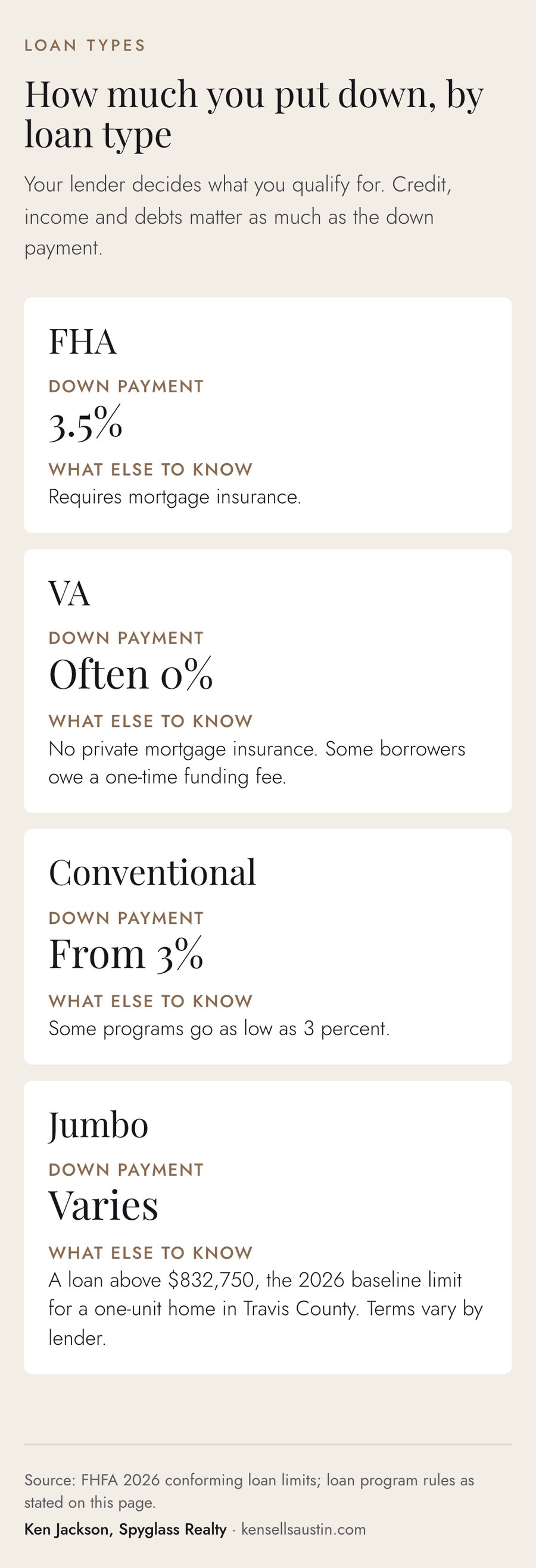
Down payment help, loan types and cash to close are covered in the lending and costs buyer FAQ.
The strings worth reading
Occupancy requirements: these are for primary residences, not investments.
Recapture: some programs can claw back a portion of the benefit if you sell within a window at a gain. Know your window.
Rate trade: an assistance-paired mortgage sometimes carries a slightly higher rate than the best conventional loan you could get on your own. If you have savings and strong credit, run both scenarios. Assistance is not automatically the better deal. It is the better deal when cash to close is your constraint.
How this plays out in the north corridor
Income and price caps mean these programs tend to fit better where purchase prices are lower, which includes parts of Leander, Hutto and Pflugerville. Some buyers who assume they are priced out of Central Texas entirely may fall inside the limits for an assisted purchase up here, and a participating lender can tell you. Here is how the corridor cities compare.
Program details, caps and funding change. Before you rely on any specific number, confirm it with a participating lender. If you want me to point you at one who actually runs these programs regularly rather than one who has heard of them, ask.
Keep reading
Questions about this? Talk to Ken.
Call (737) 307-4848 or send Ken a message.
