

The most common payment surprise I see in Leander, TX has nothing to do with the mortgage. It is property taxes, and specifically the part of the bill that comes from a MUD.
Two houses, similar size, a mile apart, similar price. One buyer's monthly payment comes in comfortably. The other buyer's comes in several hundred dollars higher and they find out late in the process. The difference is usually the taxing entities attached to the address.
The short version
- A Texas tax bill is a stack of separate rates, and a MUD adds one more on top.
- Two similar houses a mile apart can carry payments several hundred dollars apart.
- Get the entity-by-entity rate for the exact parcel, plus any PID balance, before you write an offer.
Here is how it actually works, without the jargon.
What makes up a Texas property tax bill
Your bill is not one tax. It is a stack of separate rates from separate entities, each of which taxes the same assessed value.
Typically that stack includes the school district, the county, the city, and often a community college district and a handful of smaller special districts. Each sets its own rate annually. Add them together and you get your total rate.
Because Texas has no state income tax, property tax carries more of the load here than it does in many other states. Most people relocating know that in the abstract. What surprises them is the variability address to address.
What a MUD is
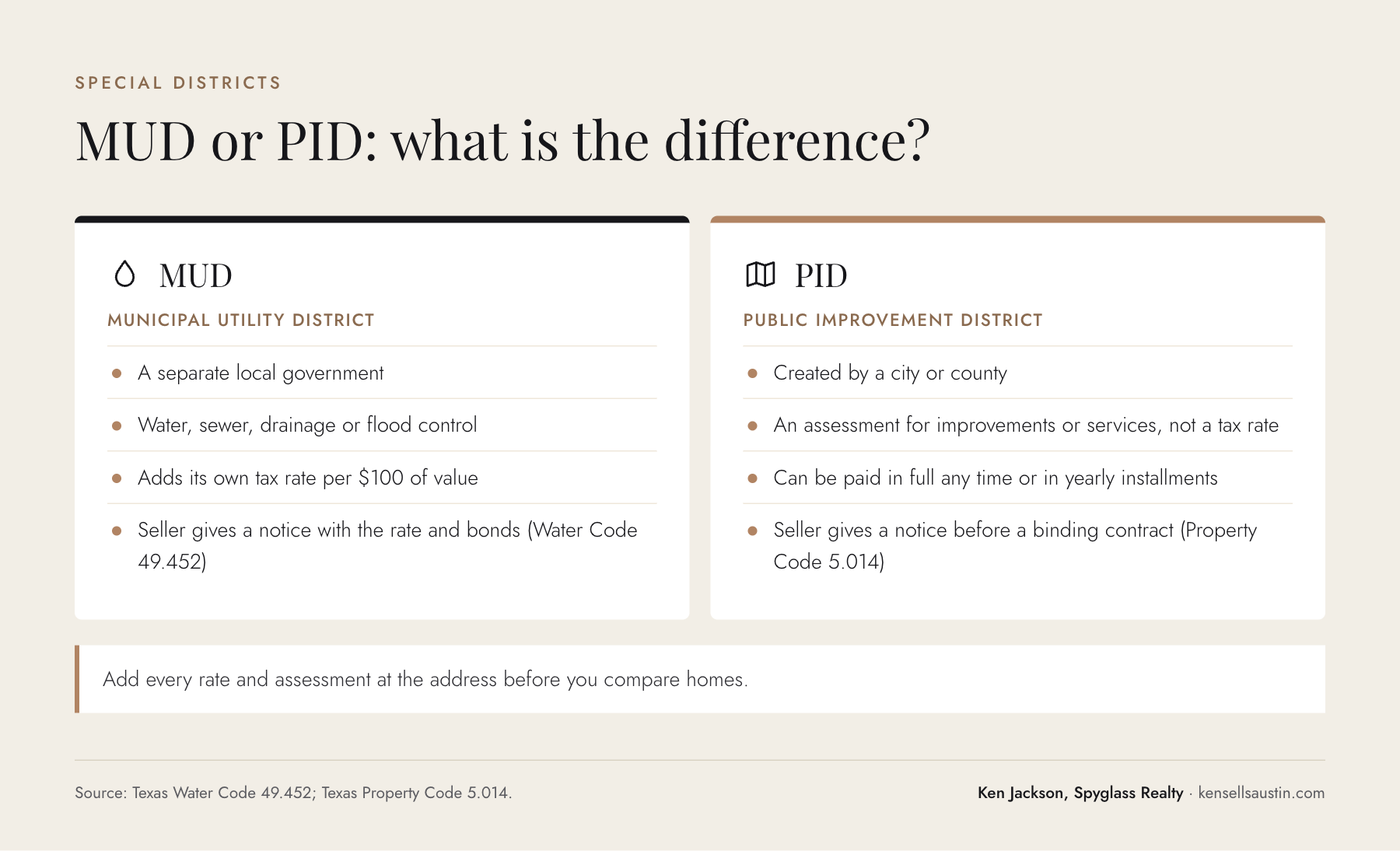
A municipal utility district is a special-purpose government created to finance infrastructure for an area that a city was not going to build out on its own timeline. Water lines, wastewater, drainage, sometimes roads and parks.
The MUD issues bonds to pay for that infrastructure up front. The residents who move in then pay it back through an additional tax rate on top of everything else.
So when you buy in a MUD, you are paying for the pipes and roads that made your subdivision possible. That is the honest framing. It is not a scam and it is not hidden, but it is very easy to miss if nobody points at it.
Large parts of newer Leander development sit inside one. That is exactly why so much new construction was possible here so quickly.
MUD and PID guide
The structures behind these districts are explained step by step in MUD and PID explained for buyers.
Why the difference can be big
A MUD rate is not a rounding error. It is a meaningful addition to your total rate, and it compounds against your assessed value every year you own the house.
The practical effect: a house priced slightly lower inside a MUD can cost you more per month than a slightly higher-priced house outside one. Buyers negotiate hard over a few thousand dollars of purchase price and then accept a tax difference worth far more over the time they own it.
I am not telling you to avoid MUDs. Plenty of Leander neighborhoods are in one, and that infrastructure is what made them possible. I am telling you to price it in deliberately rather than discover it.
MUD rates usually decline, but slowly
Here is the part that cuts the other way. As a MUD's bonds are paid down and more homes are built inside the district to share the burden, the rate typically comes down over time.
So a newer MUD often carries a higher rate than a mature one. If you are comparing two neighborhoods, the age of the district matters, not just its existence.
Do not model this as a guarantee. Rates are set annually and growth assumptions do not always hold. But it is a real reason a high current rate in a brand-new district is not the same thing as a permanent cost.
Buyers negotiate hard over a few thousand dollars of purchase price and then accept a tax difference worth far more over the time they own it.
PIDs are a different animal
You may also run into a PID, a public improvement district. Similar idea, different mechanism: it funds improvements in a defined area, and it often shows up as an assessment rather than folded into your tax rate.
The reason to care is that a PID assessment can sometimes be paid off in a lump sum, where a MUD tax cannot. If an address has one, ask specifically what the remaining balance is and whether it can be retired.
What to actually ask for
Before you write an offer on a Leander address, get these:
The full current tax rate breakdown for that exact parcel, entity by entity. Not the neighborhood average. Not the number on the listing. The county appraisal district has this and it is public.
Whether the property is in a MUD, and if so, how long that district has existed and what its rate has done over the last several years.
Whether there is a PID assessment, and whether it can be paid off.
The assessed value history for the parcel, so you can see how the taxable value has moved.
Then run your monthly payment on the real numbers rather than a generic estimate. If the payment only works at the generic estimate, that is important information.
Taxes FAQ
Property tax and new construction questions are answered in the Texas buyer FAQ on taxes and new construction.
Two things that reduce the bill
File your homestead exemption. It is free, it takes minutes, and it both reduces your taxable value and caps how fast the assessed value on your homestead can rise annually. File generally before May 1. If you buy after January 1, you can still apply for that year if the previous owner did not have the exemption; check the deadlines with the appraisal district. People forget and leave money on the table for years.
Protest the assessed value when it is wrong. This is routine in Texas, not adversarial, and a great many owners do it every year.
I am an agent, not a tax advisor or an attorney, and rates and rules change. Verify anything here against the county appraisal district and your own advisor before you rely on it. But the questions above are the ones that keep people out of trouble, and almost nobody asks them until it is too late to matter.
If you want, send me a specific Leander address and I will pull the entity breakdown for it before you get emotionally attached. More on the city itself in the Leander neighborhood guide, and on choosing between subdivisions in how to choose a Leander neighborhood.
Keep reading
Questions about this? Talk to Ken.
Call (737) 307-4848 or send Ken a message.
