
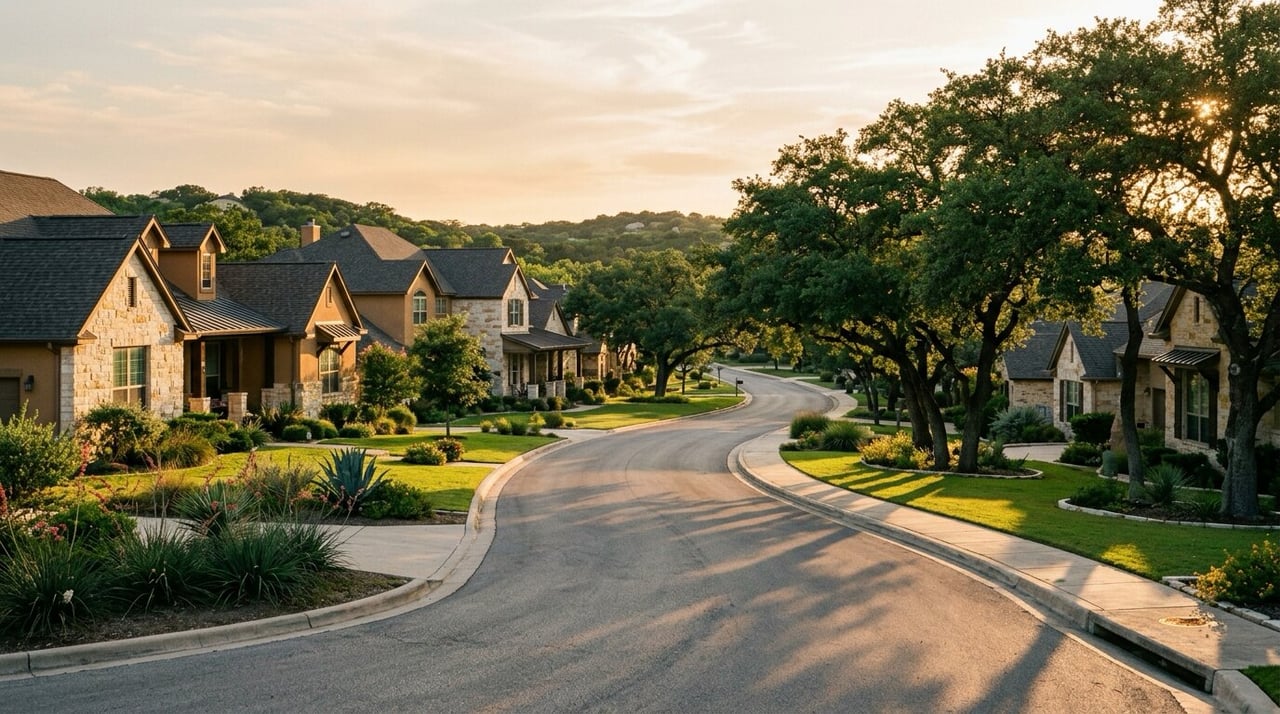
If you are moving to Leander, TX, you have probably already noticed that most of what you find online is written by someone trying to sell you a house here. This is the version I give people on the phone, including the parts that are inconvenient.
I live in this corridor. I am not describing it from a listing sheet.
The short version
- Leander is further out than a map suggests, so drive the real commute at the real hour.
- You get more house and lot than Cedar Park, and you trade distance and a neighborhood still filling in.
- Verify the attendance zone and the full tax rate, including any MUD, for the exact address.
Leander is further out than people expect
Look at a map and Leander does not seem far from Austin. Drive it at 7:45 on a Tuesday and it is a different experience. The 183A toll road is genuinely good and it is the reason the drive works at all, but you are still starting from the outer edge of the metro.
The mistake I see most often is a buyer who tours on a Saturday afternoon, loves the house, and never once drives the actual commute at the actual hour. Do that before you write an offer. Not a map estimate. The real drive.
If your work is downtown or on the west side and you are in the office most days, be honest with yourself about whether you want that every morning for the next several years. If you are remote, hybrid, or your job is north, the calculation changes completely and Leander starts to look like the best value on the corridor.

What you actually get for the money
Broadly, Leander gives you more house and more lot than Cedar Park does at the same number. That gap is the whole reason people move a few miles further out.
What you are trading for it: distance, and a neighborhood that is still becoming what it will be. Construction traffic, roads being widened while you live on them, and a subdivision that will look different in five years than it does on your walkthrough.
Neither of those is a bad deal. They are just different deals. The error is treating the price gap as a pure discount when part of it is compensation for something real. I wrote about that comparison in more detail in Leander vs. Cedar Park.
The error is treating the price gap as a pure discount when part of it is compensation for something real.
New construction dominates, and that changes how you buy
A large share of what is for sale in Leander is new. Builders here compete with each other, which means incentives are real and negotiable in a way a private seller cannot match.
It also means the buying process is different. One thing worth committing to memory before you drive out here on a weekend: do not walk into a builder's sales office without your own representation. The person at that desk works for the builder. If you register alone, many builders will take the position that you came in unrepresented, and your agent cannot help you on that community afterward. Texas now requires a written buyer agreement before an agent shows you a home. It states how your agent is paid, and that compensation is negotiable. Builders set their own policies on what they pay a cooperating agent, so ask before you tour.
On the incentives themselves, the number on the sign is not the number that matters. I broke down how to run that math in new construction vs. resale in Leander.
Schools: verify, do not assume
Most of Leander feeds Leander ISD, but the district spans four cities and the boundaries move as new campuses open. A street can split mid-block. The school shown on a listing portal comes from a database that is frequently out of date.
Buyers find this out at inspection, which is the worst possible time. Check the attendance zone for the exact address with the district directly before you are emotionally committed. For published school data, use the Texas Education Agency's school report cards at txschools.gov. More on how to do that properly in the Leander ISD boundaries post.
MUD and PID guide
How MUD and PID taxes work is laid out in MUD and PID explained for buyers.
Your tax bill is not just the tax rate
This is the single most common surprise for people relocating from out of state. Texas has no state income tax, and property taxes carry more of the load as a result. Fine, most people know that going in.
What they do not know is that many newer Leander subdivisions sit inside a MUD, a municipal utility district, which adds its own assessment on top of city, county and school. Two houses that look identical, a mile apart, can carry meaningfully different annual costs because one is in a MUD and one is not.
Ask for the actual current tax rate breakdown on the specific address, not the neighborhood average, and run your payment on that. A house you can afford at one rate can be uncomfortable at another.
The rail line is a real thing, and underrated
Leander is the northern terminus of the CapMetro Red Line. There is a park-and-ride and a transit-oriented district built around it.
For most buyers this is a nice-to-have they never use. For a specific kind of buyer, someone whose office is walkable from a downtown station, it is the single feature that makes Leander work better than anywhere else on this corridor. Cedar Park cannot match it. If that is you, it is worth organizing your whole search around proximity to that station.
Leander buyer guide
Neighborhoods, builders, districts and commutes are covered in the Leander, TX home buyer guide.
What Leander is not
It is not a walkable town center. It is not a short drive to the airport. It is not where you go if you want mature trees and a neighborhood that already finished becoming itself.
If those matter more to you than square footage, look at Cedar Park, or look at Georgetown, which has an actual downtown square. I would rather tell you that now than after you have moved.
Who Leander genuinely fits
Buyers who want maximum house and yard for the budget and are comfortable with a neighborhood still filling in. Buyers with a long horizon, who will be here long enough for the construction to finish and the trees to grow. Anyone with a realistic rail commute. Anyone who values being at the edge of the Hill Country more than being close to the middle of Austin.
If that sounds like you, the full picture is in the Leander neighborhood guide.
And if you want the two-minute version for your specific situation, tell me where you work and what you are trying to solve, and I will tell you whether Leander is the right target or whether you should be looking somewhere else on this corridor. I would rather send you to the right suburb than sell you the wrong one.
Keep reading
Questions about this? Talk to Ken.
Call (737) 307-4848 or send Ken a message.
