A separate local government for water, sewer and drainage. Its tax rate is added to the other rates on your bill.
An assessment on the lot, set by a city or county. It is not a separate government with its own tax rate, and unpaid amounts can bring penalties, interest and a lien.
A MUD shows up as a tax rate and a PID shows up as an assessment, so ask for the seller's notice, then ask the city and the title company.
If you are shopping for a house in the Austin suburbs, especially a newer one, you will run into two abbreviations before long: MUD and PID. Both can add cost to owning a home, and they work differently. This page explains what each one is, what notice the seller owes you, and how to check an address before you make an offer. I am Ken Jackson, a REALTOR with Spyglass Realty.
This is general information, not legal, tax or lending advice. The statutes, your contract, the district or city, and your title company control the details.
A MUD is a municipal utility district. It is a special district that provides water, sewer, drainage or flood control services, and it can be financed with bonds paid from district taxes. It is a separate local government. If your home is in one, the district's tax rate is added to the other rates on your bill, so your total is higher than a home outside it with the same other rates. A district's name often appears on the county tax bill next to the county, city and school district.
A PID is a public improvement district. A city or county creates it, and it levies an assessment on each property to pay for improvements or services such as roads and utilities. A PID is an assessment, not a separate government with its own tax rate. The amount is set in a service and assessment plan. In Williamson County, the annual PID assessment appears on the property tax bill that the county tax office collects. The state notice says the assessment may be paid in full at any time, and otherwise it is due in annual installments.
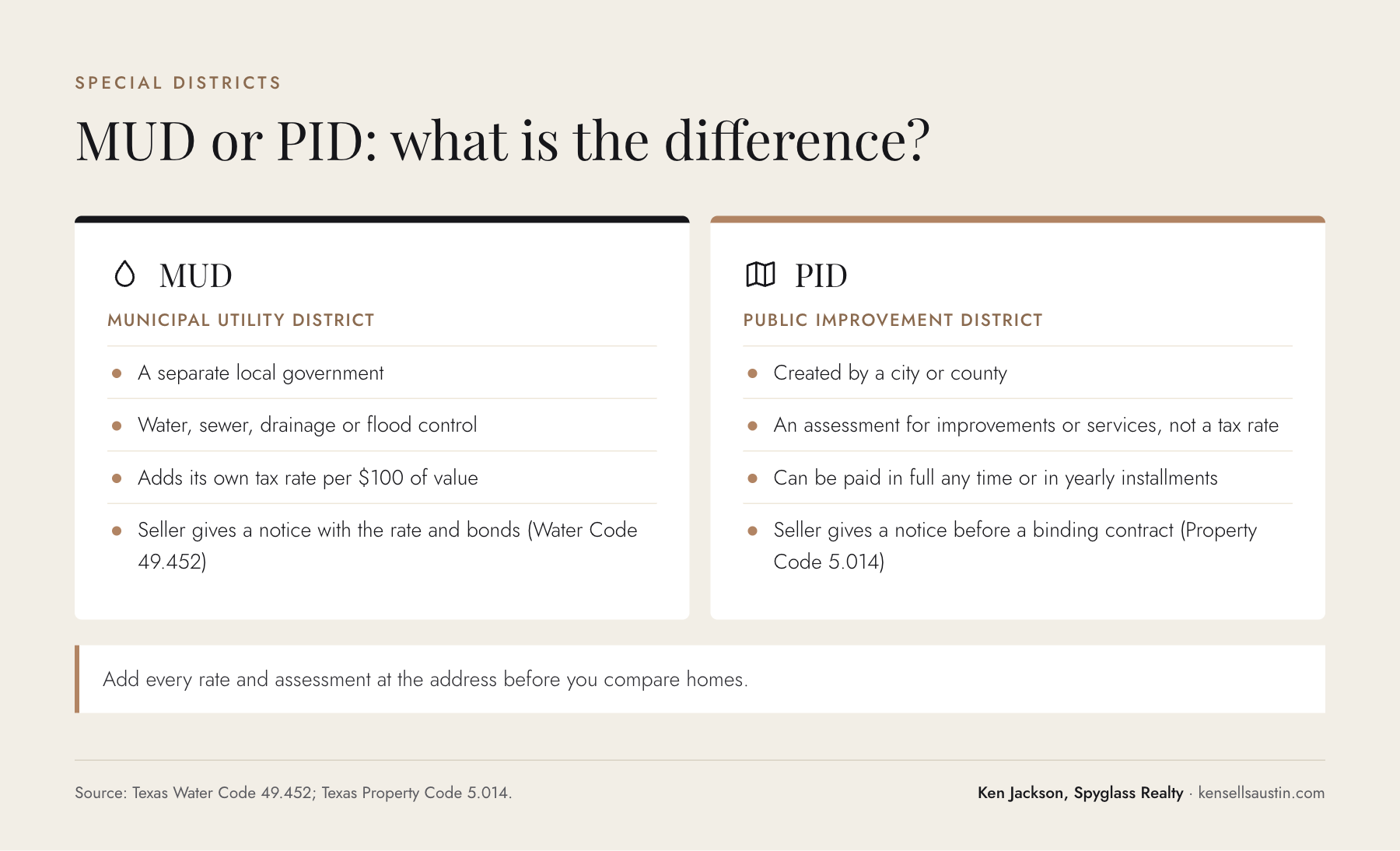
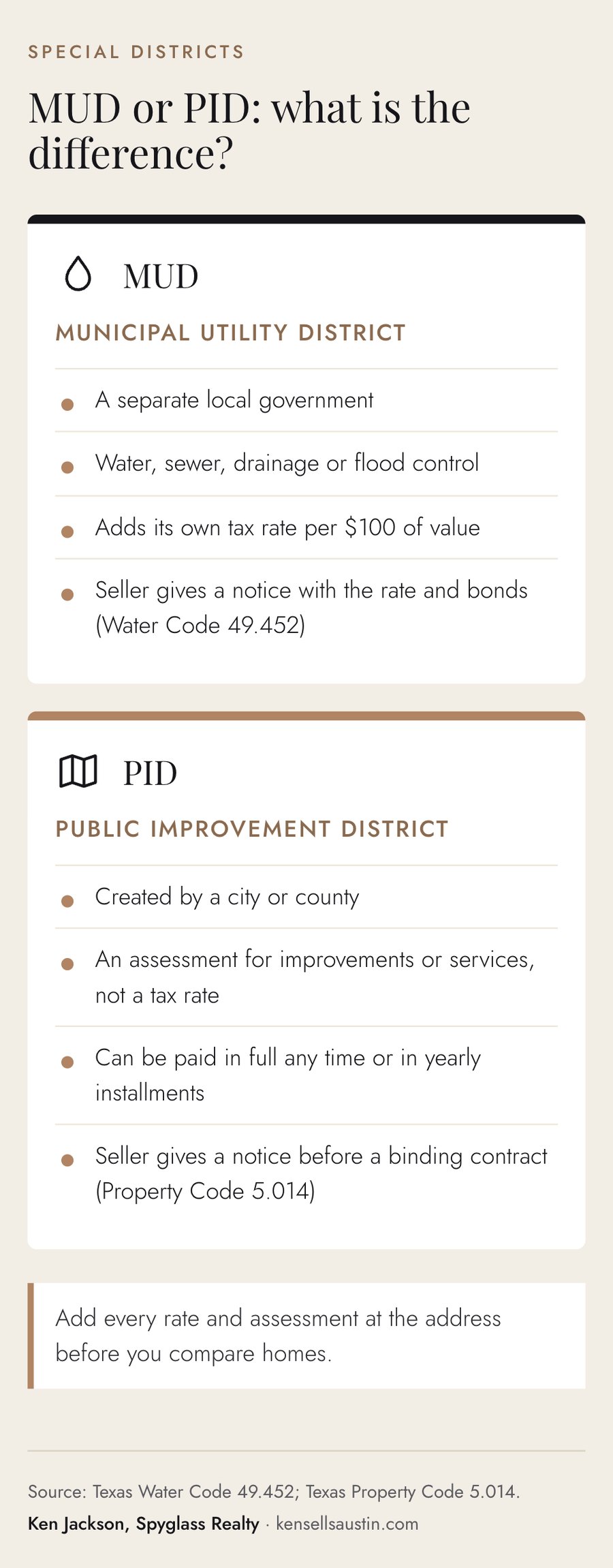
For a MUD, Texas Water Code section 49.452 requires the seller to give you a notice with a bold title: Notice to Purchaser of Special Taxing or Assessment District. It names the district and states its current tax rate per $100 of value, or a projected rate if no tax has started. It gives the bond amounts voters approved and the amounts already issued. It also says whether there are assessments or a standby fee. If you sign without the notice, you may be able to terminate. If the seller gives you the notice before closing and you close anyway, you give up that right. Ask an attorney how that works on your contract. Read the rate and bond lines first.
For a PID, Texas Property Code section 5.014 requires the seller to give you a written notice before the effective date of a binding contract. It says you are obligated to pay assessments, that an assessment has been levied on the property, that it may be paid in full at any time, and that unpaid amounts can bring penalties, interest and a lien. It names the city or county that can tell you the exact amount. Read it, and ask for the amount.
Some cities help. Round Rock publishes a MUD map layer, Pflugerville posts a PID page and a MUD map service, Leander has a PID page, and Hutto posts assessment documents for its districts. I run this check on any address before an offer goes in.
It can add a district tax or a yearly assessment, and the total is what matters. I will not give a blanket answer on whether a MUD rate is higher than a city rate. A MUD tax is added on top of the other rates that apply to the home. Add the school district, county, any city, any other district, and the MUD, then compare the total and the purchase price with the alternatives. Ask for the district's current rate and its outstanding bonds, not last year's number.
Some new communities have a MUD, a PID, or both. Appraisal districts value property as it stands on January 1. If your home was not finished on that date, the first bill may be based on the lot or partial value, and a later year includes the finished home. Plan for a higher bill than the first one. The Texas Property Code has its own chapter for construction defect claims, chapter 27, and an attorney can advise you on it.
Check the seller's notice, the TCEQ Water Districts Map Viewer, the appraisal district's property search and the tax bill. Your title company can also confirm.
The state notice says an assessment may be paid in full at any time. Ask the city for a written payoff and the remaining term.
The city or county that created the PID handles payoff questions. Williamson County lists its PIDs on its tax office page and links to each notice.
It depends on the address, so compare the total rate at each one. A bill is the sum of every taxing unit and any MUD or PID that applies, applied to the taxable value. Two homes in the same city can have different totals. I can pull the current rates for the specific addresses you are comparing.
Rollback or additional taxes can be charged when land with a special appraisal, such as agricultural use, changes use. It matters more for acreage than for a typical subdivision lot. Ask me if the property has agricultural valuation.
Send me an address and I will check the county, taxing units, MUD and PID notices with you. Let's connect, or call (737) 307-4848. Related pages: Greater Austin buyer guide, closing costs in Texas and the Texas home buyer FAQ.
Ken Jackson, REALTOR, TREC license 754679, Spyglass Realty (broker license 588051). General information only, not legal, tax or lending advice.
Last reviewed: October 13, 2026.
Questions about a MUD or PID on a home? Talk to Ken.
Call (737) 307-4848 or send a message.

SPYGLASS REALTY 8501 N MOPAC EXPY STE 110 AUSTIN TX 78759
SPYGLASS REALTY 8501 N MOPAC EXPY STE 110 AUSTIN TX 78759