New construction tool
A worked example on a $500,000 new home in Leander at today's average rate, with the property tax included and the math shown.
Short answer
In this example, a $15,000 builder incentive on a $500,000 Leander home at 7.40 percent, a $15,000 price cut leaves you about $6,399 better off after five years than a 2-1 buydown, mostly because the loan balance and tax stay lower. A buydown helps if you need lower payments in the first two years.
Rate: Freddie Mac PMMS 30-year average, 7.40% on October 8, 2026. Arithmetic shown below. Checked October 14, 2026.
Freddie Mac's 30-year fixed average was 7.40 percent on October 8, 2026.
Freddie Mac PMMS
A 2-1 buydown lowers the rate by 2 points in year one and 1 point in year two, then the note rate applies.
Fannie Mae Selling Guide B2-1.4-04 allows up to 3 points, rising no more than 1 point a year
With a temporary buydown, Fannie Mae requires the lender to qualify you at the full note rate, not the bought-down rate.
Fannie Mae Selling Guide B2-1.4-04
On a $450,000 loan at 7.40%, a 2-1 buydown costs about $10,677: the payment savings in years one and two, paid up front.
Arithmetic shown on this page
Fannie Mae caps seller and builder contributions on a primary home at 3 percent above 90 percent loan-to-value, 6 percent from 75.01 to 90 percent, and 9 percent at 75 percent or less.
Fannie Mae Selling Guide B3-4.1-02
The CFPB tells borrowers to get Loan Estimates from more than one lender and compare them.
Consumer Financial Protection Bureau
The mechanics
The builder puts money into an account at closing that covers part of your payment for two years. Your note rate does not change. In year one you pay as if the rate were 2 points lower, in year two 1 point lower, and from year three on you pay the full rate. On a $450,000 loan at 7.40 percent:
Year | Rate | Monthly principal and interest | Builder pays per month |
|---|---|---|---|
1 | 5.40% | $2,527 | $589 |
2 | 6.40% | $2,815 | $301 |
3+ | 7.40% | $3,116 | $0 |
30-year fixed loan, principal and interest only. Buydown cost = 12 x (full payment minus year 1 payment) + 12 x (full payment minus year 2 payment) = $10,677.
Worked example
Same house, same $15,000 from the builder, three ways to take it. Assumptions: $500,000 price, 10 percent down, 30-year fixed at 7.40 percent, Leander with the 2026 rates and a homestead exemption. The buydown option uses $10,677 for the 2-1 buydown and the rest toward closing costs.
A. Price cut | B. 2-1 buydown | C. Closing cost credit | |
|---|---|---|---|
Price | $485,000 | $500,000 | $500,000 |
Down payment (10%) | $48,500 | $50,000 | $50,000 |
Loan amount | $436,500 | $450,000 | $450,000 |
Payment, year 1 (P&I) | $3,022 | $2,527 | $3,116 |
Payment, year 2 | $3,022 | $2,815 | $3,116 |
Payment, years 3 to 5 | $3,022 | $3,116 | $3,116 |
Cash credit left at closing | $0 | $4,323 | $15,000 |
Yearly property tax, Leander, with homestead | $8,305 | $8,611 | $8,611 |
Tax uses market value equal to the price and the 2026 Leander rates from the tax rate table; the appraisal district sets the real value. Whether a builder allows a credit toward closing costs, and how much, is in the builder's offer. Fannie Mae's 6 percent cap applies at 90 percent loan-to-value.
Five-year view
Add up what you put in and what you still owe. The loan balance belongs in the total: a price cut shrinks the loan for its whole life, while a buydown only lowers the first two years of payments.
After five years | A. Price cut | B. 2-1 buydown | C. Closing cost credit |
|---|---|---|---|
Down payment | $48,500 | $50,000 | $50,000 |
Principal and interest paid | $181,334 | $176,266 | $186,943 |
Property tax paid | $41,523 | $43,053 | $43,053 |
Minus cash credit | -$0 | -$4,323 | -$15,000 |
Plus loan balance still owed | $412,593 | $425,353 | $425,353 |
Five-year total | $683,950 | $690,349 | $690,349 |
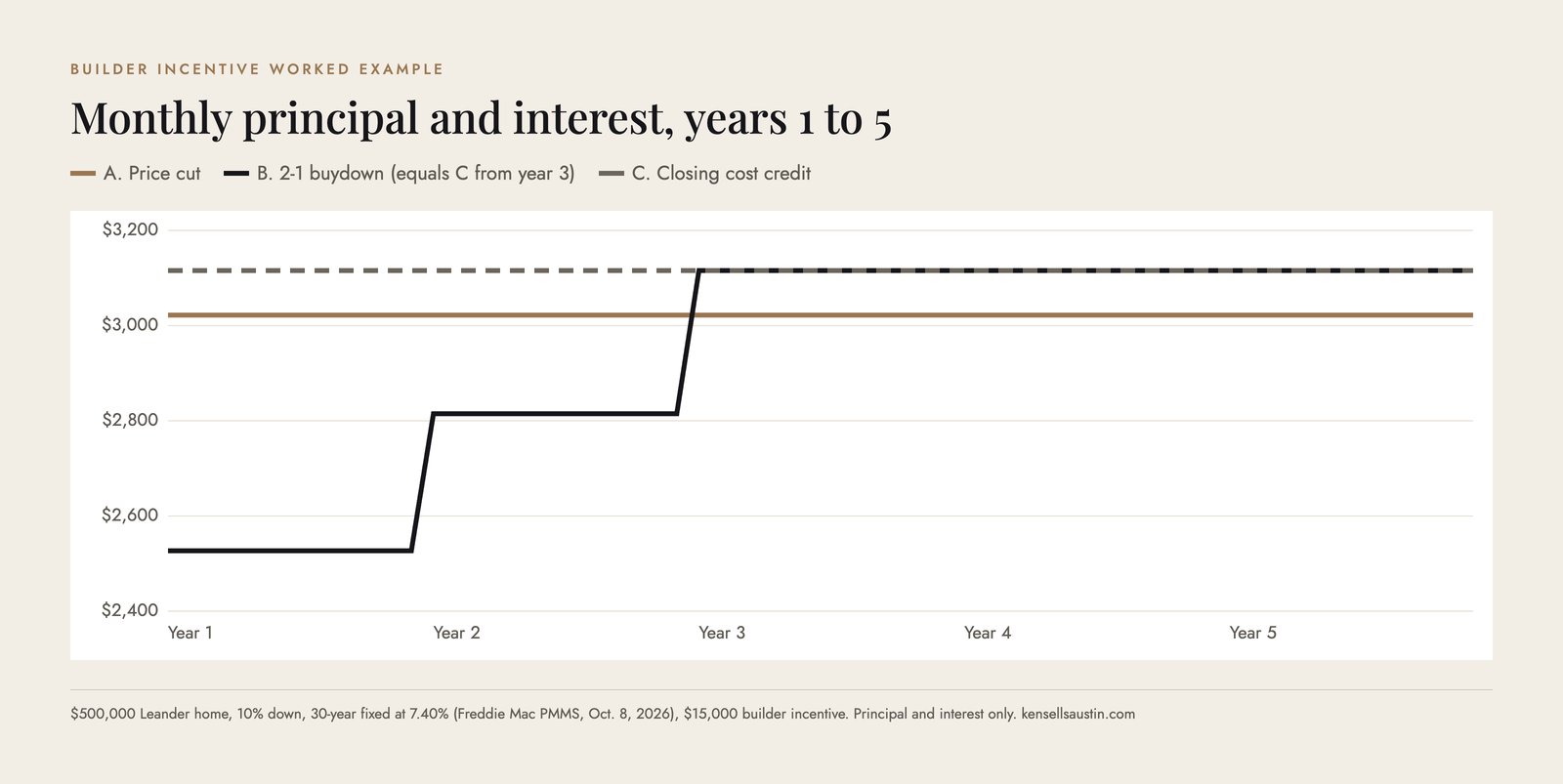
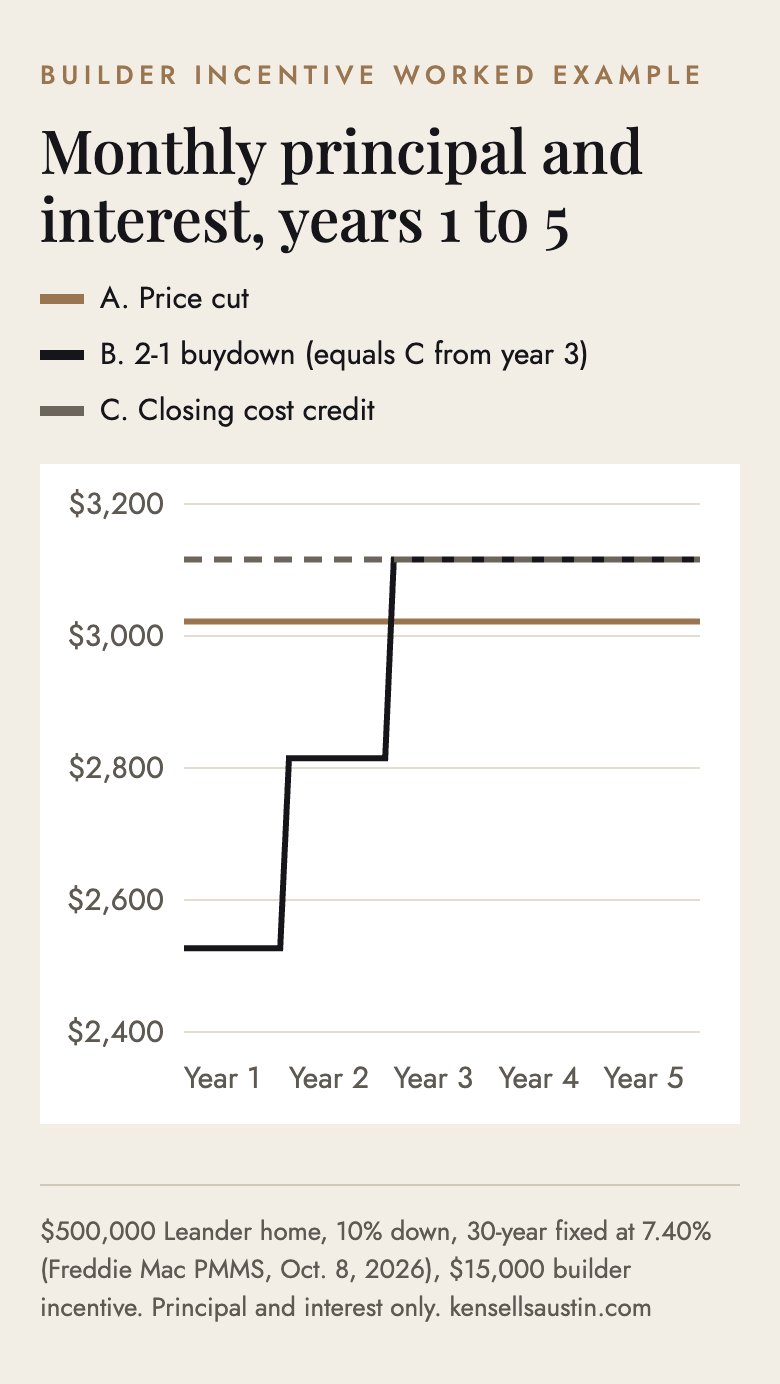
Reading it: in this example the price cut comes out about $6,399 ahead after five years. B and C come out the same because a 2-1 buydown is prepaid interest: its cost equals the payment savings. The buydown is worth choosing when you need the lower payment early, not because it is cheaper.
Show the math
Monthly payment = L x i / (1 - (1 + i)^-360), where L is the loan and i is the yearly rate / 12
2-1 buydown cost = 12 x (full - year 1 payment) + 12 x (full - year 2 payment)
Read before you sign
Builder incentives are often tied to using the builder's preferred lender. That can be a fine loan, but you only know by comparing. Ask the builder's lender and at least one outside lender for a Loan Estimate on the same day and compare the rate, the points and the cash to close.
Two more checks: the lender has to qualify you at the full note rate even with a temporary buydown (Fannie Mae B2-1.4-04), and seller contributions have caps by loan-to-value (Fannie Mae B3-4.1-02). The CFPB Loan Estimate page shows what each line means.
Same day, same loan amount, one from the builder's lender and one from outside.
New homes often carry MUD or PID charges. Budget from the parcel record, not the brochure.
Try your numbers
Change the price, rate and incentive below. The calculator uses the same formulas as the worked tables above, and Ken can run your exact offer.
A. Price cut
-
B. 2-1 buydown
-
C. Closing cost credit
-
Five-year totals = down payment + principal and interest + property tax - cash credit + loan balance owed at the end. Estimates only, not lending advice.
FAQ
Not always. In this page's example ($500,000 Leander home, 10 percent down, 7.40 percent, $15,000 incentive), the price cut comes out about $6,399 ahead after five years. A 2-1 buydown lowers payments in years one and two only.
It costs the payment savings it creates. On a $450,000 loan at 7.40 percent, that is about $10,677: 12 months at a rate 2 points lower plus 12 months at 1 point lower.
No, for a Fannie Mae loan. The Selling Guide requires the lender to qualify the borrower at the note rate, not the bought-down rate.
For a Fannie Mae loan on a primary home, interested-party contributions are capped at 3 percent above 90 percent loan-to-value, 6 percent from 75.01 to 90 percent and 9 percent at 75 percent or less. Other loan types have their own limits.
The incentive may require it. Get a Loan Estimate from the builder's lender and from an outside lender and compare the full cost, as the CFPB suggests.
It can. The appraisal district sets the taxable value, not the contract price; this page uses the price as the value to keep the estimate simple.
Keep reading
Sources
Reviewed October 2026 by Ken Jackson, REALTOR, Spyglass Realty, TREC #754679. Every figure below was checked on the official page on October 14, 2026. Rates and rules change; the linked source is the authority.
Talk to Ken
Send it to Ken for a side-by-side on your numbers. Call or send a message.
Ken Jackson, REALTOR, Spyglass Realty. General information, not legal, tax, insurance or lending advice.

SPYGLASS REALTY 8501 N MOPAC EXPY STE 110 AUSTIN TX 78759
SPYGLASS REALTY 8501 N MOPAC EXPY STE 110 AUSTIN TX 78759