This part of the Texas home buyer FAQ is for buyers choosing among Leander, Cedar Park, Round Rock, Pflugerville, Hutto, Georgetown and Austin, and for buyers moving to Texas. The answers stick to facts you can check for an address.
28 questions, 5 topics
Pick a topic to go straight to its questions.
Topic 1 of 5 · 3 questions
Austin sits mainly in Travis County. Georgetown is the Williamson County seat, and Hutto is in Williamson County. Leander, Cedar Park and Round Rock are mainly in Williamson County, with parts in Travis County. Pflugerville is mainly in Travis County, with a small part in Williamson. County matters because each county has its own appraisal district and tax office, and a street near a county line can fall in either one. Look up the parcel, not the city name. Ask Ken to check the county and taxing units for any address you like.
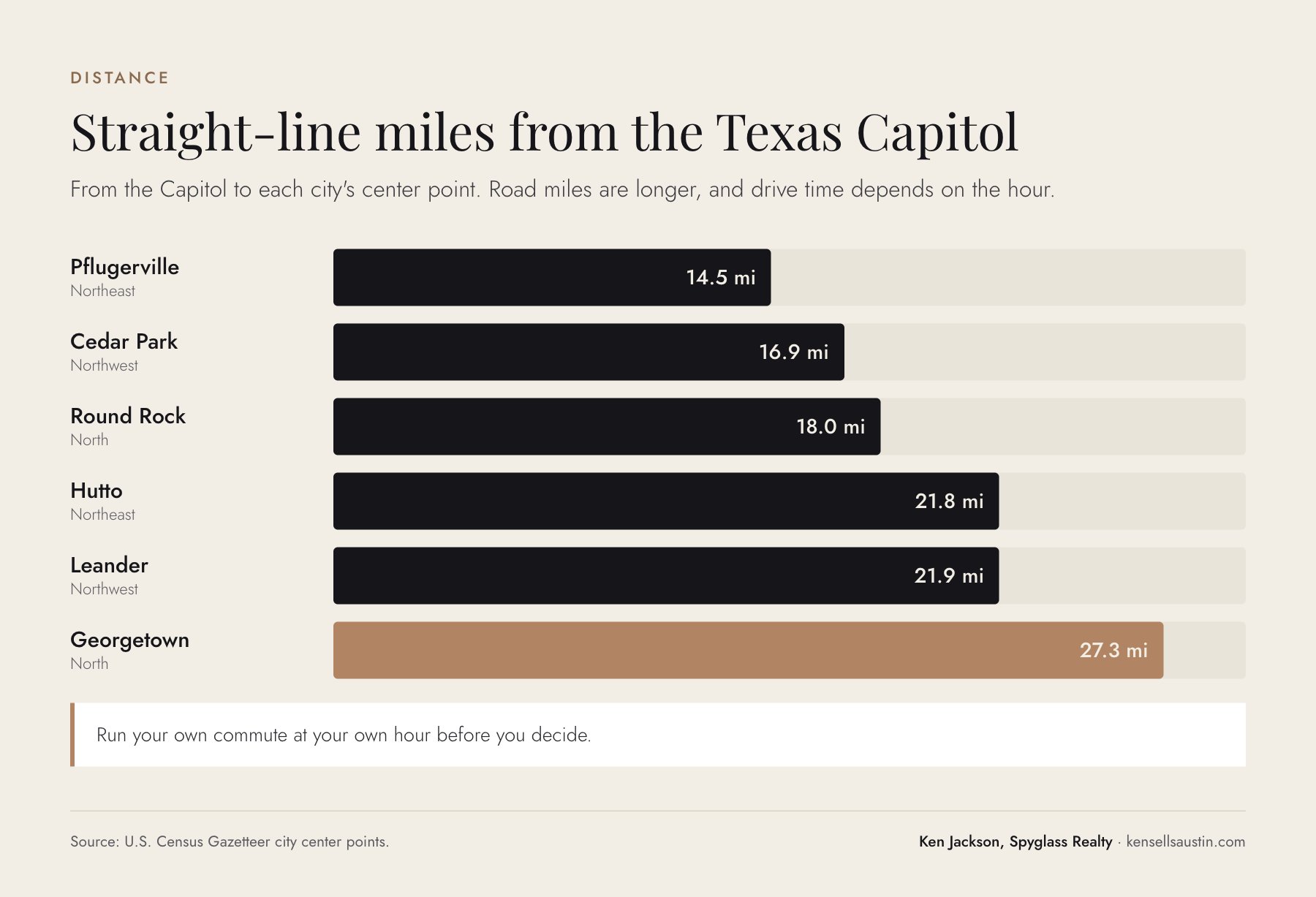
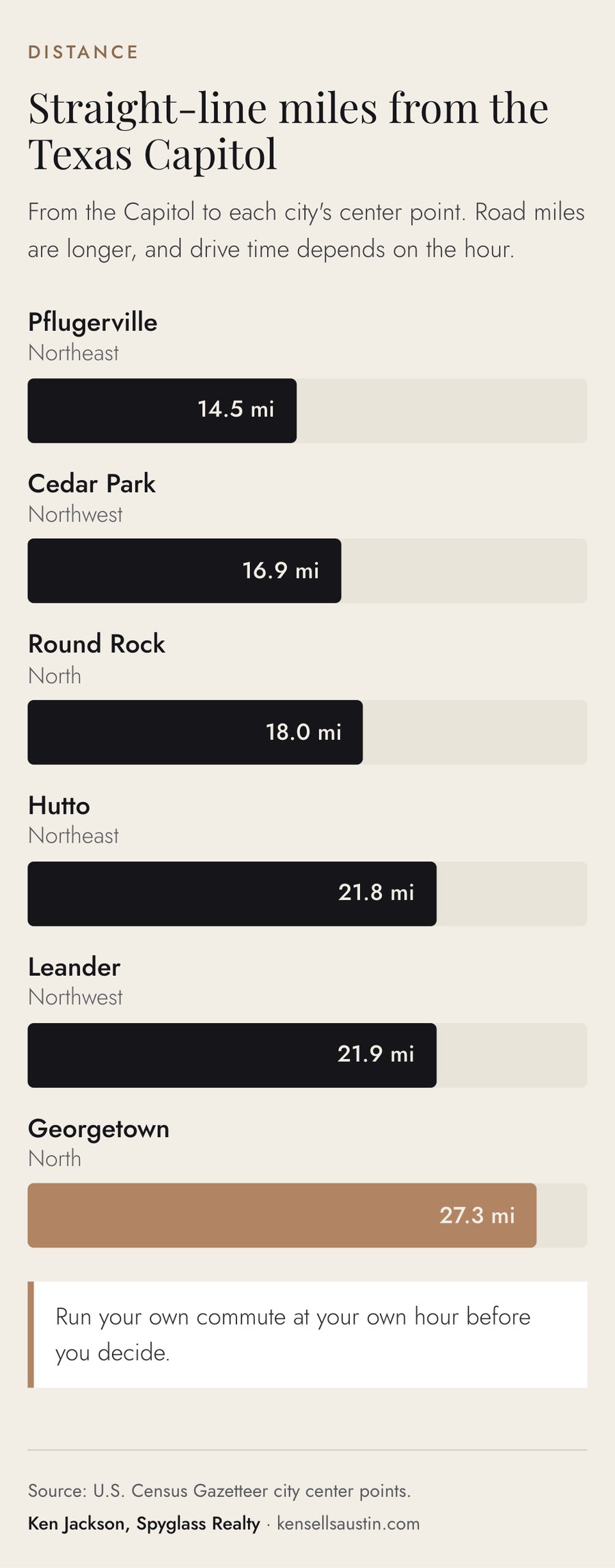
Straight-line, from the Texas Capitol to each city's center point: Pflugerville 14.5 miles, Cedar Park 16.9, Round Rock 18.0, Hutto 21.8, Leander 21.9 and Georgetown 27.3. Road miles are longer, and drive time depends on your route, the hour and construction. A suburb that is closer on the map is not always faster at 8 a.m. Run your own commute at your own hour before you decide. Ask Ken to help you test two or three routes from a home you are considering.
Open a map tool, set it to leave at the hour you would drive, and test a few different days. Then compare the free route with the tolled one. The 183A Toll Road and the MoPac Express Lane are tolled, and the MoPac lane changes its price with traffic. I-35 has a long-running TxDOT rebuild, so conditions change. If a CapMetro rail or bus stop is near, check its timetable too. Texas toll roads bill by tag or by mail, so ask what each route would cost you in a month.
Topic 2 of 5 · 5 questions
No. The Texas Comptroller states that Texas has no personal income tax. The state has no state property tax either. Instead, local taxing units such as the county, city, school district and any special district set property tax rates, so the property tax bill is where most homeowners feel local costs. Sales tax and other state taxes still apply. For how this affects your own situation, talk with a tax professional.
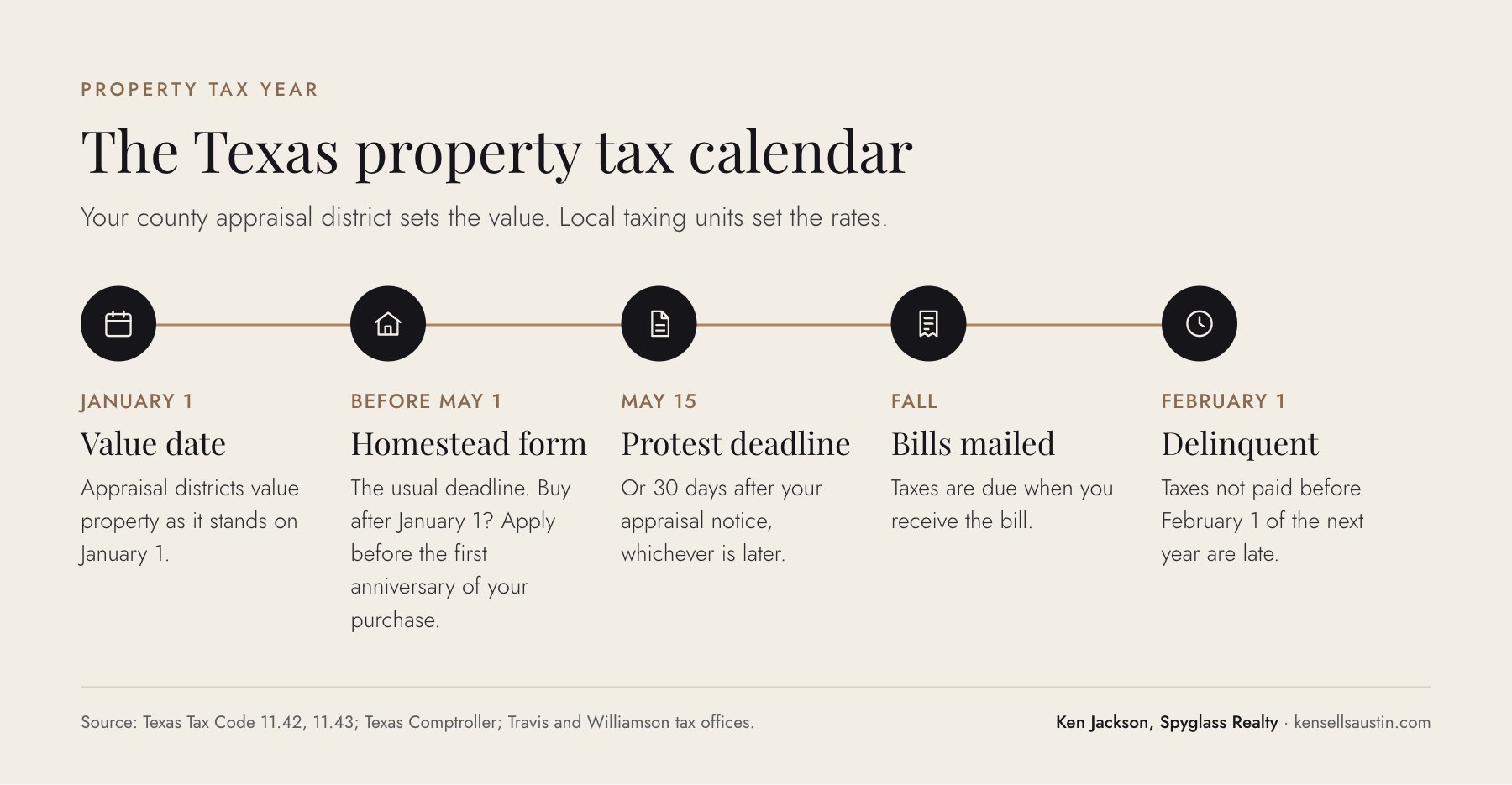
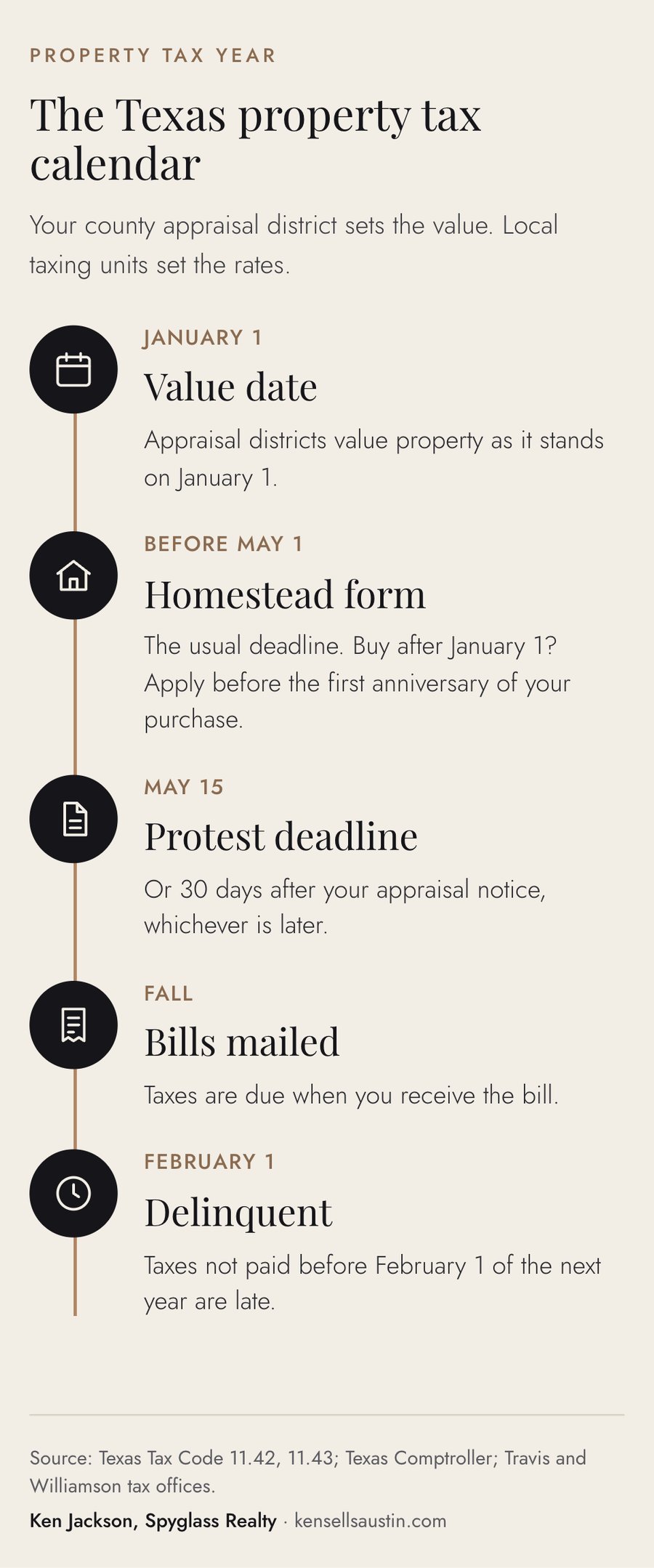
The county appraisal district (Travis or Williamson) sets the appraised value. Each taxing unit on your parcel sets its own rate. That can include the county, city, school district, community college and a MUD. The Comptroller does not set rates. Your bill comes from the value, the rates and any exemptions. Taxes are due when you get the bill and are late if unpaid before February 1 of the next year. Rates change every year, so look up the parcel's current total rate before you make an offer. Ask Ken to pull it with you.
$140,000
school district homestead exemption
20%
local option exemption, $5,000 minimum
10%
yearly cap on a homestead's appraised value
The Comptroller lists a $140,000 school district homestead exemption. Cities, counties and other units may add their own, up to 20 percent of value with a $5,000 minimum. You apply with the appraisal district on Form 50-114. It is not automatic. It applies to your main home only. If you own and live there on January 1, the form is due before May 1. If you buy after January 1, you can still get it for the rest of that year if the previous owner did not have it, and you apply before the first anniversary of your purchase date. Williamson CAD and Travis CAD each take applications online.
After you qualify for a homestead exemption, the appraisal district cannot raise your home's appraised value for tax purposes by more than 10 percent a year, plus the value of new improvements. The limit starts January 1 of the tax year after your first exemption year. It ends when you or your spouse no longer qualify. It limits the taxed value, not the market value. Your home can be worth more than the taxed value. The cap does not follow you to a new house. Ask your appraisal district how it applies to a specific parcel.
File a written protest with your county's appraisal review board by May 15 or the 30th day after your appraisal notice was delivered, whichever is later. A late filing needs good cause. Both appraisal districts accept protests online, and Travis CAD uses an informal meeting stage first. Read your Notice of Appraised Value, since it states your deadline. Bring evidence such as sale prices of similar homes. A protest is about value. Exemptions are a separate filing.
Related guides
Property tax FAQ Homestead exemption Closing costs in Texas Back to topics
Topic 3 of 5 · 4 questions
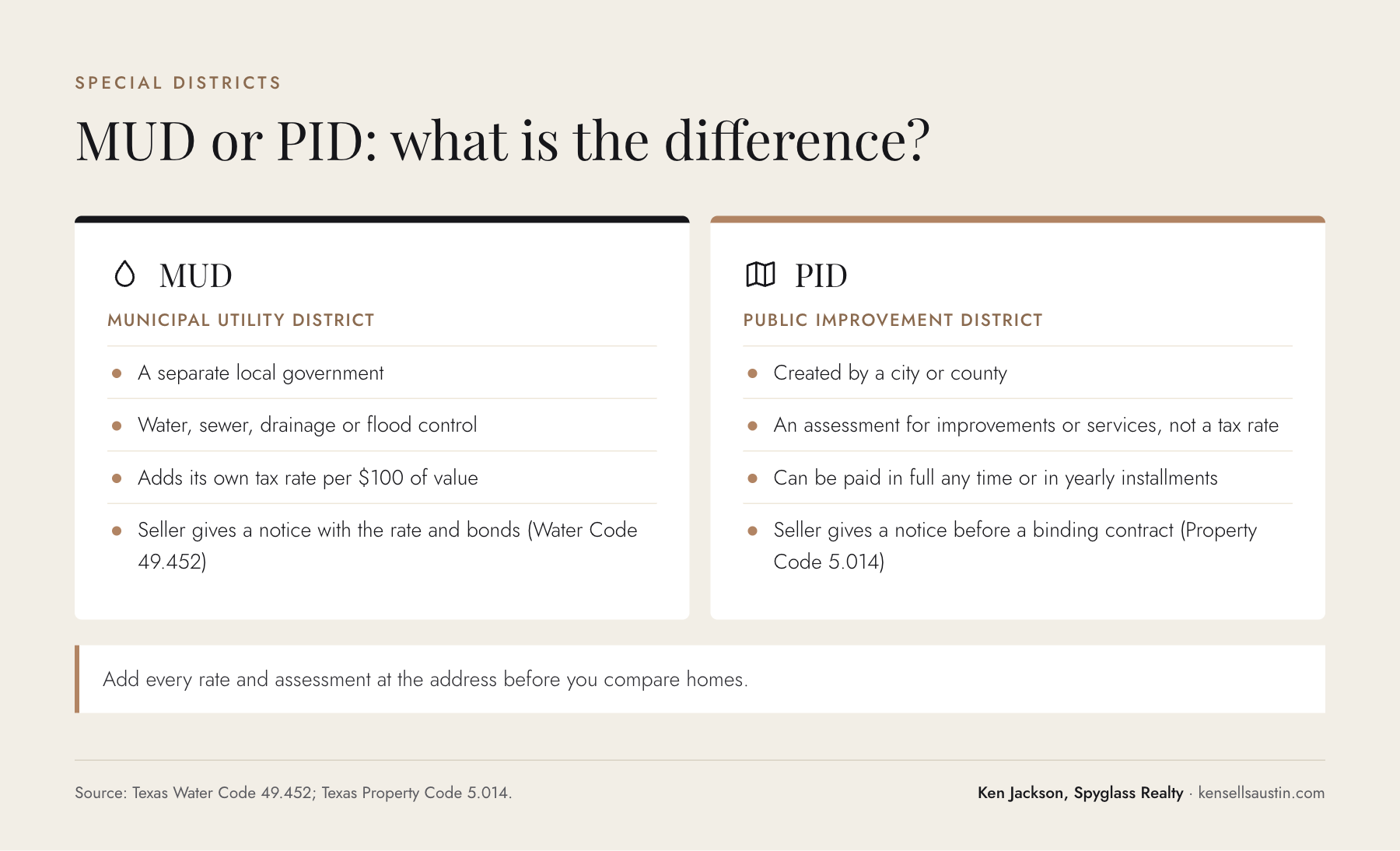
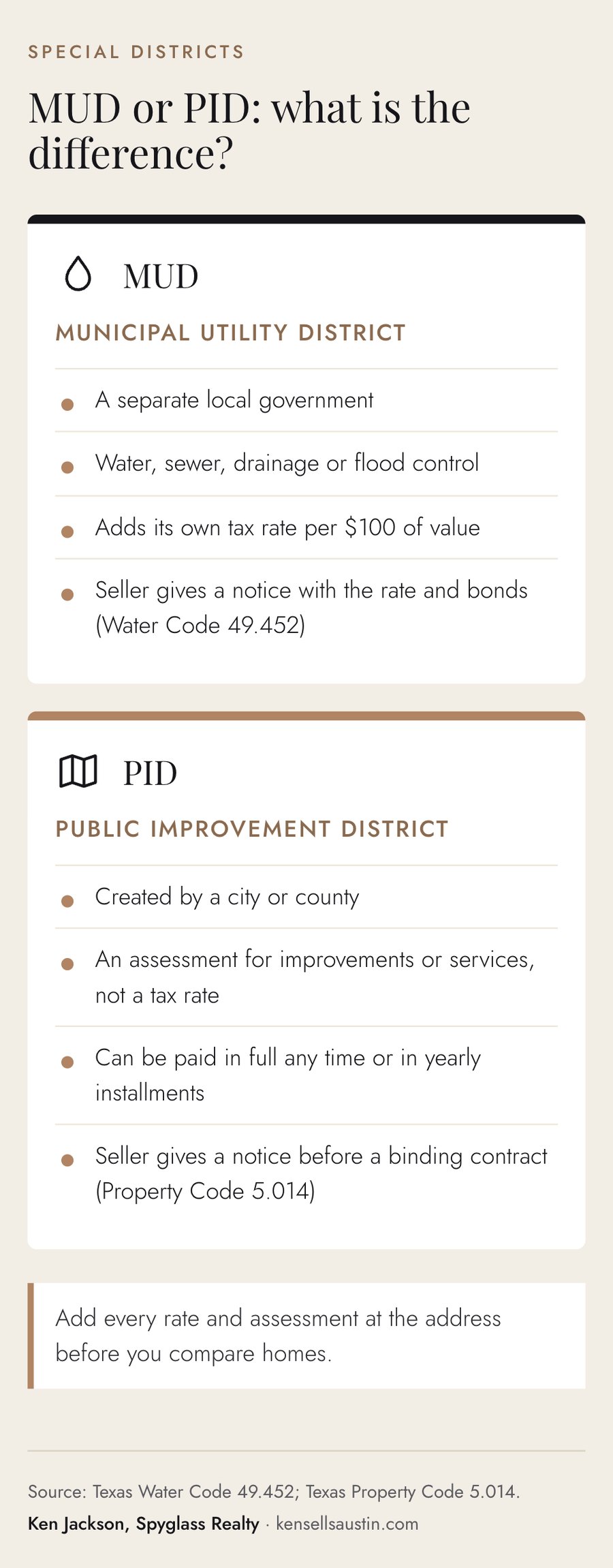
A MUD is a municipal utility district. It is a separate local government that provides water, sewer and drainage, and pays for the pipes with bonds. It can add its own property tax to your bill, on top of the county, city and school district. Before you sign a contract, the seller must give you a written notice that names the district and states its current tax rate per $100 of value. If you sign without it, you may terminate. If the seller gives you the notice before closing and you close anyway, you give up that right. Search a district at TCEQ, then ask the district for its current rate.
A PID is a public improvement district. A city or county sets a special assessment on each lot to pay for roads, utilities or other improvements. It is an assessment, not a separate government with a tax rate. You can pay it off in full any time, or pay it in yearly installments. If you do not pay, penalties and a lien on the property can follow. The seller must give you a state-prescribed notice, and you sign that you got it before the contract takes effect. Ask the city for the assessment amount and schedule.
Start with the listing and the seller's required notices. Then check the county tax office's rate breakdown for the parcel, which lists every taxing unit. TCEQ has a Water Districts viewer where you can search by address or district name. Round Rock publishes a MUD map layer, and Pflugerville posts a PID page and a MUD map service. A PID shows up as an assessment, not a tax rate, so ask the city and the title company for it. Ask Ken to run this check before you write an offer.
Ask for the HOA documents in writing. A Texas property owners association must deliver the restrictions, bylaws, rules and a resale certificate within 10 business days of a written request from the owner, buyer, agent or title company. The certificate lists the regular assessments, any special assessments, amounts owed, and other items. The buyer or agent may need to show proof of the right to buy there first. For condos, the seller must furnish the declaration, bylaws, rules and a resale certificate, and read them before you sign.
Related guides
MUD and PID explained Condos and HOAs FAQ Hutto buyer guide Back to topics
Topic 4 of 5 · 5 questions
Both are northwest of Austin. Cedar Park is closer, about 16.9 straight-line miles to Leander's 21.9. Both sit on the 183A Toll Road. Leander has a CapMetro Red Line station, and Cedar Park's rail stop is Lakeline Station just over the Austin line. Both are mainly in Williamson County with parts in Travis. Compare MUD and PID status, tax units and school district lines for each address. Ask Ken for a side-by-side.
Leander is northwest of Austin at about 21.9 straight-line miles. Georgetown is north, at about 27.3, and is the Williamson County seat. Leander has the Red Line and the 183A Toll Road. Georgetown has I-35 and the start of SH 130. Leander's city spans two counties. Check MUD, PID and HOA status, and the school district line, for each address. Ask Ken for a side-by-side for the homes on your list.
Cedar Park is northwest of Austin at about 16.9 straight-line miles. Round Rock is north at about 18, on the I-35 corridor. Cedar Park uses the 183A Toll Road and Lakeline Station for rail. Round Rock has CapMetro bus service and a city on-demand program. Both are mainly in Williamson County. Compare commute at your hour, MUD and PID status and tax units for each address. Ask Ken for a side-by-side.
Look up the parcel
County lines, MUD and PID status and school district lines follow the parcel, not the city name.
Both are northeast of Austin. Pflugerville is about 14.5 straight-line miles from downtown, and Hutto is about 21.8. Pflugerville is mainly in Travis County and Hutto is in Williamson. Hutto is on US 79 and SH 130, and has many PIDs. Pflugerville is on SH 130 as well and has PIDs and MUDs in places. Compare tax units, assessments and your commute for each address. Ask Ken to run the numbers.
Do not rely on the listing. Use the school district's own boundary or address lookup, then confirm by contacting the district. TEA has a Finding a School page with district boundaries, campus locations and enrollment, and a School District Locator. District lines do not always follow city lines, so two homes in the same city can be in different districts. Ask Ken for the district links for any address you like.
Where to look
Use official sources for any address. District lines do not always follow city lines.
Topic 5 of 5 · 11 questions
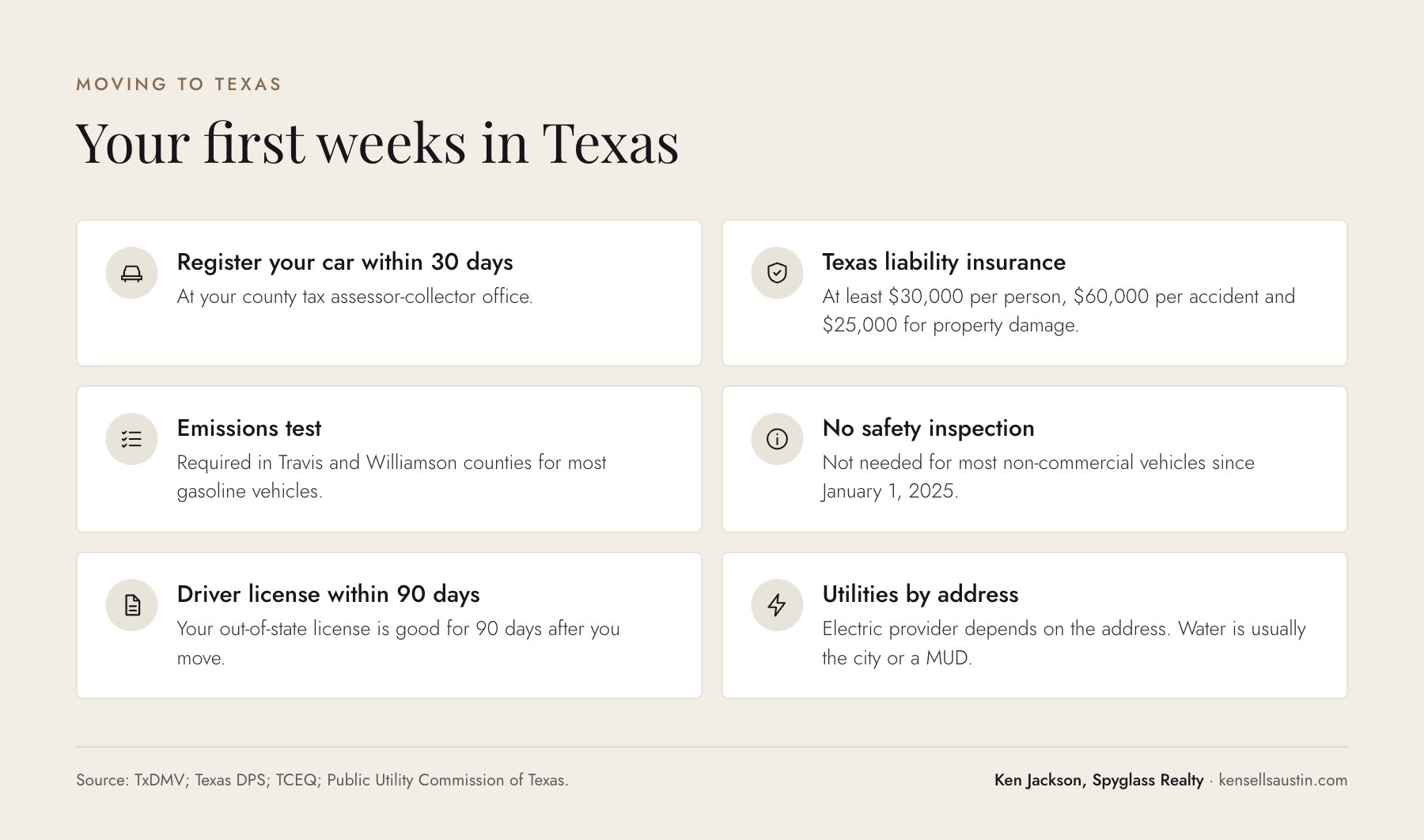
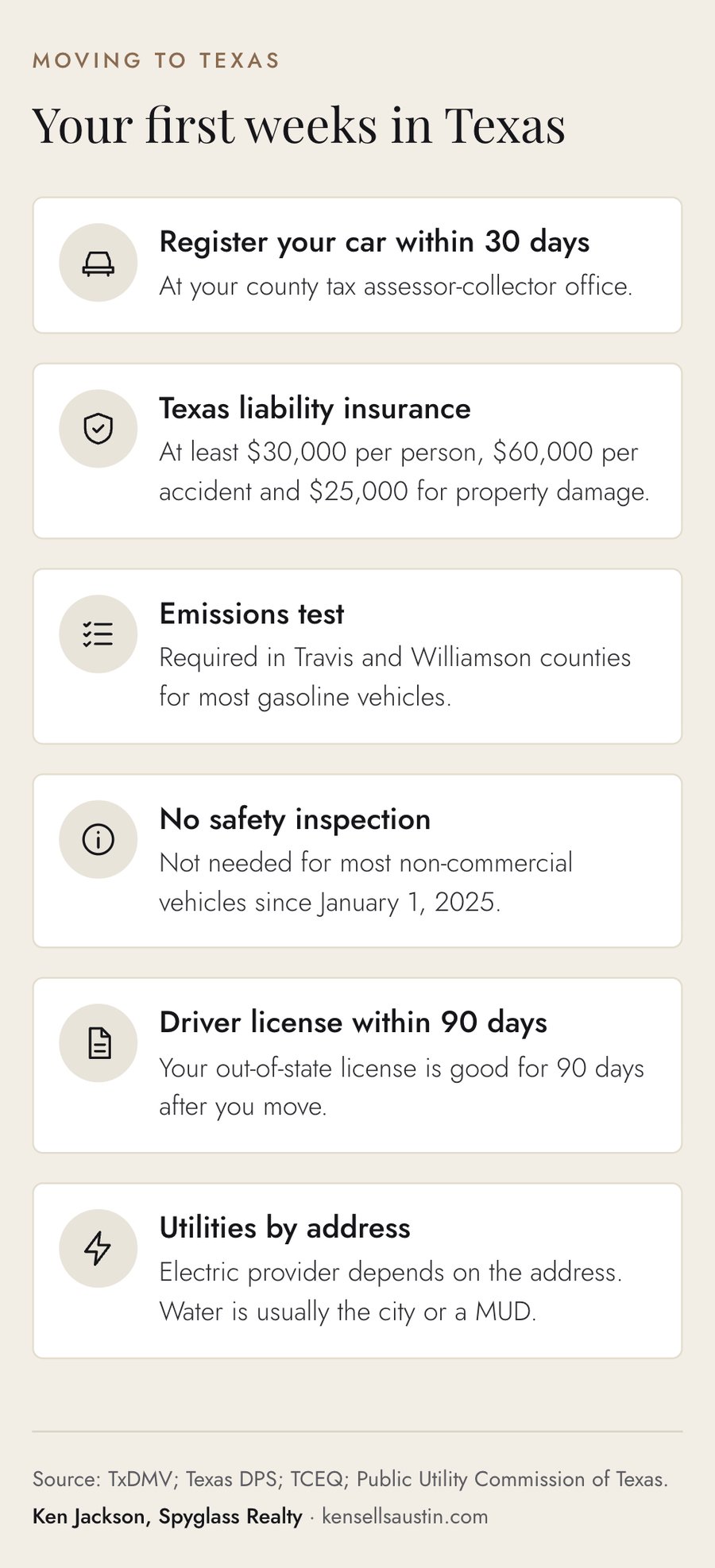
Plan these early. Register your vehicle within 30 days of moving, and get a Texas driver license, since your old license is good for 90 days. Travis and Williamson counties require emissions tests for most gasoline vehicles. Texas has no state income tax, but property taxes are set locally, so look at the parcel's real rate. Set up utilities by address, and decide whether to rent first. Ask Ken to build a timeline from your move date.
You have 30 days from the time you move to register your vehicle, at your county tax assessor-collector office. Bring proof of Texas liability insurance, at least $30,000 per person, $60,000 per accident and $25,000 for property damage. Bring proof of ownership or your old registration. If you live in an emissions county, which includes Travis and Williamson, you need an emissions test first. Fees change, so check TxDMV for the current amounts.
Not for most vehicles. Since January 1, 2025, non-commercial vehicles no longer need a safety inspection to register. A program fee is paid at registration instead. Emissions tests are still required in certain counties, including Travis and Williamson, and prices vary. Electric-only vehicles are exempt. Check with your county tax office for what you owe.
You can drive on a valid license from another U.S. state for up to 90 days after you move. After that you need a Texas license. If your license is from another state, a territory or Canada, you surrender it and do not need to take the knowledge or skills exams. Register your vehicles with TxDMV before you apply. Bring proof of residency. DPS lists the documents. Check the DPS page for current requirements and appointment options.
Start with the address. The electric provider depends on where the home is. Austin Energy serves parts of Austin and nearby cities, Pedernales Electric Cooperative serves others, and some city or co-op areas do not offer a choice of retailer. Power to Choose is the Public Utility Commission's site for comparing plans where choice exists. Enter your ZIP code. Water usually comes from the city or the MUD. Ask the seller, then call the utilities a week or two before closing. Ask Ken for the providers for your address.
It depends on how sure you are of where you want to live. Renting first lets you try the commute, the neighborhood and the home type before you commit. It can cost you extra moves and rent during a time you are also saving for a purchase. Buying right away works when your timeline and area are clear. A contract can set a closing date, and the option period lets you inspect and, if needed, walk away. Ask Ken to talk through both paths.
Time the move
The option period lets you terminate, so breaking a lease or booking movers before it ends carries risk.
Yes, it can be done. Buyers use video tours and a trusted agent, hire a TREC-licensed inspector in the option period, and sign documents electronically. Closings can use remote online notarization, but the title company decides which method it will use. The risk is what a video does not show, so do not skip the inspection. Ask Ken how he would set it up for your timeline.
I do not predict the market. Look at what you control: your timeline, your pre-approval and monthly budget, and how long you plan to stay. Then look at current data: recent closed sales in the area you want, days on market and the rate your lender quotes today. Freddie Mac publishes a weekly average mortgage rate survey for reference. Ask Ken to pull local data for the type and area you want.
There is no single answer. The comparison depends on the price, the rate, the down payment, taxes, insurance, repairs, HOA dues, how long you stay and what rent would be. Build both monthly budgets side by side. Include property taxes and any MUD or PID. Use a calculator and a lender quote, not a rule of thumb. For a tax view, ask a tax professional. Ask Ken to help you compare for a specific home.
The contract sets your closing date, and your lender sets the loan timeline, so build backward from those. The option period lets you terminate, so breaking a lease or booking movers before it ends carries risk. Give your landlord notice only when you are comfortable with where the deal stands. Ask your lender for a realistic closing window. Ask the title company when funds are due. Ask Ken to lay out the dates for your situation.
Texas has no personal income tax, which the Comptroller confirms. Your employer's rules, your old state's tax rules, and any home office deduction are questions for a tax professional. For the house, think about space for a home office and which internet service is available at the address. Commute may matter less, so you may have more suburbs to consider. Ask Ken to help you widen your search.
Keep reading
Each page has short, sourced answers on one part of buying a home in Texas.
General information, not legal, tax or lending advice. Your contract, your lender and your title company control the details. Questions about your own situation? Call Ken Jackson at (737) 307-4848 or send a message.
Last reviewed: October 13, 2026.
Still have questions? Ask Ken.
Call (737) 307-4848 or send a message.

SPYGLASS REALTY 8501 N MOPAC EXPY STE 110 AUSTIN TX 78759
SPYGLASS REALTY 8501 N MOPAC EXPY STE 110 AUSTIN TX 78759