This part of the Texas home buyer FAQ covers offers and closing: making an offer, the deadlines in a Texas contract and what happens through closing day. Contract references are to the current TREC forms.
49 questions, 9 topics
Pick a topic to go straight to its questions.
Topic 1 of 9 · 7 questions
You make an offer by completing and signing the TREC One to Four Family Residential Contract (Resale). It holds the price, earnest money, option fee, option period, closing date and any addenda. The seller can accept, counter or pass. The contract takes effect on the date of final acceptance. Within 3 days after that date you deliver the earnest money and option fee to the title company named in the contract. Your agent fills in the blanks with you. Agents may not add or change contract terms unless a party or a party's attorney wrote them.
A condo offer uses a different form, the TREC Residential Condominium Contract (Resale). The steps match a house offer, with condo additions. The contract names the unit and its share of the common areas. It also asks whether you already have the association documents (declaration, bylaws, rules) and the resale certificate. If you do not, the seller delivers them and you get 7 days after receiving each to terminate and keep your earnest money. Association transfer fees you pay are capped at a dollar amount written into the contract.
No percent rule
Start with recent sales of similar homes nearby. The CFPB calls it very risky to pay more than the appraised value.
There is no percent rule. Start with recent sales of similar homes nearby, then adjust for size, condition, lot and updates. Terms count too: the option period, closing date, earnest money and who pays which costs can matter to a seller as much as price. Your lender's appraisal tests the number later, and the Consumer Financial Protection Bureau calls it very risky to pay more than the appraised value. A price you can support with sold comparables is easier to defend.
Compare the asking price with what similar homes nearby actually sold for recently, not with other asking prices. A fair comparison matches size, age, condition, lot and location, and then adjusts for differences. That is what a comparative market analysis does. A home that has sat for a long time at a price above those sales is often a sign of a price problem, but it can also be condition or terms. The lender's appraisal is the later check.
It shows the seller that a lender has looked at your finances and expects to lend. A pre-qualification is an estimate based on what you tell a lender. A pre-approval means the lender has reviewed your documents, so sellers take it more seriously. Neither is a loan commitment. Under the financing addendum, your loan is not approved until the lender confirms your assets, income and credit and the property meets its rules.
When more than one buyer offers, the seller chooses. The seller may accept one, counter one or ask everyone for their best terms. Nothing in the TREC contract sets a process. The seller's agent must convey to the seller all known information that affects the decision. Strong offers usually stand out on terms the seller values: a clean financing plan, a short option period, flexible closing and a deposit the seller trusts. Price is only one of those.
Yes. In the contract, "as is" means the home's present condition, with any defects and no warranty except for title and the warranties in the contract. Agreeing to "as is" does not stop you from inspecting, from negotiating repairs in a later amendment, or from terminating during the option period. You can also choose "as is with specific repairs": the seller completes repairs listed by name. General phrases like "subject to inspections" do not count.
Related guides
Topic 2 of 9 · 7 questions
The contract leaves the amount blank for you and the seller to agree on. Texas does not set a minimum or a maximum in the form. You deliver it to the title company within 3 days after the effective date. At closing it is applied first to your cash down payment, then to your buyer expenses, and any excess is refunded to you. A larger deposit can make an offer look stronger. It also puts more money at risk if you default after your protections end.
A title company, named in the contract as the escrow agent, holds your earnest money. It is a neutral holder, not a party to the contract. It owes no interest on the money. It can require the funds to clear before it releases anything. When the deal closes, the money goes to your costs. If the deal ends, the escrow agent usually wants a signed release from both sides, or follows the written demand steps in the contract.
3 days
to deliver earnest money and the option fee
5:00 p.m.
option notice deadline on the last day
15 days
to object to a written demand for the earnest money
You get it back if you terminate inside the option period, if the title commitment is not delivered on time, or if title objections are not cured and you terminate in time. It is also refunded if the seller does not deliver the Seller's Disclosure Notice, if a required lender repair is not agreed, or if the lender-related exits in the financing addendum apply. You do not get back the option fee. And if you default after your protections end, the seller may keep the earnest money.
Yes, in some cases. If you fail to comply with the contract and have no valid exit, you are in default. The seller may then terminate and receive the earnest money as liquidated damages, or ask a court to force the sale. If you miss the deadline to deliver the deposit, the seller may terminate before you deliver it. If the seller defaults, you can get the earnest money back. If the two sides disagree, the escrow agent follows a written demand process with a 15 day objection window.
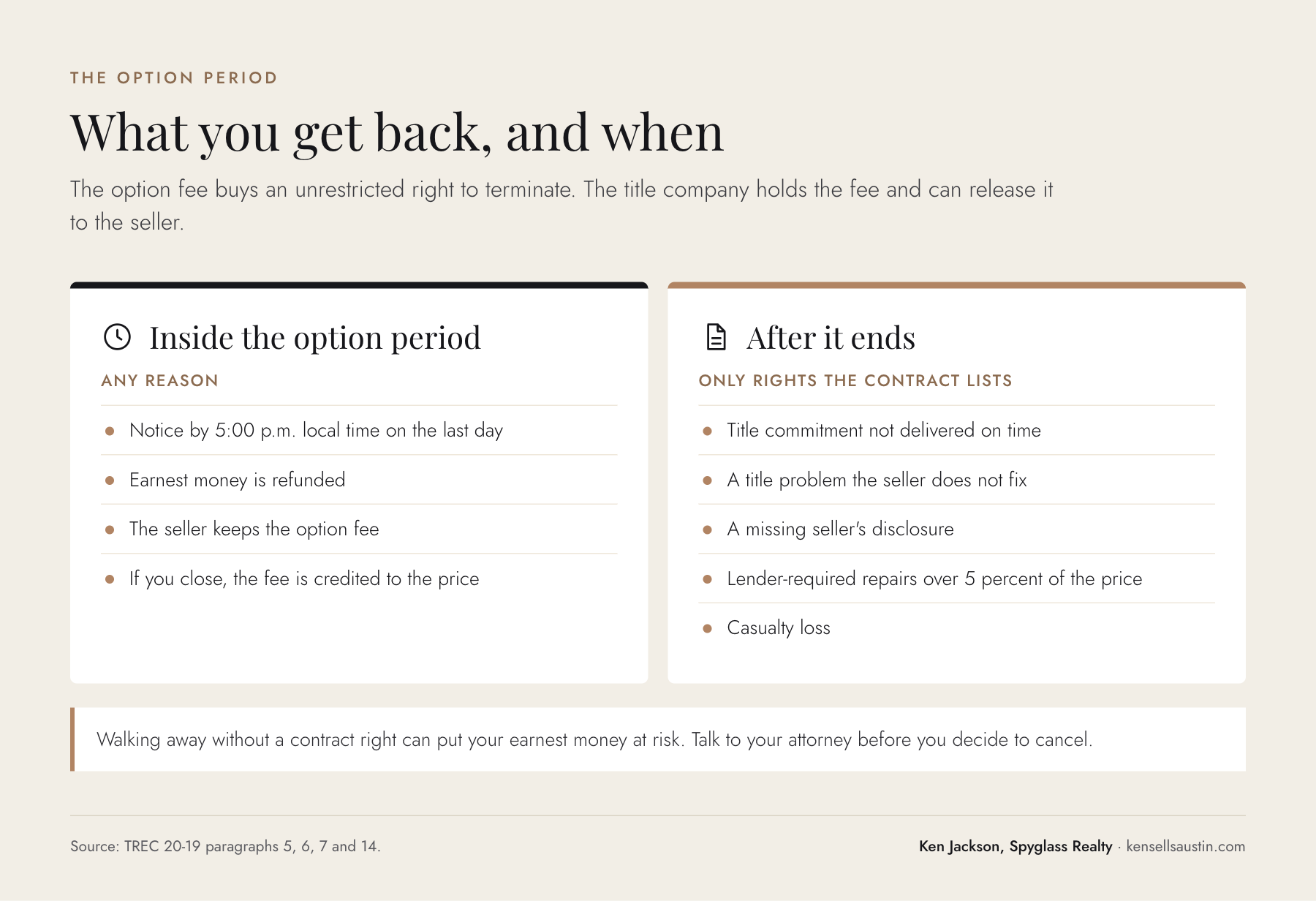
The option fee is a payment for an unrestricted right to terminate for any reason during the option period. The option period is the number of days after the effective date, written in the contract, when you can inspect the home and walk away. If you terminate on time, you lose the option fee and your earnest money is refunded. If you close, the option fee is credited toward the sales price. The fee goes to the seller, and the title company can release it without asking you again.
Your unrestricted right to terminate ends. Notice must reach the seller by 5:00 p.m. local time on the last day, and the contract says time is of the essence for this paragraph. You also lose the unrestricted right if the option fee is not delivered on time. You may still have other exits written in the contract, such as title, financing or disclosure rights, but none lets you walk away for any reason. If the last day to deliver the earnest money or option fee falls on a weekend or legal holiday, that delivery deadline moves to the next day that is not one. The option period deadline does not move.
At closing
Earnest money is applied first to your cash down payment, then to your buyer expenses, and any excess is refunded to you.
It depends on timing and which clause you use. Inside the option period you can leave for any reason; you lose the option fee and keep your earnest money. After that, you need a reason written in the contract, such as a title, financing or disclosure right. Without one, leaving is a default, and the seller may keep the earnest money or ask a court to enforce the contract. This answer is for a standard resale contract.
Related guides
The option period Closing costs in Texas Inspections Back to topics
Topic 3 of 9 · 7 questions
The date of final acceptance becomes the effective date. Within 3 days, you deliver the earnest money and option fee to the title company. During the option period, you inspect and decide. The title company has 20 days after it receives the contract to give you the title commitment. Your lender orders an appraisal and finishes the loan. If you have an HOA or condo, the association documents arrive too. Closing happens on the date in the contract.
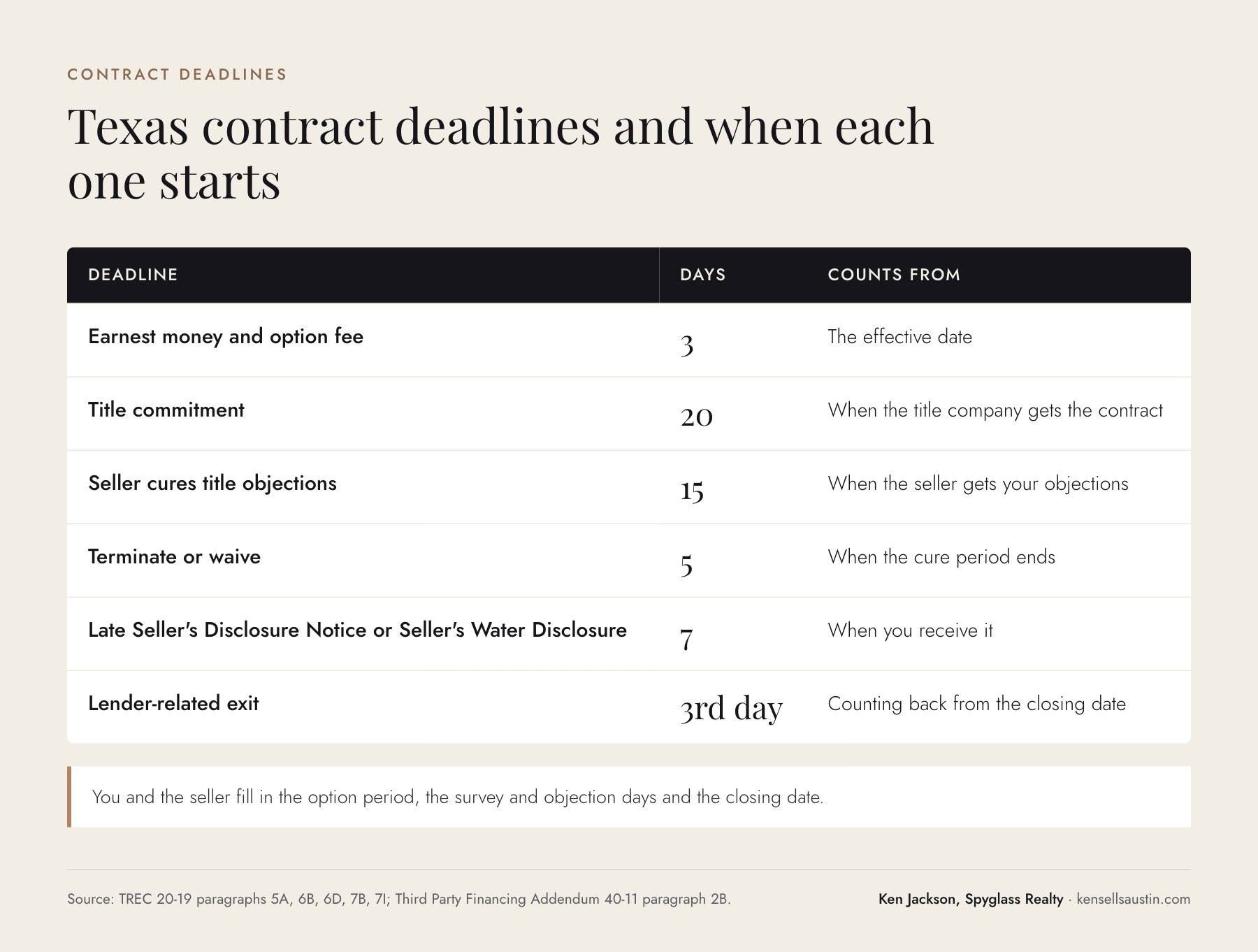
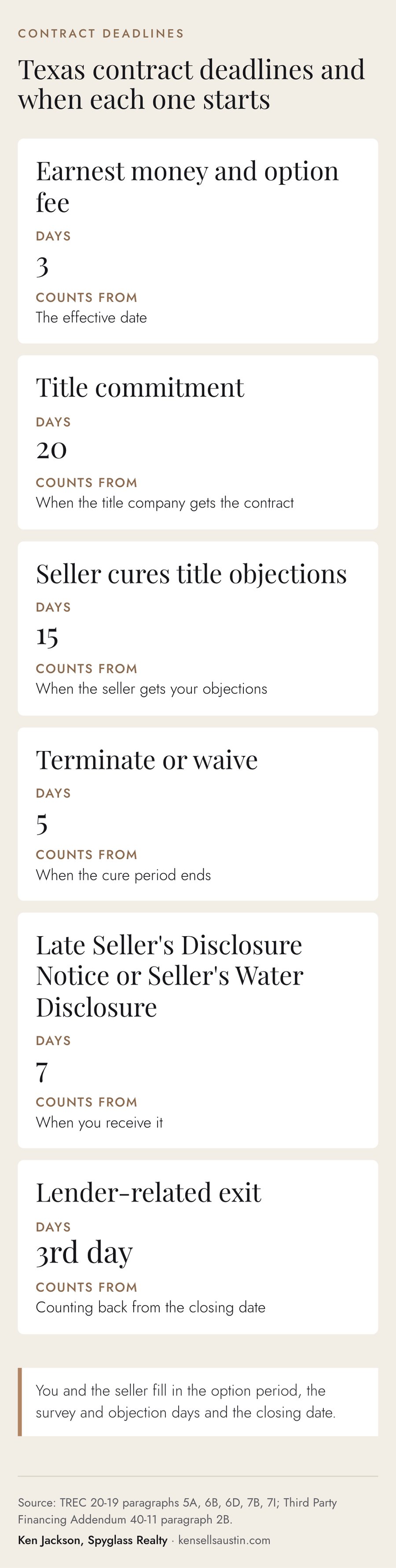
Some are fixed in the form and some you fill in. Fixed: 3 days to deliver the earnest money and option fee, counted from the effective date. 20 days for the title commitment, counted from when the title company gets the contract. 15 days for the seller to cure title objections, from when the seller gets them. 5 days for you to terminate or waive, from when the cure period ends. 7 days to terminate after a late Seller's Disclosure Notice or Seller's Water Disclosure, from when you receive it. The lender-related exit counts back to the 3rd day before closing. You and the seller fill in the option period, the survey and objection days and the closing date.
New in 2026
The current TREC resale contract adds a Seller's Water Disclosure about groundwater and surface water rights.
The contract has a box for it. If you have not received the notice, the seller must deliver it within the number of days written there. If you never receive it, you may terminate any time before closing and get your earnest money back. If the seller delivers it, you may terminate for any reason within 7 days of receiving it or before closing, whichever comes first, and get your earnest money back. A seller who is not required to give the notice can tick a third box.
The current TREC resale contract adds a Seller's Water Disclosure about groundwater and surface water rights, such as water wells, ponds and severed groundwater rights. If you have not received it, the seller delivers it within the days written in the contract. If you never receive it, you may terminate any time before closing. If the seller delivers it, you may terminate for any reason within 7 days after you receive it, or before closing if that comes first, and your earnest money is refunded. A seller is excused only when every condition listed in the form is true.
They are repairs or treatments your lender requires before it will fund, such as wood destroying insect treatment. Unless the parties agree in writing, neither side has to pay for them. If you and the seller do not agree on who pays, the contract ends and your earnest money is refunded. If the cost is more than 5 percent of the sales price, you may also terminate and get your earnest money back. Agreed repairs must be done by licensed or commercially engaged people, with paperwork.
Often yes, if you had not received them when you signed. The condo contract gives you 7 days after receiving the association documents to terminate with your earnest money refunded, and the same 7 days after receiving the resale certificate. You also keep rights under Texas Property Code section 82.156. If you already had the documents when you signed, that extra window does not apply, so read them first. A special assessment due and unpaid at closing is the seller's obligation.
Ask Ken
Want this checked for a specific home? Call (737) 307-4848 or send Ken a message.
Use the TREC association addendum. You choose who gets the subdivision information (restrictions, bylaws, rules and a resale certificate): the seller, at the seller's cost, or you. When the seller delivers it, you may terminate within 3 days of receiving it, or before closing, and get your earnest money back. If it never arrives, your sole remedy is to terminate. Association transfer fees and reserve deposits that you pay are capped at a dollar amount in the addendum, and the seller pays any excess.
Related guides
Condo documents Inspections FAQ MUD and PID explained Back to topics
Topic 4 of 9 · 3 questions
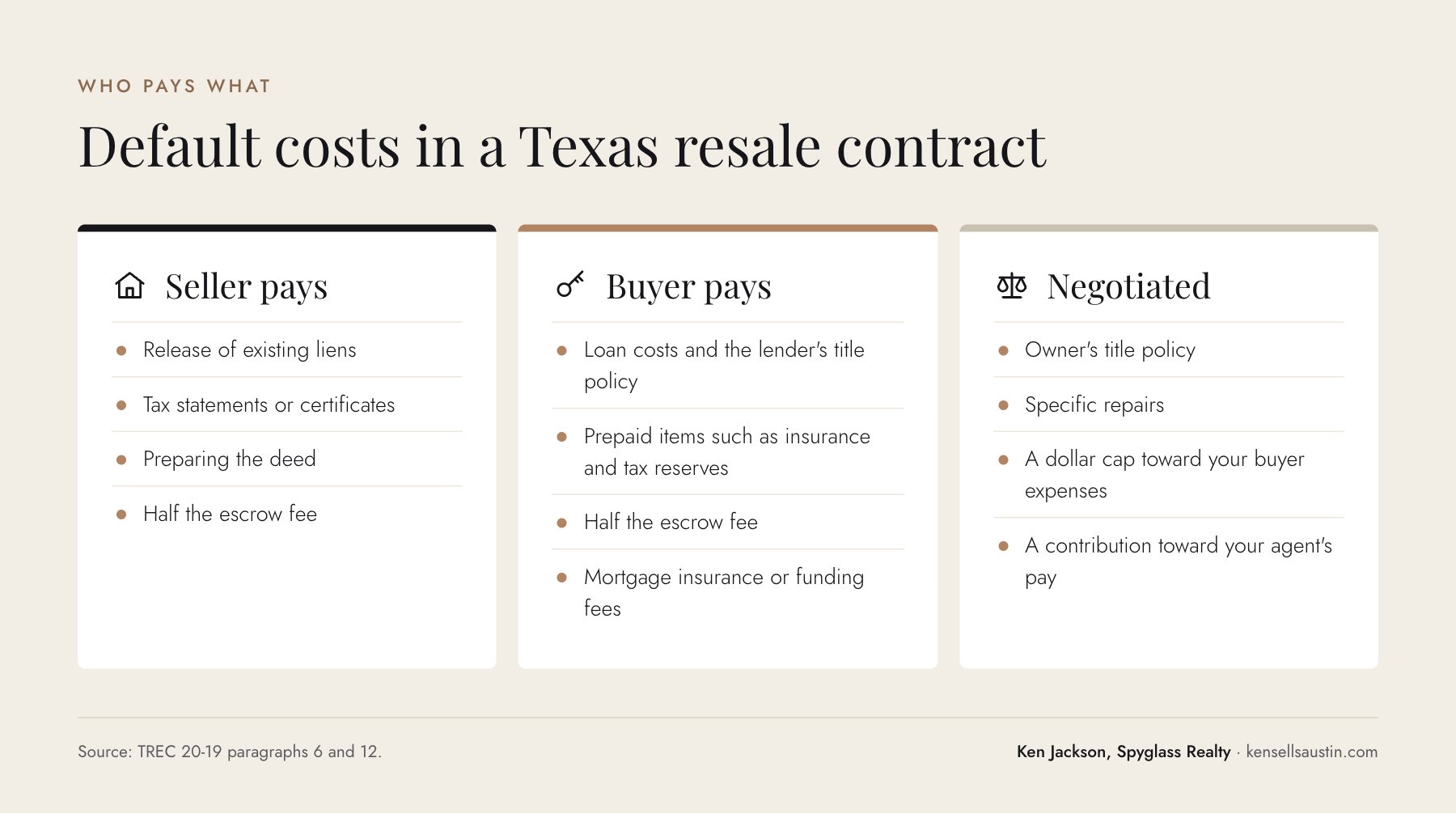
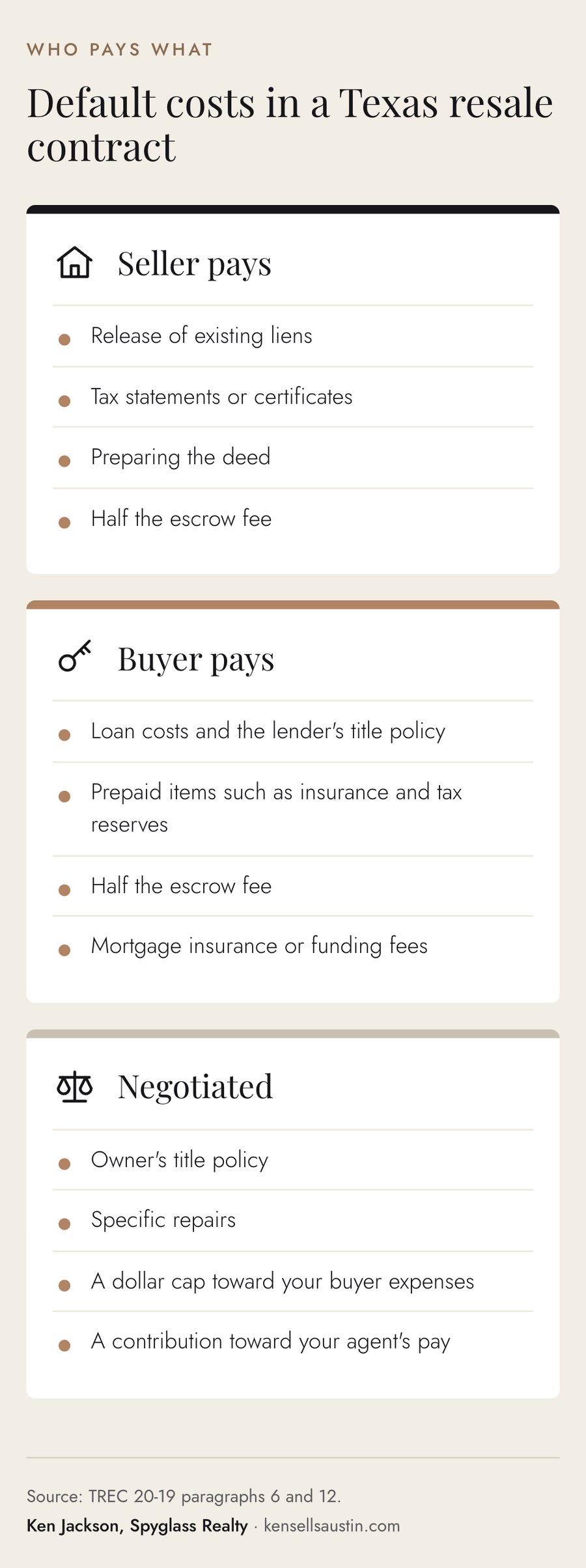
By default the seller pays to release existing liens, tax statements or certificates, preparing the deed and half the escrow fee. Other items are negotiated and written into the contract: whether the seller or buyer pays for the owner's title policy, specific repairs, a residential service contract up to a stated amount, a dollar limit toward your buyer expenses, and a contribution toward your agent's pay. The buyer pays loan costs, prepaid items and the other half of the escrow fee.
It is money the seller agrees to put toward your costs at closing. In the Texas contract, it is a dollar cap on the amount applied to your buyer expenses, such as loan fees and prepaid items. Brokerage compensation is handled on a separate line. If a government loan program bars you from paying certain fees, the concession first pays those prohibited fees. Your lender sets how much help it will accept.
Agent pay is not set by law and is fully negotiable. You and your agent agree on it in a written buyer agreement before you tour homes. A seller may agree to contribute toward it, and the 2026 Texas contract has a line for that. The contribution is applied toward what you owe your agent. It does not change what your agreement says you owe.
Related guides
Closing costs in Texas What it costs to buy Agent pay Back to topics
Topic 5 of 9 · 3 questions
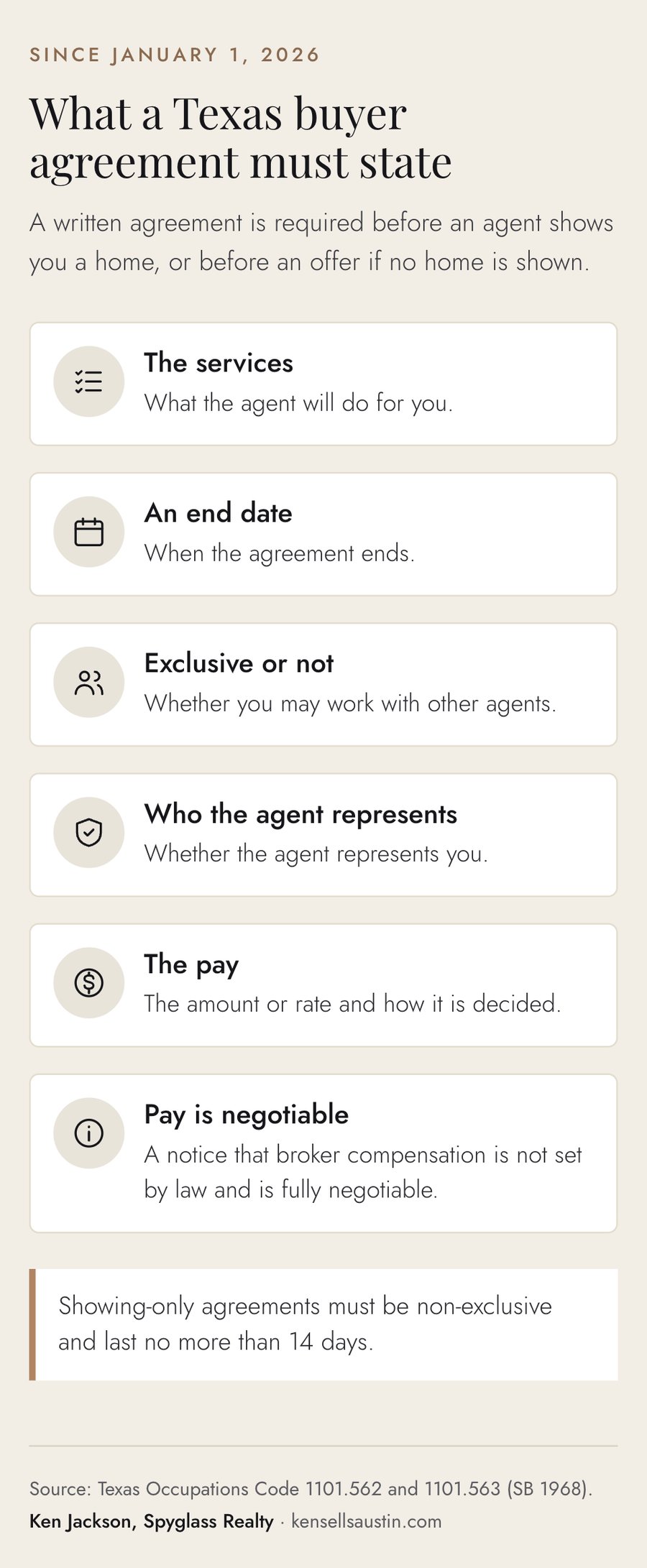
Yes, for residential buyers. Since January 1, 2026, a Texas license holder must have a signed written agreement with you before showing residential property. If no property is shown, it must be in place before an offer is presented for you. The agreement can be a representation agreement or a showing-only, non-representation agreement. It does not apply to commercial buyers or to tenants.
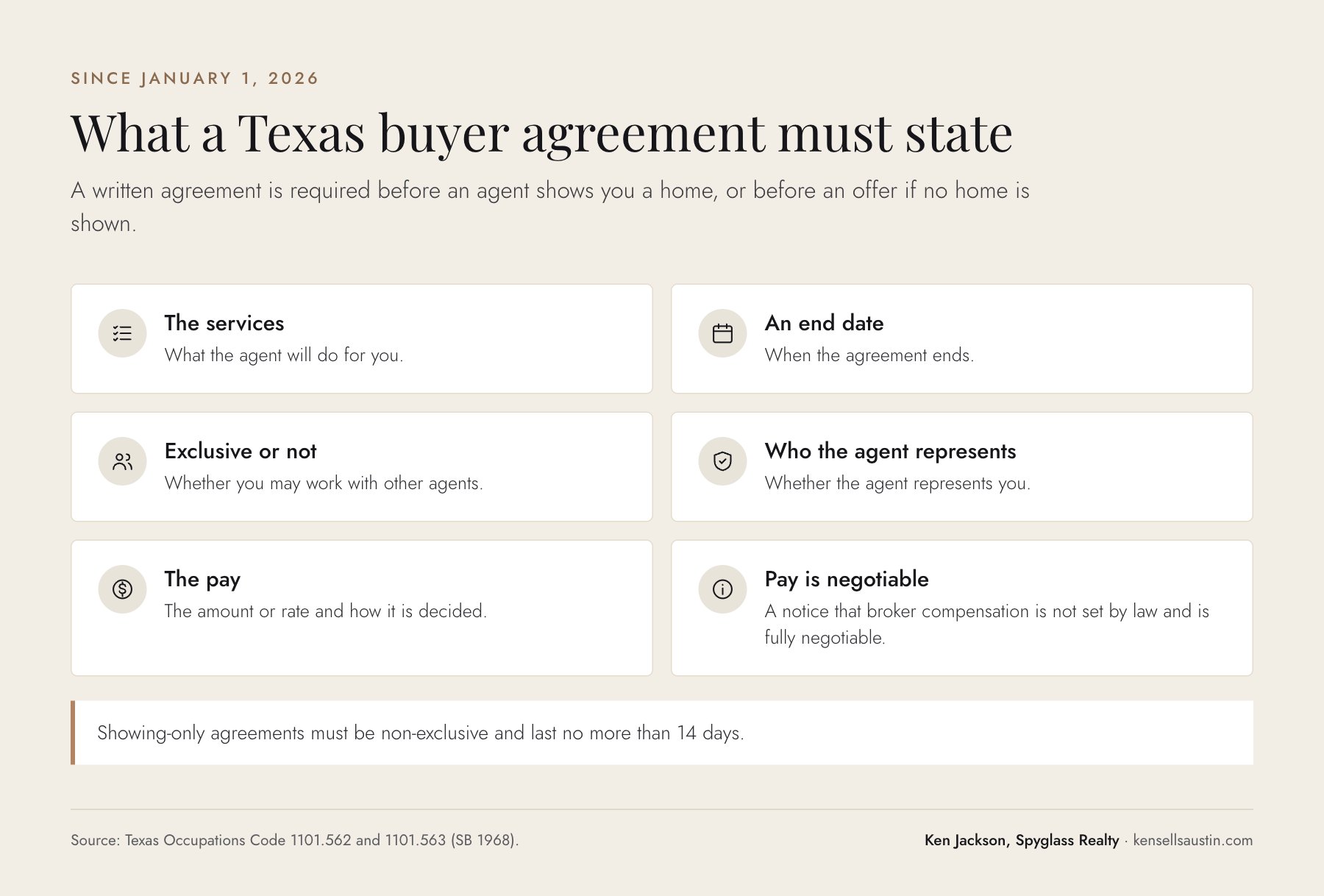
It must state the services the agent will provide, a termination date, whether the agreement is exclusive or non-exclusive, whether the agent represents you, and the amount or rate of pay and how it is decided. It must also say in conspicuous language that broker compensation is not set by law and is fully negotiable. A representation agreement may limit services, such as to showing only, but cannot waive the minimum duties an agent owes a client under TREC rules.
Only under a showing-only, non-representation agreement. It must be non-exclusive and last no more than 14 days. The agent may not give you opinions or advice about the property or real estate generally, may not agree to represent you, and may not provide other brokerage services. The agent must say whether they represent the owner. If you refuse to sign anything, the agent cannot show you the home. This also applies at open houses hosted by an agent from outside the listing brokerage.
Related guides
Choosing a realtor Agent agreements and pay Buyers guide Back to topics
Topic 6 of 9 · 5 questions
A title company checks the property's ownership records, issues title insurance, holds your earnest money as escrow agent and runs the closing. You may choose any licensed title company. You do not have to use one picked by an agent, builder or lender, and a seller may not require a particular one as a condition of the sale. The premium is set by the state, so every company charges the same for the policy. Escrow and closing fees can differ.
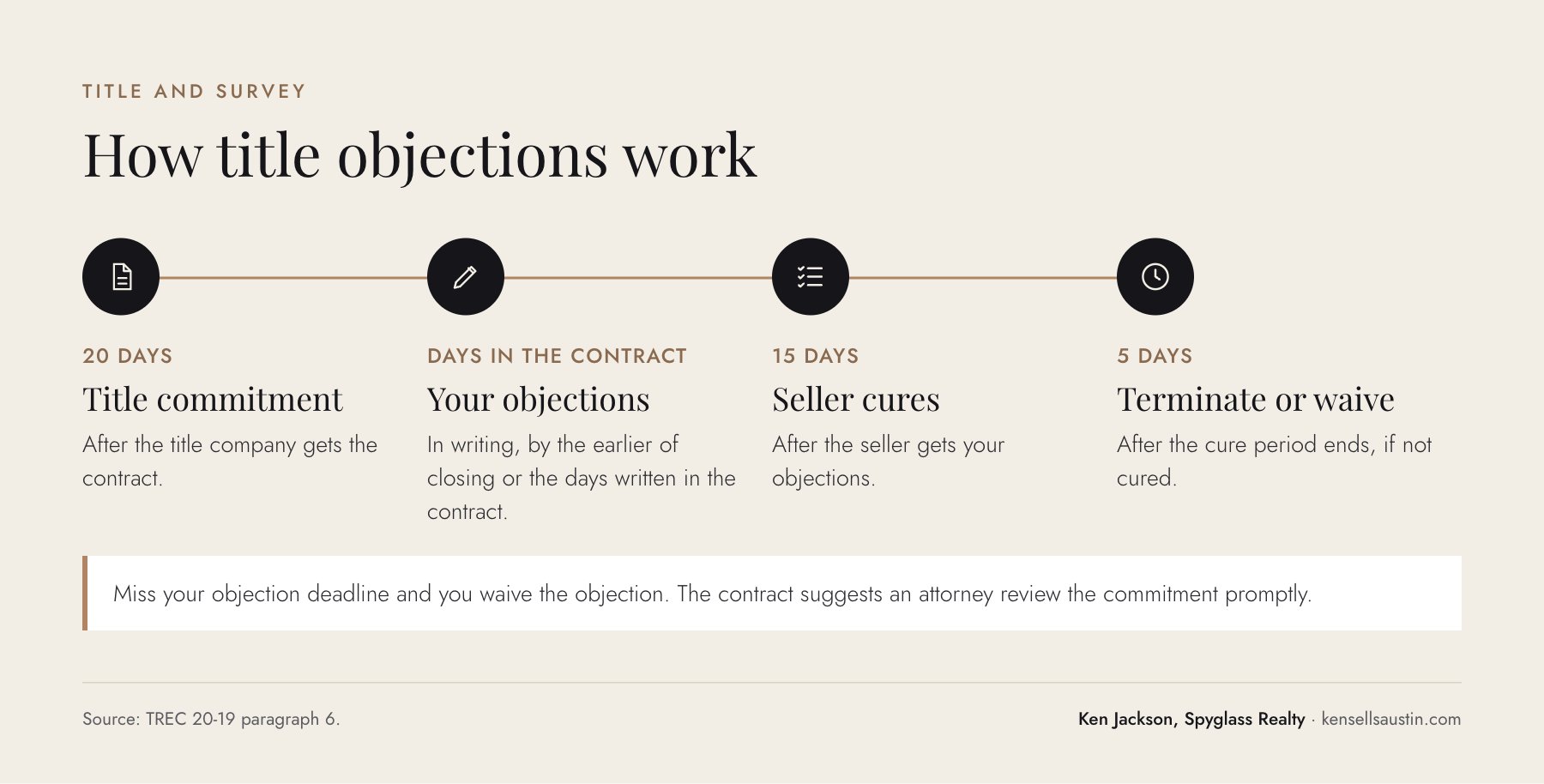
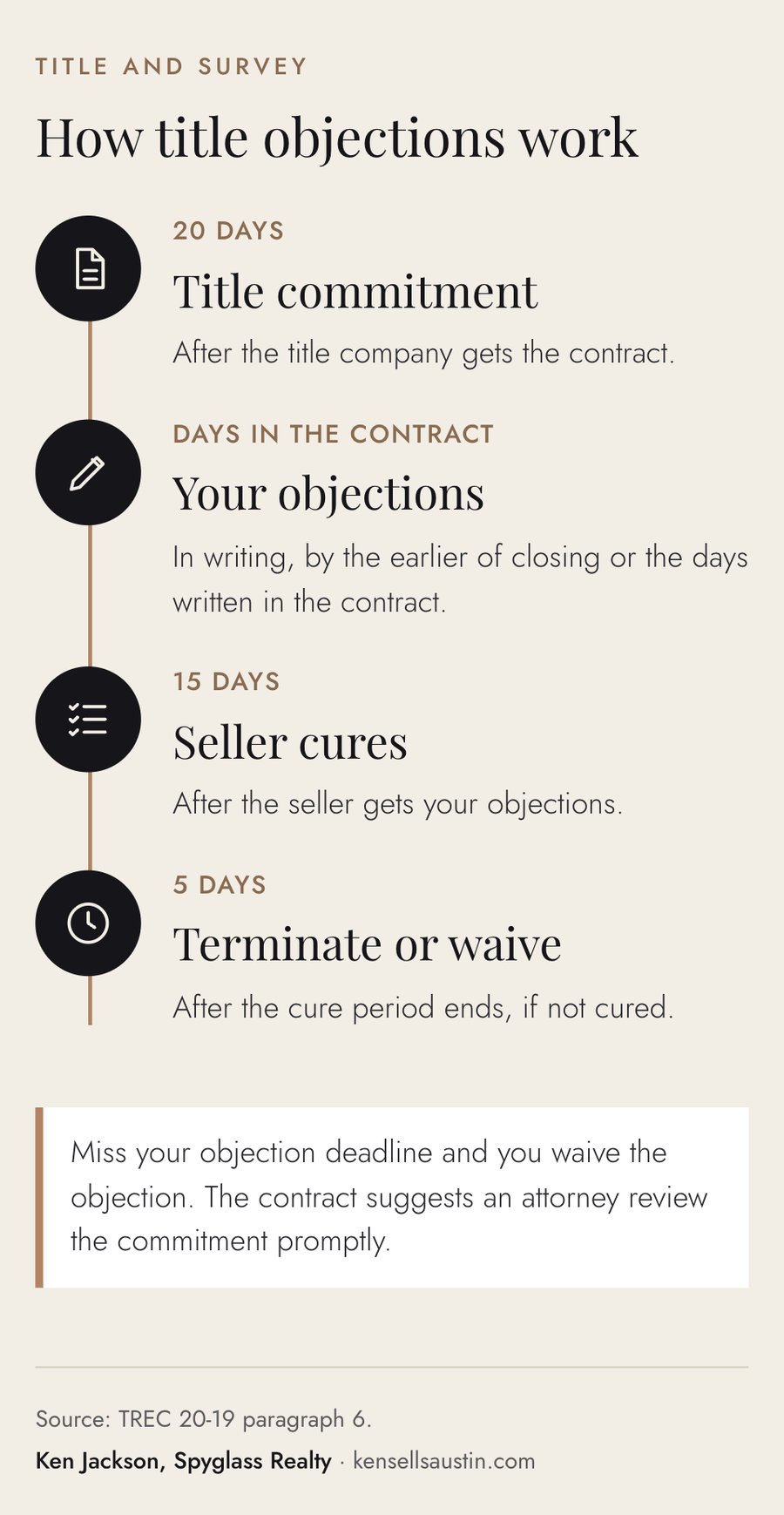
It is the title company's written statement of the conditions under which it will issue your title policy. It lists exceptions, exclusions and requirements. It does not promise there are no problems. The seller must furnish it within 20 days after the title company receives the contract, along with copies of the restrictions and other exception documents, at your expense. The contract suggests you have the commitment promptly reviewed by an attorney, because the time to object is short.
Title objections are written objections to defects, exceptions or encumbrances shown on the commitment or survey. You must object by the earlier of the closing date or the number of days written in the contract after you receive the commitment, exception documents and survey. If you miss it, you waive the objection. The seller must cure timely objections within 15 days, unless it would cost the seller money. If not cured, you have 5 more days to terminate or waive.
Three survey choices
The seller's existing survey with a T-47 or T-47.1, a new survey at your expense, or a new survey at the seller's expense.
The contract has three choices. One, the seller gives the title company and you an existing survey with a Texas Department of Insurance affidavit (T-47) or declaration (T-47.1). Two, you get a new survey at your expense. Three, the seller pays for a new survey. The survey must be acceptable to the title company and your lender. If the seller's existing survey or affidavit is not accepted, a new one is ordered at the party's expense the contract names, no later than 3 days before closing.
The contract lists the buyer's expenses: appraisal fees, loan application and origination charges, credit reports, loan document preparation, interest from funding to one month before the first payment, recording fees, the loan title policy, half the escrow fee, prepaid items (flood and hazard insurance, tax and insurance reserves), underwriting and wire fees, and mortgage insurance or funding fees your loan requires. Your lender's Loan Estimate shows the numbers for your loan.
Topic 7 of 9 · 7 questions
The contract sets the closing date in a blank you and the seller fill in. From acceptance, some dates are fixed: 3 days to deliver the earnest money and option fee, 20 days for the title commitment, and a 3rd-day-before-closing lender exit. How soon your loan finishes depends on your lender, the appraisal and the file. If title objections are cured late, closing can be pushed up to 7 days after they are cured or waived. Finding a home comes before all of this and has no fixed time.
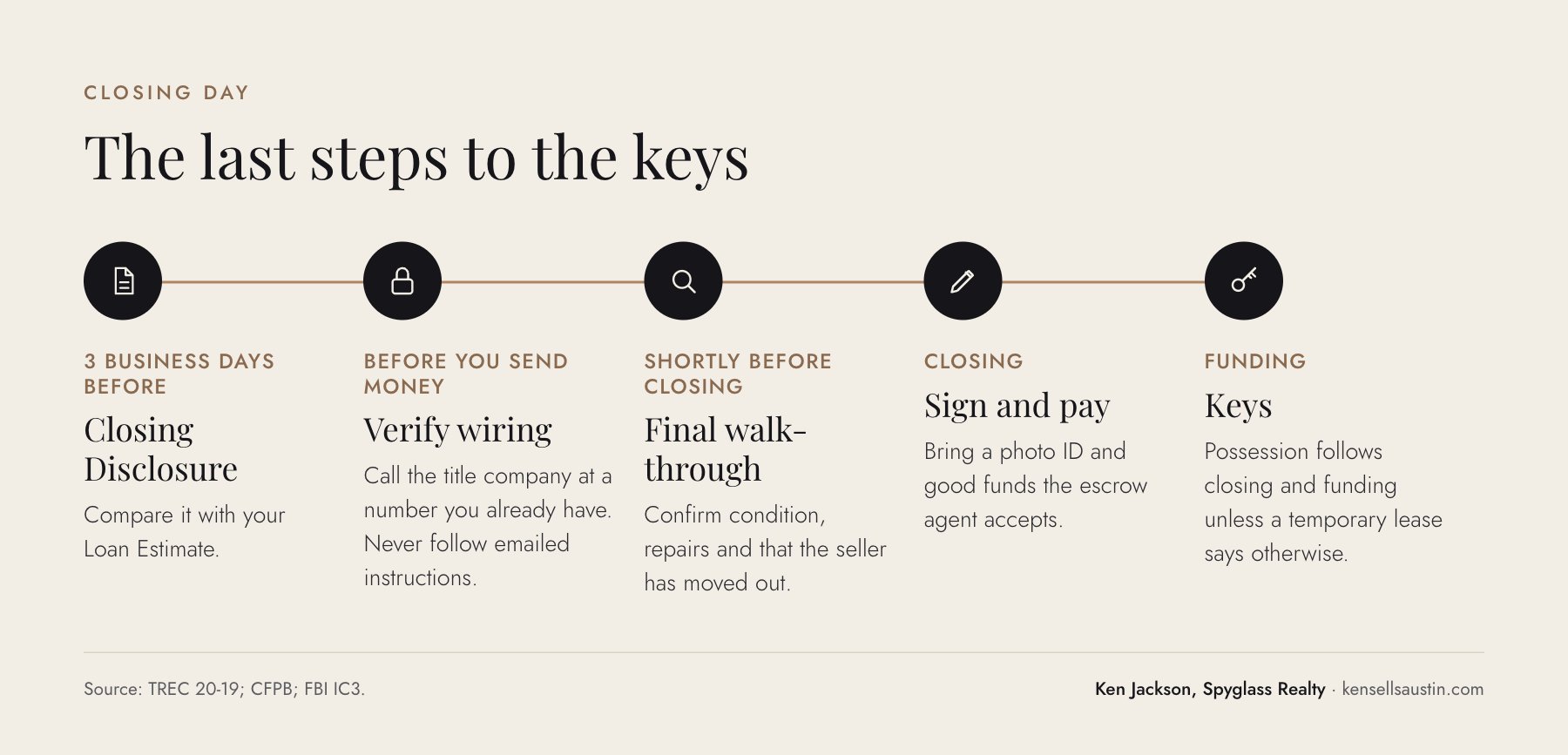
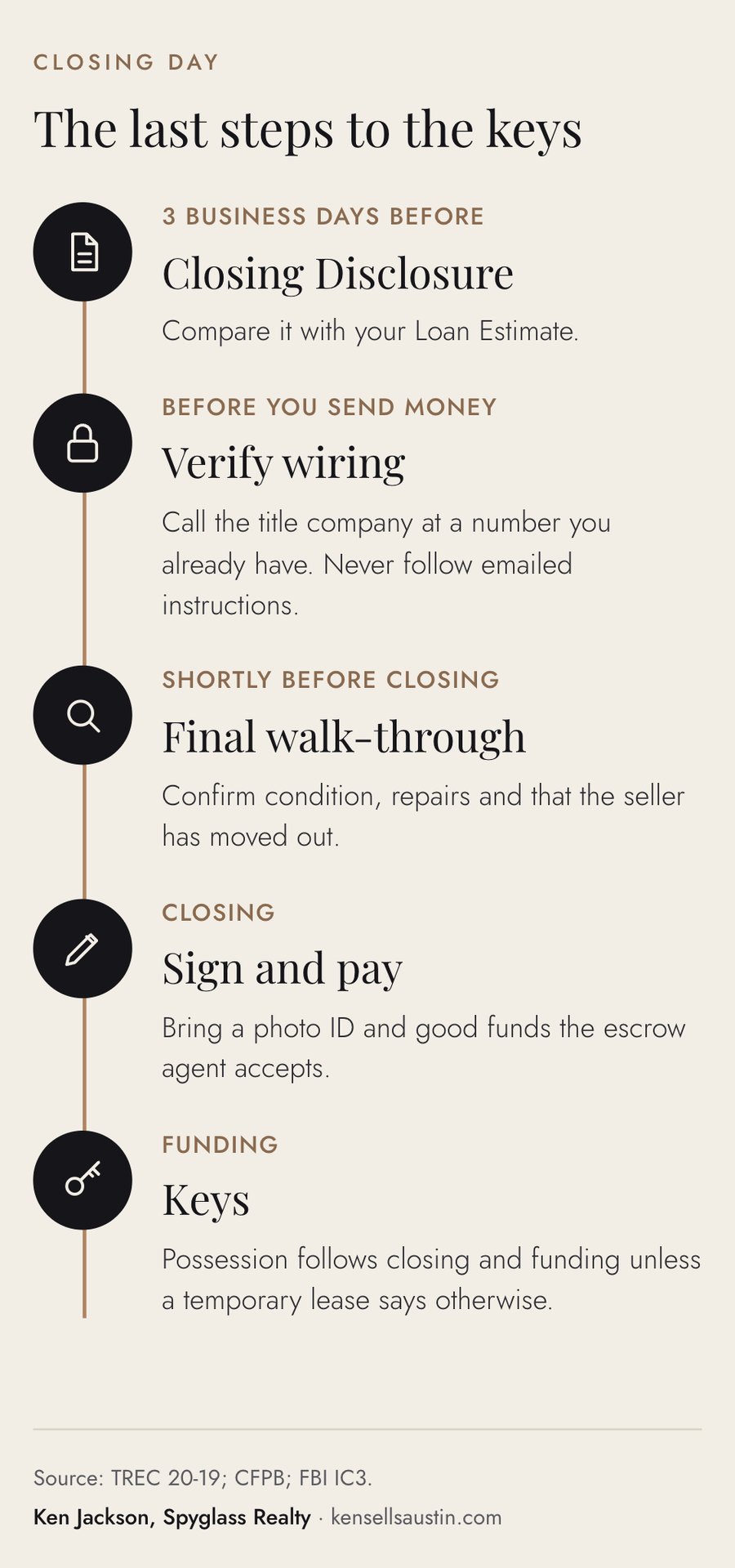
The seller signs and delivers a general warranty deed and tax statements showing no delinquent taxes. You pay the sales price in good funds the escrow agent accepts. Both sides sign loan documents, notices, affidavits and other papers the closing and the title policy need. Existing liens are paid from the sale proceeds. Your earnest money goes first to your cash down payment, then to your buyer expenses, with any excess refunded to you. Possession follows closing and funding.
Your title company gives you the list, so ask for it. Plan on a government photo ID. Your funds must be "good funds" the escrow agent accepts, which usually means a wire you have verified by phone or a cashier's check, as the title company directs. Bring your Closing Disclosure to compare with the final figures. Do not send money from an emailed instruction without calling the title company at a number you already have.
Wire fraud
Never follow wiring instructions you receive by email. If money goes to the wrong account, call your bank for a wire recall and report it at ic3.gov.
It is the lender's final statement of your loan terms and costs. Under federal rules you must receive it no later than three business days before closing. If it is mailed or sent electronically and not handed to you, you are treated as receiving it three business days after it is sent. Compare it to your Loan Estimate, which the lender sends within three business days after you apply. Ask your lender about anything that looks different.
Most changes only require a corrected form at or before closing. Three changes restart the three business day wait: the annual percentage rate becomes inaccurate, the loan product changes, or a prepayment penalty is added. You can shorten or waive the wait only for a bona fide personal financial emergency, with a dated, written statement signed by all borrowers. Printed waiver forms are not allowed. Closing late can affect your contract dates, so tell your agent right away.
Never follow wiring instructions you receive by email. Before you send money, confirm the account name and number by phone with your title company, using a phone number you already had, not one in the email. Choose two trusted contacts at the start, such as your agent and the title company, and agree how money will move. Do not email financial information. A last-minute change to the instructions is a red flag.
Act at once. Call your bank or wire-transfer company and ask for a wire recall. Reporting quickly improves the chance of recovering money. Then file a complaint with the FBI's Internet Crime Complaint Center at ic3.gov. Tell your title company and your agent, and keep every email, confirmation and account number.
Topic 8 of 9 · 6 questions
It is your last look at the home shortly before closing, to confirm its condition, that agreed repairs are done, that items that stay are still there and that the seller has moved out. The TREC contract has no walk-through clause, so it is a good practice rather than a contract step, and your agent can schedule it. The contract does require agreed repairs to be completed before closing with paperwork, and items the seller keeps to be removed before possession.
Unless the parties agree otherwise in writing, the seller must complete agreed repairs before the closing date, using licensed or commercially engaged people, and give you paperwork showing what was done and paid for. If the seller does not finish, you may use your remedies under the default paragraph, or extend the closing date by up to 5 days so the seller can finish. Do not close on a promise. Get the change in writing.
The closing date is on or before the date in the contract, or within 7 days after title objections are cured or waived, whichever is later. If either side fails to close by then, the other may use its remedies under the default paragraph. The parties can agree to move the date, but only in writing. Repairs can add up to 5 days and casualty loss up to 15. A new Closing Disclosure can add three business days if certain terms change.
Keys
Possession follows closing and funding unless the parties signed a written temporary lease.
Under the standard contract, the seller delivers possession upon closing and funding, unless the parties signed a temporary lease instead. "Funded" means the lender's money has reached the title company. Confirm with your title company that it has funded before you head to the home. At possession the seller must also hand over access codes and apps for any smart devices and remove their own connections to them.
It is a written lease that lets the seller stay in the home after closing for an agreed time, or lets the buyer move in before closing. Texas has a Seller's Temporary Residential Lease and a Buyer's Temporary Residential Lease. Without a written lease, anyone in possession outside the contract's terms is a tenant at sufferance. The contract also warns that insurance may be limited or end at a change of ownership and possession, so talk to your insurance agent.
The seller is to deliver possession upon closing and funding in the home's present or required condition, with ordinary wear and tear excepted. If the seller stays after closing without a written lease, that is a tenancy at sufferance, and if the seller breaches, the contract's default remedies apply. The best fix is a short written lease before closing. Check at the walk-through that the home is empty and that anything excluded is gone.
Related guides
Inspections FAQ Homeowners insurance Buyers guide Back to topics
Topic 9 of 9 · 4 questions
Change the locks and garage codes. Set up utilities in your name. Update your address with your bank, employer and the post office. Ask about the homestead exemption and its deadline. Save your closing documents, including the deed, Closing Disclosure and title policy. Check smoke and carbon monoxide alarms. Log in to any smart devices and confirm the seller's access is gone. Put your repair receipts and warranties in one folder.
Who provides water, wastewater, trash, electric and gas depends on the address, not just the city. Ask your agent or the title company to confirm each provider for your home before closing. City accounts for water, sewer and trash are usually set up with the city's utility office. Where electricity is open to competition, the Public Utility Commission's Power to Choose site lets you compare plans by ZIP code. Do not guess a provider from the city name.
The steps match a house, with three additions. The seller delivers the association documents and a resale certificate, prepared at the seller's expense no more than 3 months before it is delivered. Association transfer fees, deposits and reserves that you pay are capped at a dollar amount in the contract, and the seller pays any excess. Dues are prorated through the closing date, reserves from regular assessments are not credited to the seller, and a special assessment unpaid at closing is the seller's.
First week
Change the locks and codes, set up utilities, and ask about the homestead exemption and its deadline.
Under the TREC association addendum, you pay association fees, deposits, reserves and other charges tied to the transfer, up to a dollar cap written into the addendum, and the seller pays the excess. Regular dues are prorated through closing like other periodic assessments. The seller also pays the private transfer fee, if one exists, unless the contract says otherwise. Ask the title company to show every HOA line on your closing statement.
Related guides
Homestead exemption Moving to Texas Condo closings Back to topics
Keep reading
Each page has short, sourced answers on one part of buying a home in Texas.
General information, not legal, tax or lending advice. Your contract, your lender and your title company control the details. Questions about your own situation? Call Ken Jackson at (737) 307-4848 or send a message.
Last reviewed: October 13, 2026.
Still have questions? Ask Ken.
Call (737) 307-4848 or send a message.

SPYGLASS REALTY 8501 N MOPAC EXPY STE 110 AUSTIN TX 78759
SPYGLASS REALTY 8501 N MOPAC EXPY STE 110 AUSTIN TX 78759