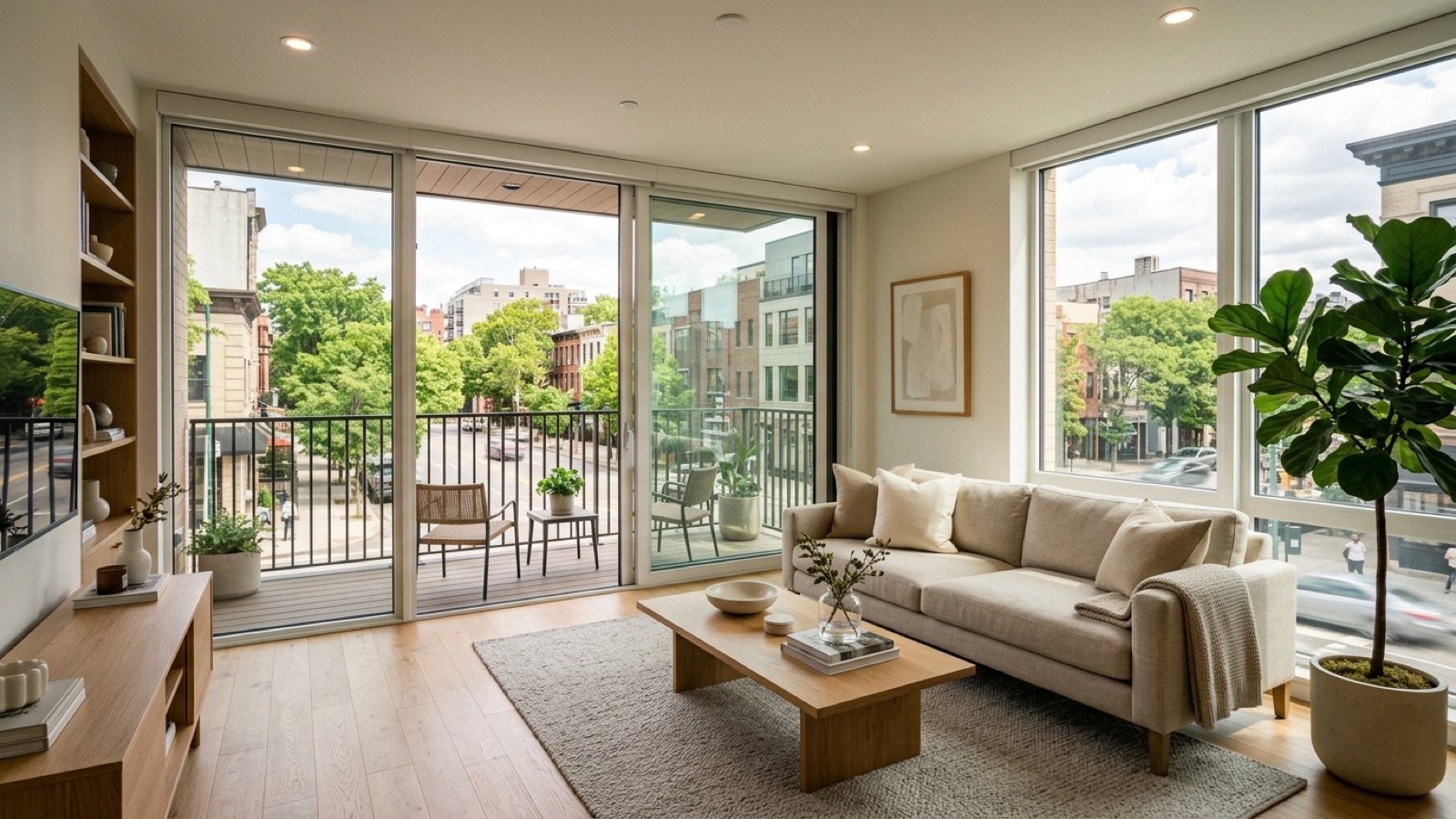
You own your unit and an undivided interest in the common elements. The declaration decides the boundaries, so read it first.
The declaration, bylaws and rules, the resale certificate, the association's insurance summary and recent meeting minutes.
By law the association must furnish it within 10 days after a written request from the unit owner.
Most of my buyers start by looking at houses, and that is where I put the most attention. Condos are a real option for plenty of people in Austin and the surrounding suburbs, and they work differently enough that they deserve their own guide. When you buy a condo, you are buying a unit plus a share of a building and an association. This page covers what to read, what to ask and where your rights come from. I am Ken Jackson, a REALTOR with Spyglass Realty.
This is general information, not legal, tax or lending advice. The contract, the association's documents, your lender and an attorney control the details.
In a condo you own your unit and an undivided interest in the common elements. Texas law says a property is a condominium only if some common elements are owned by the unit owners in undivided shares. The declaration decides the boundaries. Unless it says otherwise, Texas law treats the finished surfaces of walls, floors and ceilings as part of your unit and the rest of those structures as common elements. Doors, windows, balconies and patios built for one unit but outside its boundaries are limited common elements for that unit. Read the declaration and plat for who maintains which parts.
A townhome community is often set up as a subdivision with a property owners association, which falls under different chapters of the Texas Property Code than a condominium association. Your deed, plat and declaration show which one you have. The TREC condo contract is for condos. Ask me or the title company which contract and which resale certificate apply.
Condo board meetings are open to unit owners, except for limited executive-session topics. Reading recent minutes before you buy shows you a lot.
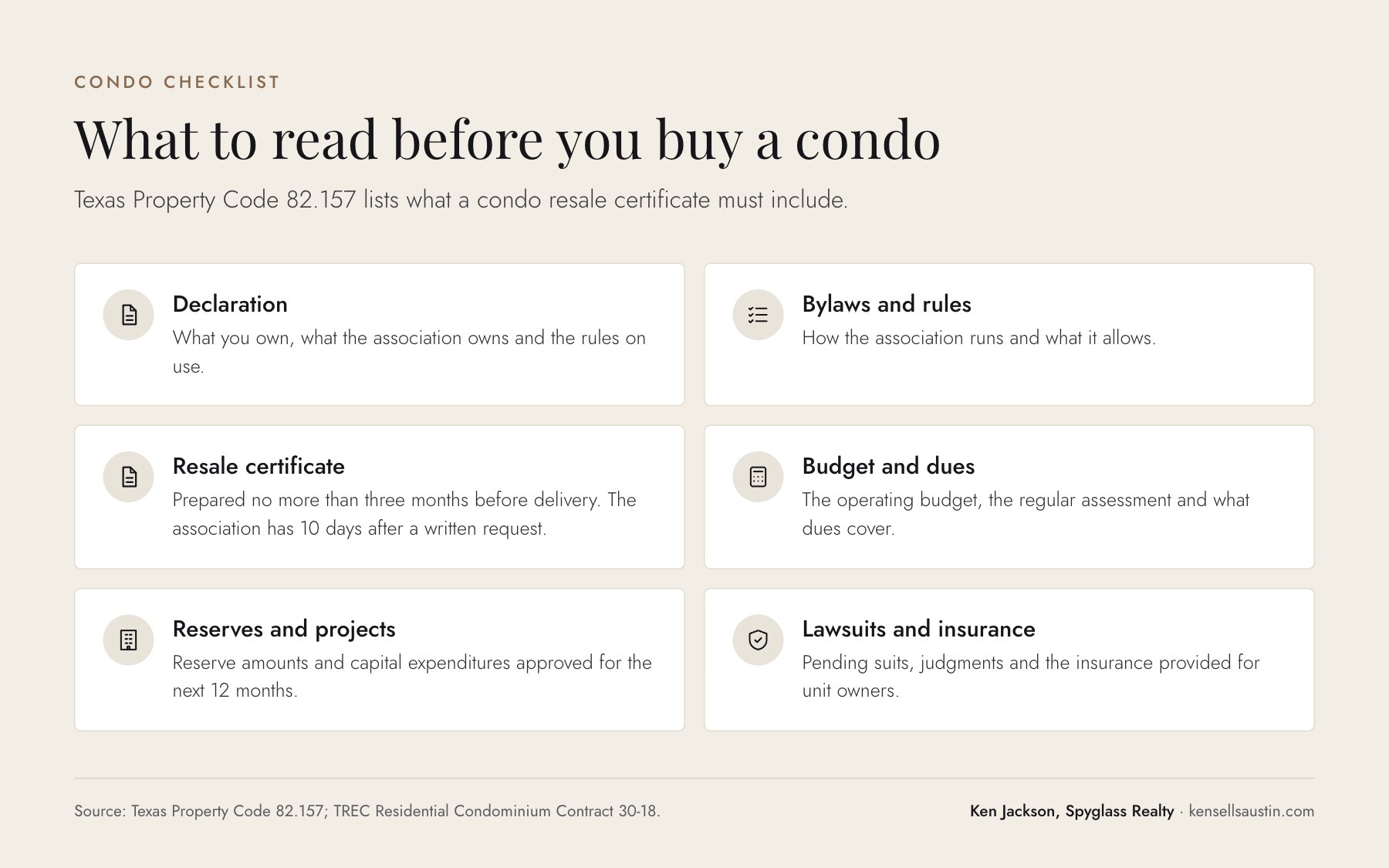
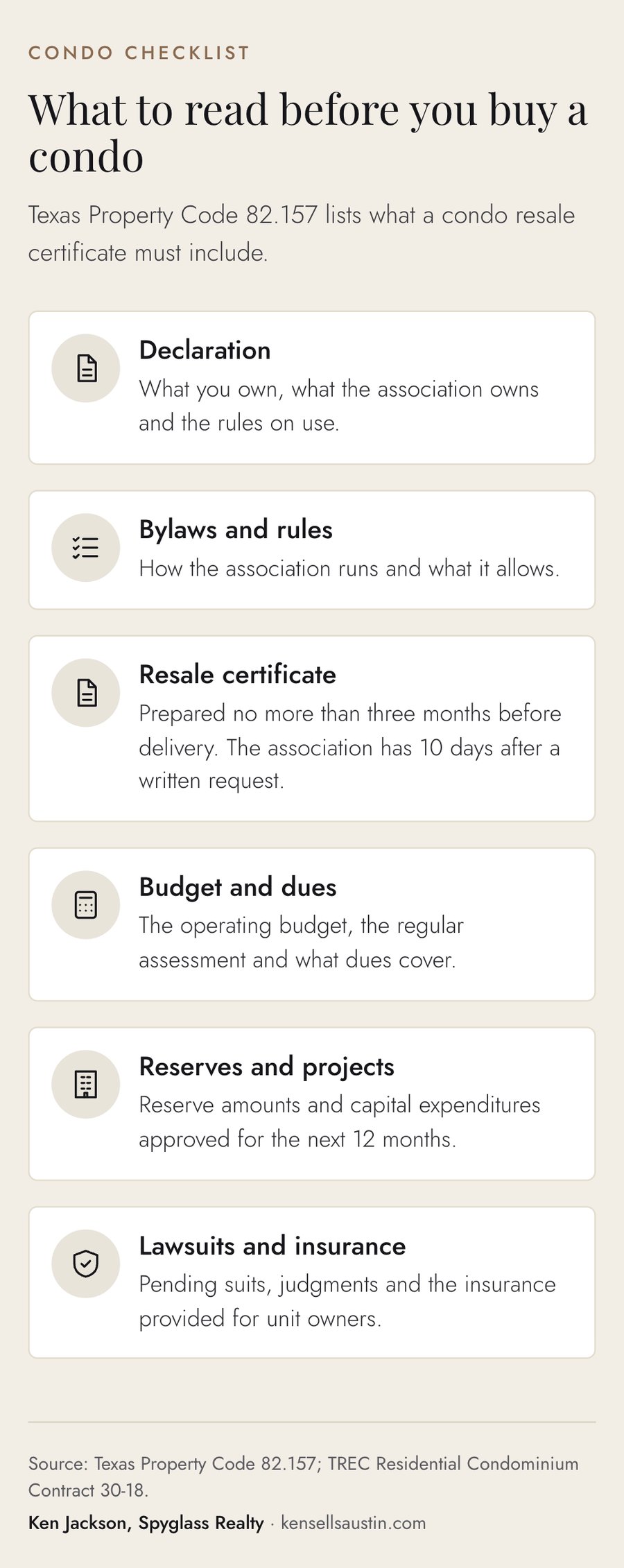
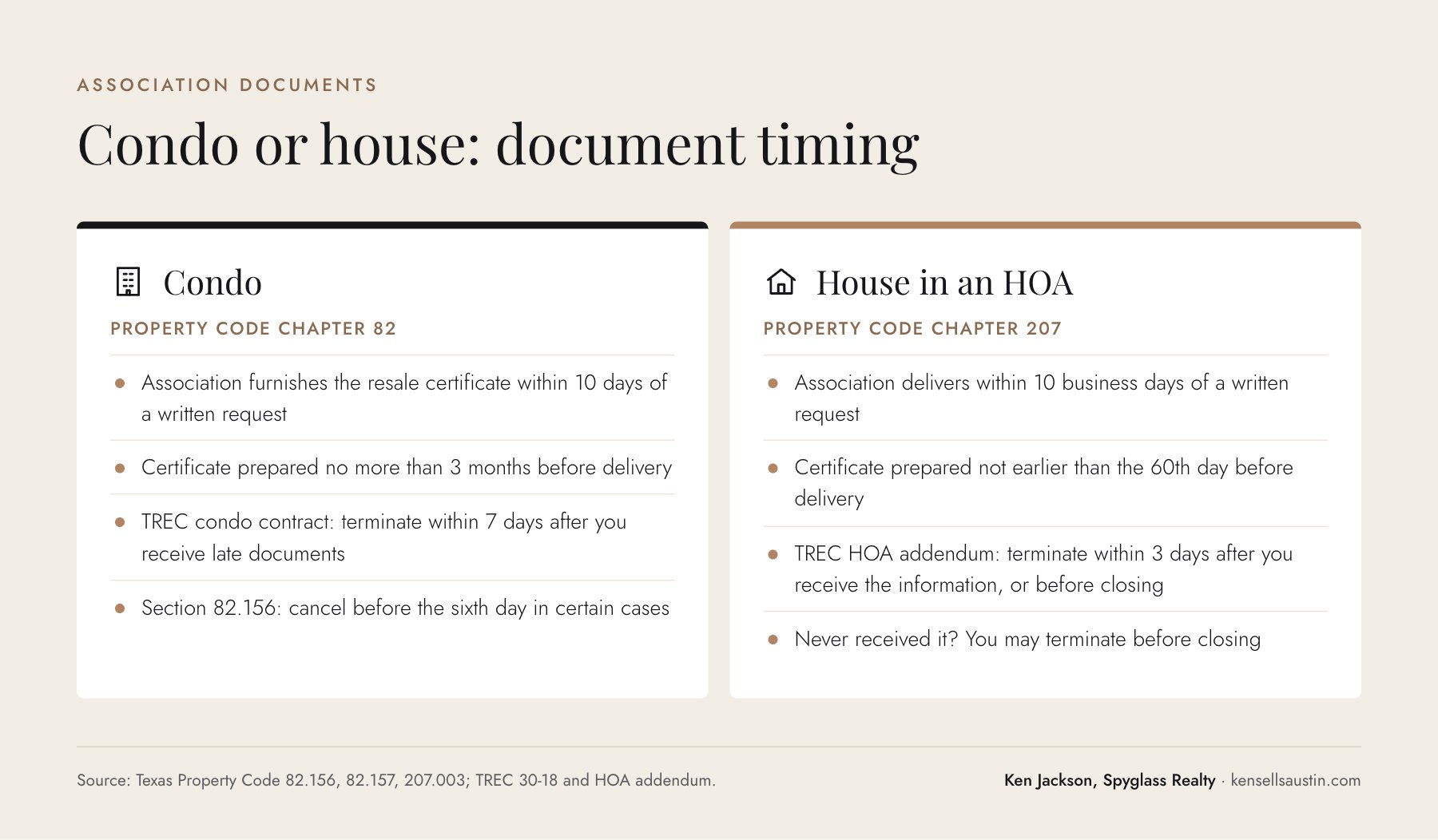
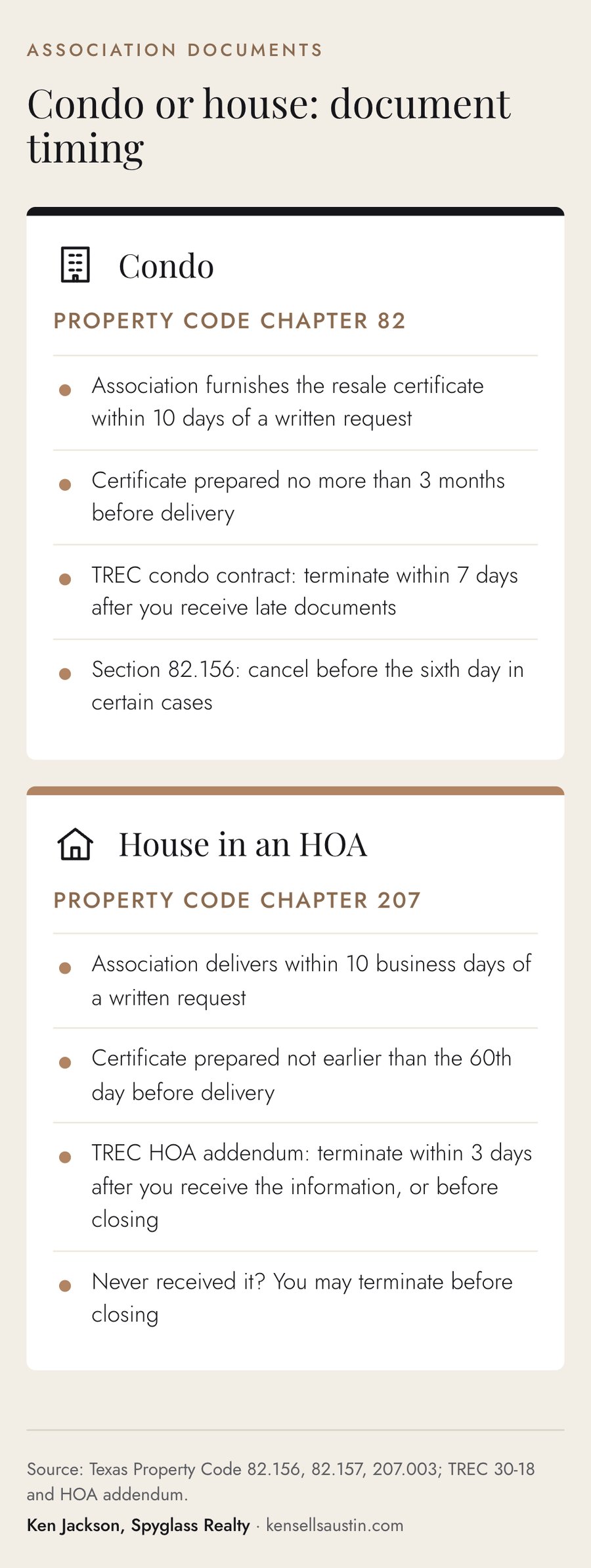
By law the association must furnish the resale certificate within 10 days after a written request from the unit owner. It must be prepared no earlier than three months before delivery to the buyer. If the association does not provide it in time, the seller can give you a sworn affidavit explaining the request and the missed deadline, and the seller and buyer may agree in writing to waive the certificate. The TREC condo contract has a box for this. If you have not received the declaration, bylaws and rules, the contract lets you terminate within 7 days after you receive them, with your earnest money refunded. Ask me which boxes are marked on your contract.
A special assessment is an extra charge beyond regular dues, often for a repair or capital project. In the TREC condo contract, a special assessment that is due and unpaid at closing is the seller's obligation. A special assessment approved for the future but not yet due is different, and it can fall on you, so read the certificate and ask the association in writing whether any are planned. A reserve is money set aside for big repairs, like roofs and elevators. A thin reserve with large repairs ahead raises the chance of a special assessment. Look at the reserve next to the budget and any reserve study.
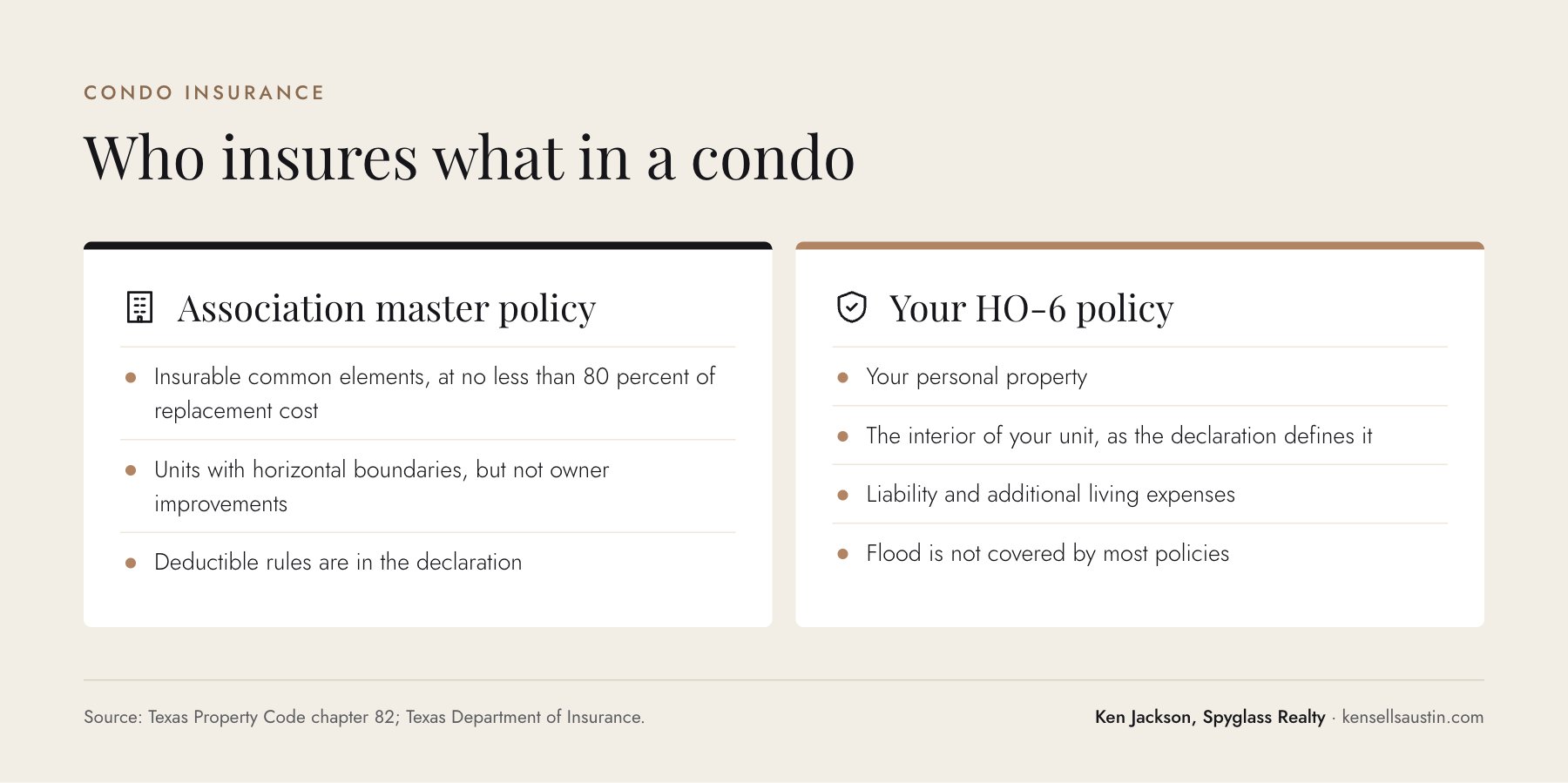
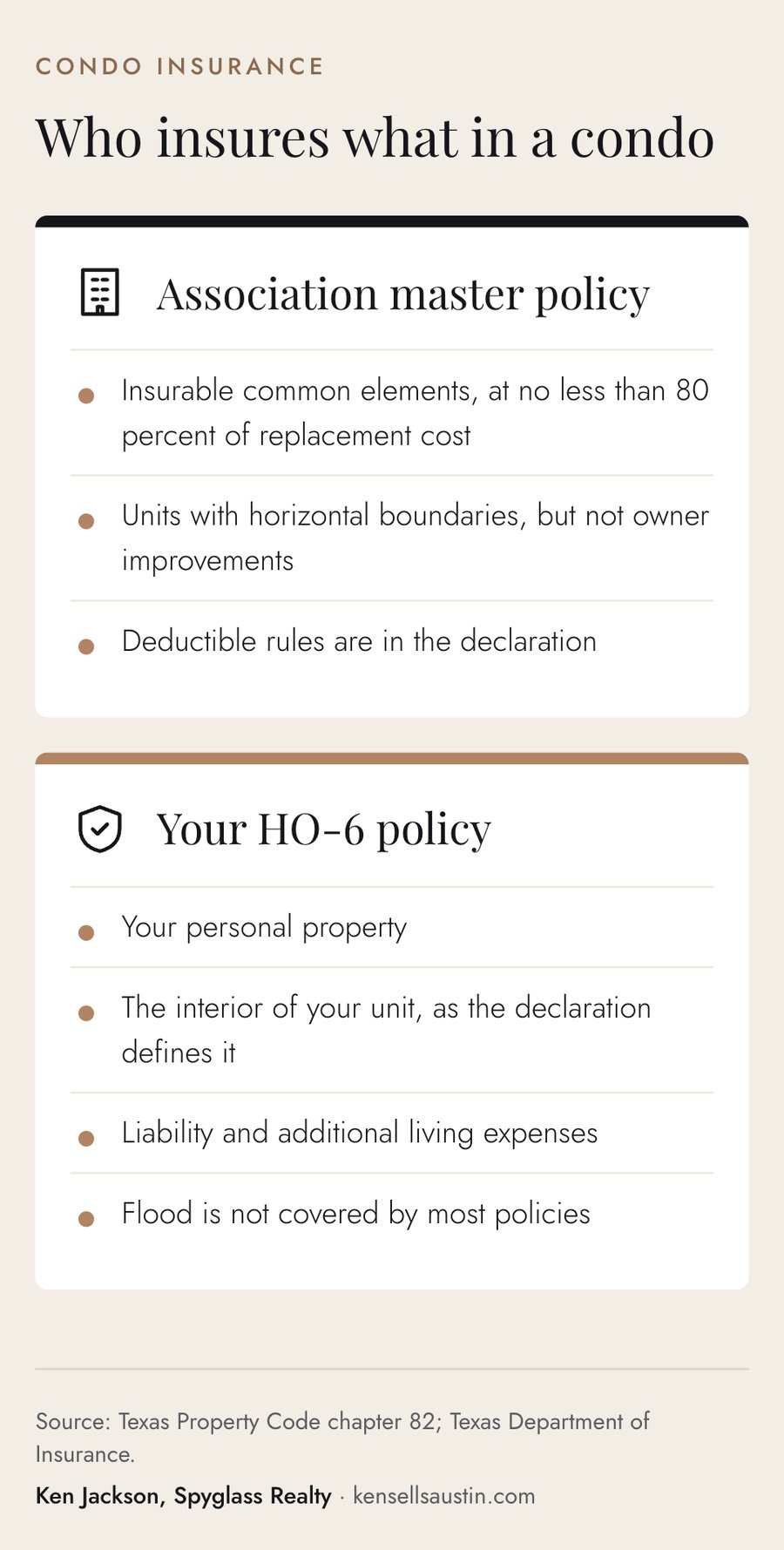
Texas law requires the association to carry property insurance on insurable common elements, to the extent reasonably available, at no less than 80 percent of replacement cost. Your own policy fills the gaps. A condominium owner's policy, often called HO-6, covers your personal property and the interior of your unit, with liability protection. What counts as your interior depends on the declaration. Most home policies do not cover flood, and a condo is not automatically covered either, so ask your insurance agent to compare your policy with the master policy and the deductible rules before closing.
The lender reviews the building as well as you. Conventional and FHA programs each have rules about the project, such as the budget, reserves, litigation, owner-occupancy and insurance. Rules change, so ask your lender early which program fits the building, and ask me to share the building's documents with the lender as soon as you are under contract. Delays at the association can slow a closing.
A condo inspection covers your unit, not the shared roof or foundation. That is why the association's records matter. Ask for them.
The condo contract says the buyer pays association transfer-related fees, deposits and reserves up to a dollar amount written in the contract, and the seller pays any excess. It does not apply to regular dues that are prorated. It covers transfer-related charges, not special assessments. The amount is negotiated.
They are fees the association charges when ownership changes. The resale certificate must list each fee, who it is paid to and the amount. Amounts differ by association, so read the certificate.
Check the declaration and rules before you buy. Some declarations limit how many units can be rented, and a lender may also look at how many units are rented. Short-term rentals add city rules. Ask the association in writing what rental rules apply.
The declaration and other association documents say. If they are silent, the board decides by resolution, and if the board does not, it is a common expense. If an owner or guest caused the damage, the association can assess the deductible against that owner. Ask what the deductible is today.
Condo owners are taxed on their unit, and a condo you live in can qualify for a homestead exemption like a house. You apply with the appraisal district. Ask me for the details for your county.
An association may foreclose in some cases for unpaid assessments, but not for fines alone. This is general information. Ask an attorney about your situation.
Neither is better in general. Compare dues, insurance, repair responsibility and financing for each home. I can build a side-by-side for the homes you like. See house or condo in Austin.
If you are looking at a condo, send me the listing and I will walk through the documents with you. Let's connect, or call (737) 307-4848. Related pages: Texas home buyer FAQ, Buyers Guide and closing costs in Texas.
Ken Jackson, REALTOR, TREC license 754679, Spyglass Realty (broker license 588051). General information only, not legal, tax or lending advice.
Last reviewed: October 13, 2026.
Questions about buying a condo in Texas? Talk to Ken.
Call (737) 307-4848 or send a message.

SPYGLASS REALTY 8501 N MOPAC EXPY STE 110 AUSTIN TX 78759
SPYGLASS REALTY 8501 N MOPAC EXPY STE 110 AUSTIN TX 78759