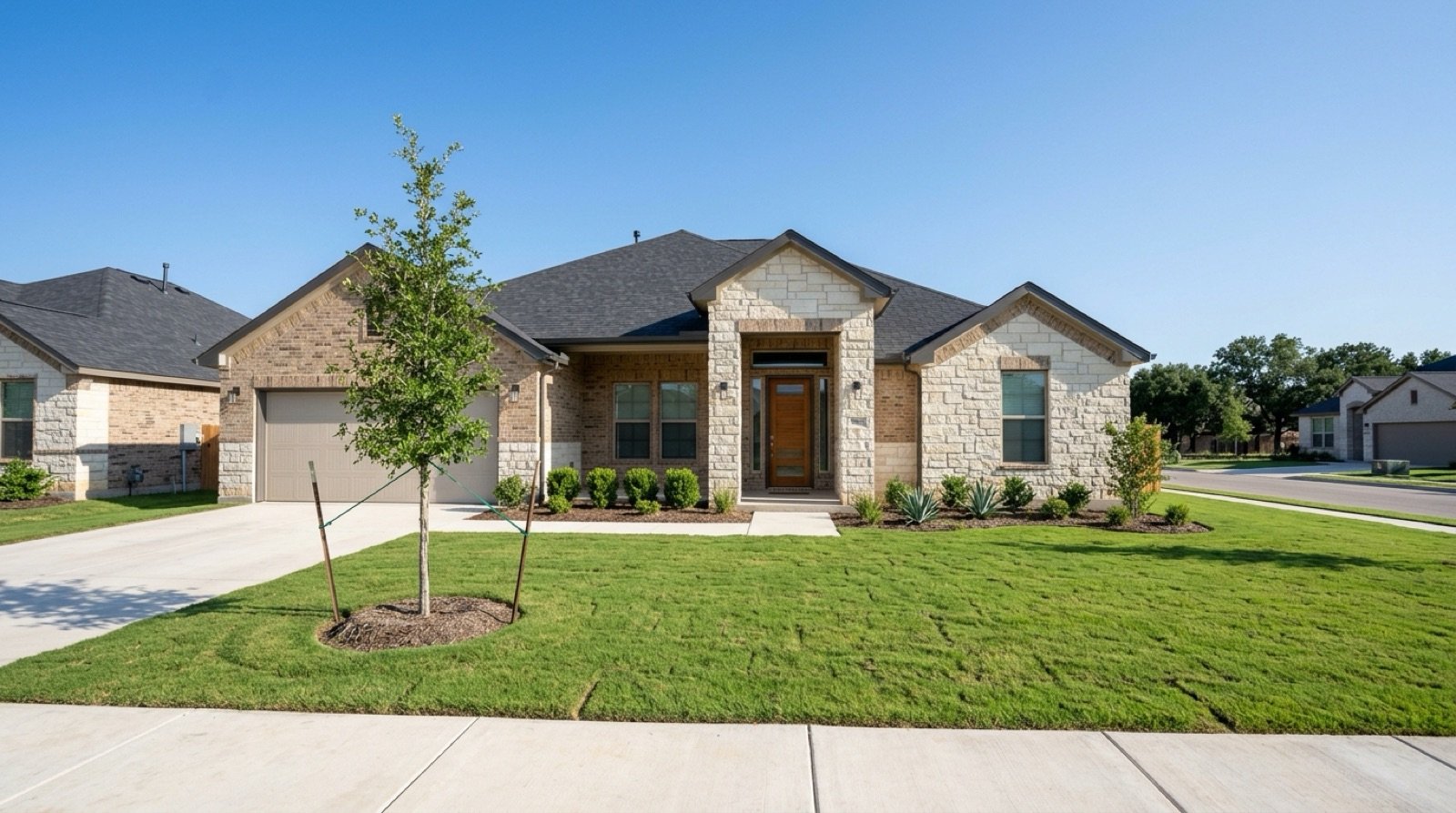
This part of the Texas home buyer FAQ covers property taxes and new construction: tax bills, homestead exemptions, MUDs and PIDs, and buying a new build in the Austin area. Rates and deadlines change every year, so check the current ones for your address.
49 questions, 9 topics
Pick a topic to go straight to its questions.
Topic 1 of 9 · 6 questions
No. The Texas Comptroller says Texas does not have a personal income tax. The state pays for services with other taxes, with sales tax as the main one, and local governments rely on property tax. That is why property tax matters so much to a Texas buyer. The Comptroller's own site says it does not collect property tax or set property tax rates. Local taxing units do that, so your bill depends on your address.
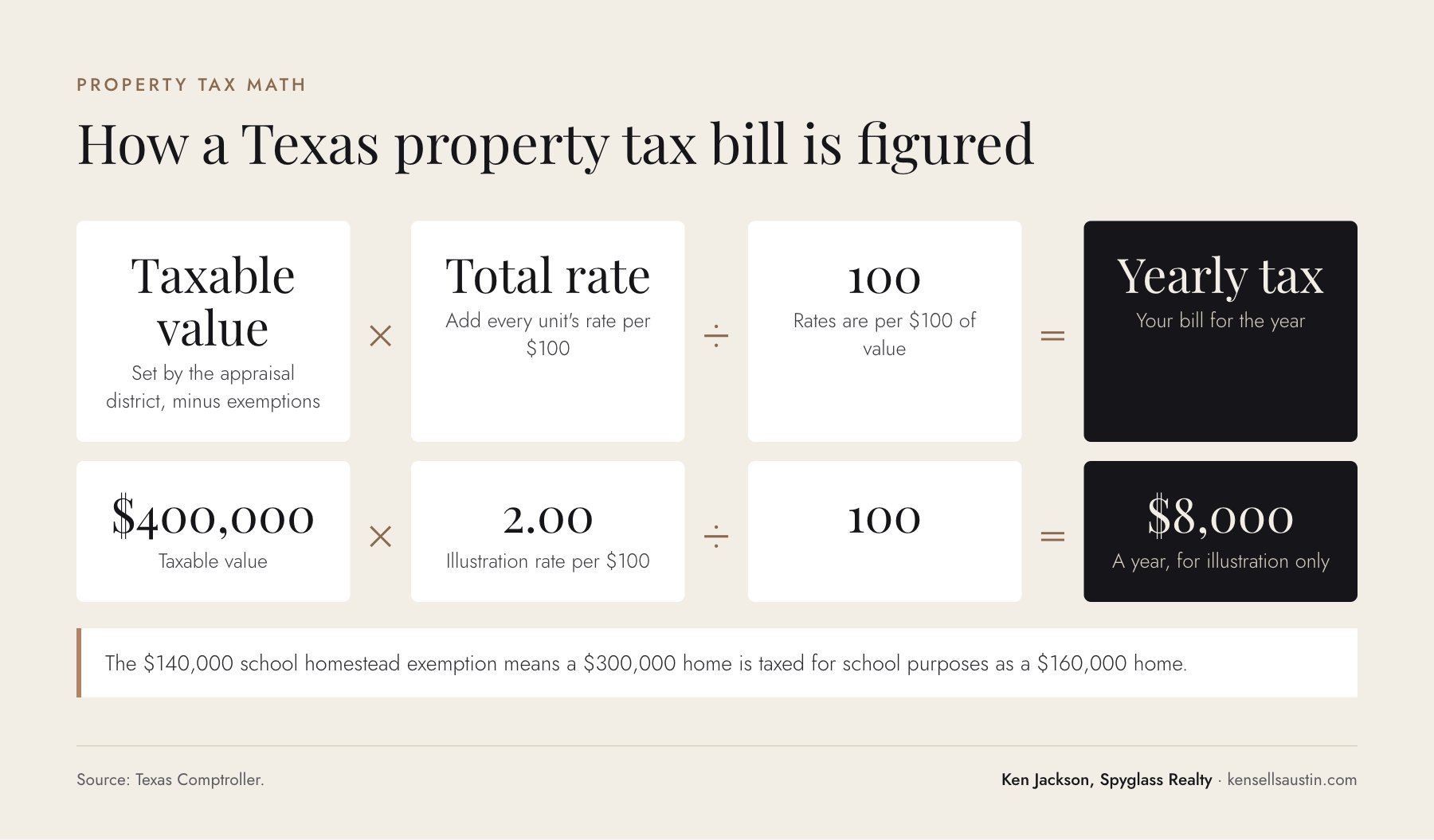
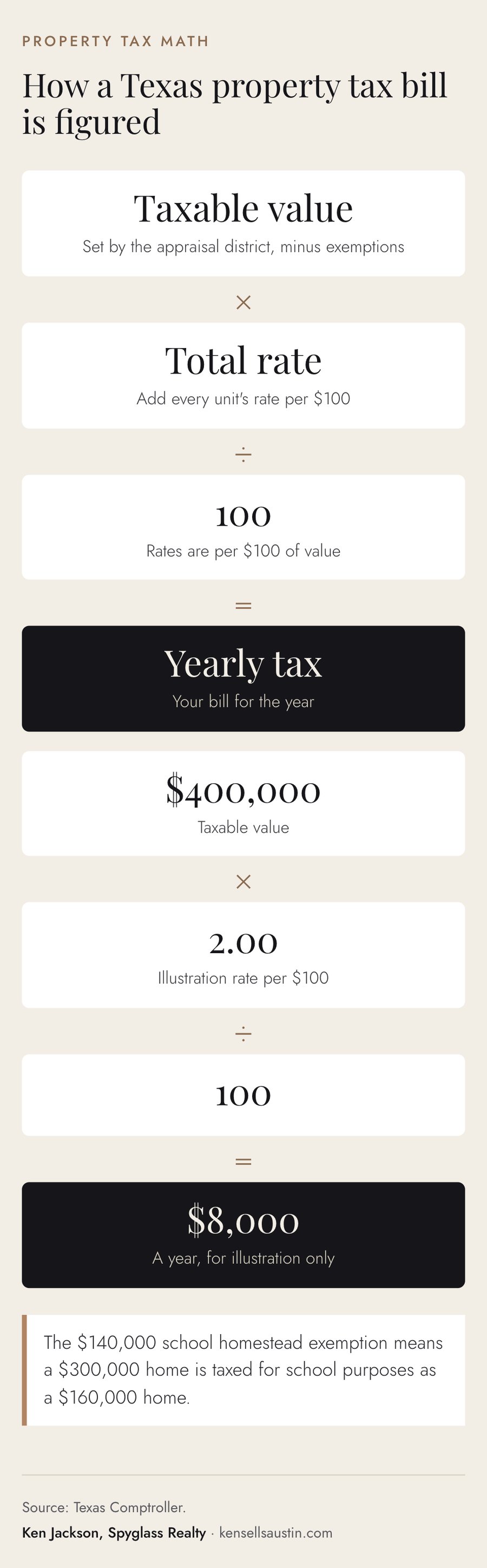
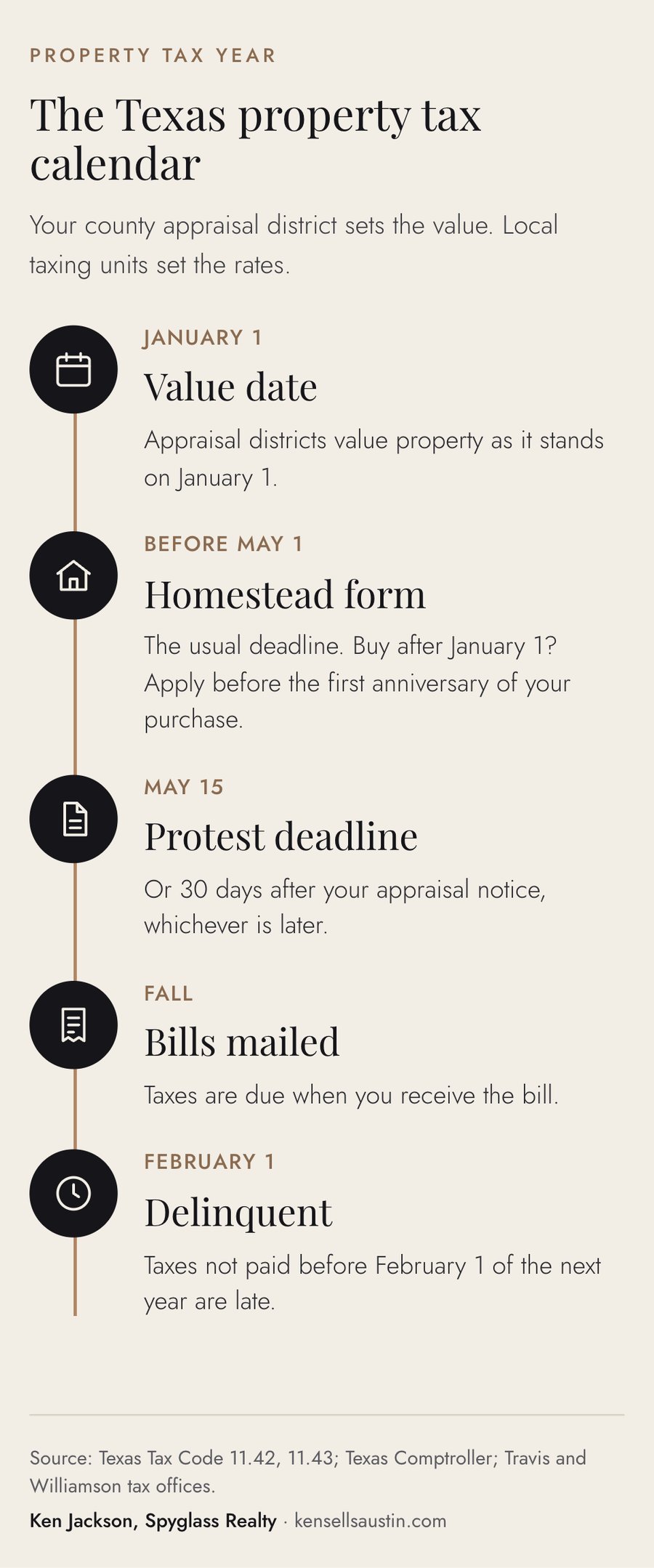
Your bill is the taxable value times each tax rate that applies, added together. The appraisal district sets the value, which is market value as of January 1. Exemptions such as the homestead exemption lower the taxable value. Each taxing unit, such as the school district, county and city, sets its own rate per $100 of value. Texas has no state property tax. For illustration only, a rate of 2.00 per $100 on $400,000 of taxable value is $8,000 a year.
Start with the county appraisal district's property search for the address, which lists the taxing units that apply, such as the school district, city, county and any MUD or emergency services district. Then find each unit's rate. Williamson County posts its rates and exemptions by jurisdiction on tax.wilcotx.gov. Hays County posts its table on its Tax Rate page. Travis County posts its tables in the tax office's Reports and Data area. The Comptroller also keeps a statewide list of rates by unit. Rates change every year, so check the current year.
Use the current rates for that address and a taxable value you expect, not the seller's old bill. The seller's bill may include a homestead exemption you will not have until you qualify, and the value is often lower than the sale price. Find the units that tax the address, add their rates, multiply by taxable value, and divide by 100. Any estimate is not a promise.
They can, and I cannot forecast it. The appraisal district reappraises property every year, with value set as of January 1, and each taxing unit sets its rate every year. For a home that is your homestead, Texas limits how much the appraised value can go up in a year, but that limit does not stop a rate change or a new assessment. In the year after you first qualify, the 10 percent limit begins. Ask me for the current rates at the address so you can plan a range.
On a home with a homestead exemption, the appraisal district may not raise the appraised value more than 10 percent a year, apart from the value of new improvements. The cap starts January 1 of the tax year after you first qualify for the homestead exemption. The district still tracks the market value, so the gap between market and capped value can grow. It limits value, not the tax rate. Ask the appraisal district how the cap applies after a sale.
Topic 2 of 9 · 5 questions
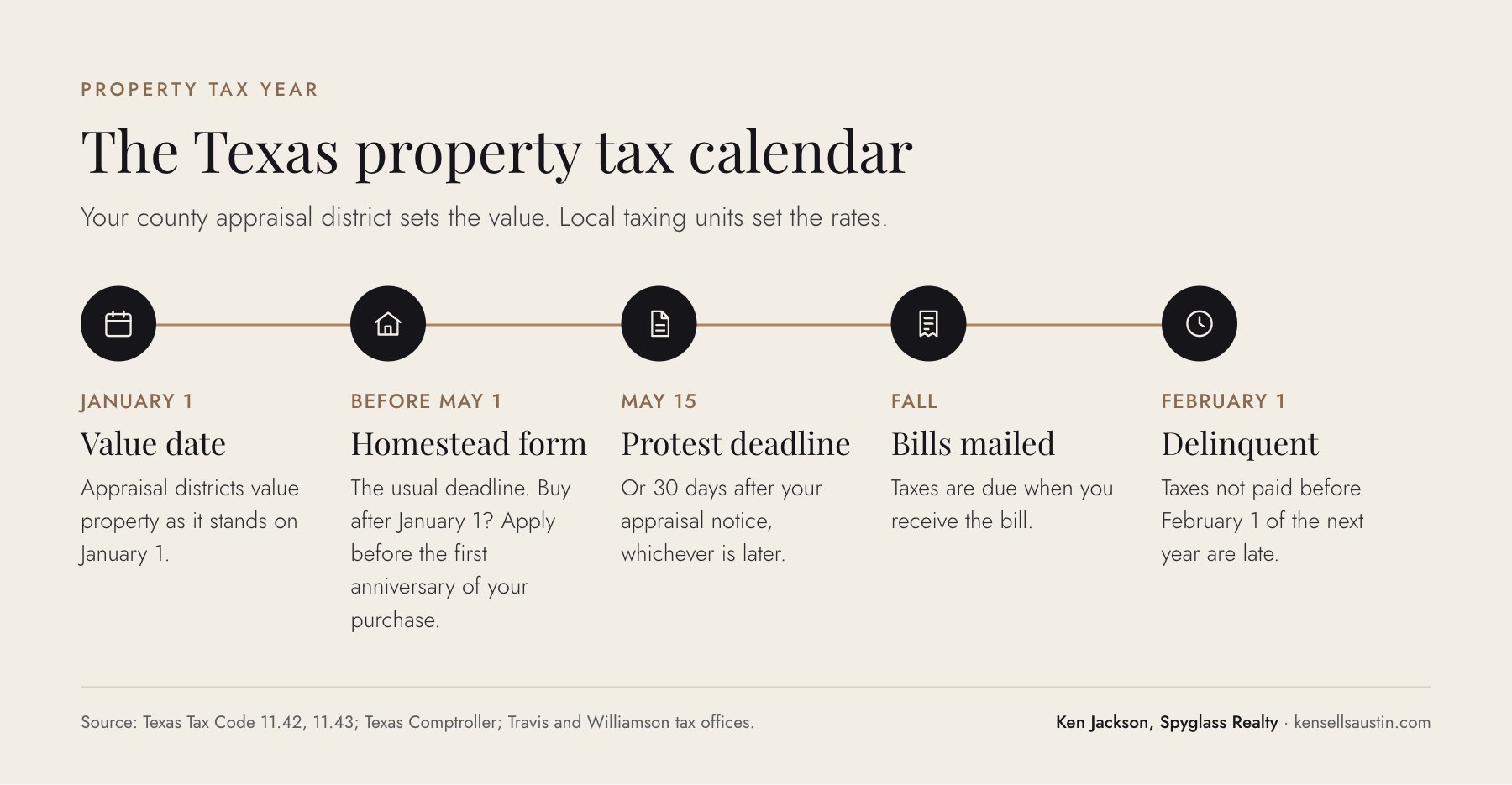
It lowers the taxable value of the home you own and live in as your main residence. The Comptroller lists a $140,000 school district exemption. Cities, counties and other units may add their own, up to 20 percent of value with a $5,000 minimum. You apply once with the county appraisal district, usually by April 30, and you generally do not need to reapply unless the district asks or you move. It is free. Each district has its own online form.
File as soon as you own and live in the home. The Tax Code lets a person who buys after January 1 get the school and local homestead exemption for the rest of that year, if the previous owner did not get the same exemption for that year. A buyer who acquires property after January 1 must apply before the first anniversary of the date they bought it. Otherwise the usual deadline is before May 1. Your 10 percent cap then begins on the January 1 after the year you first qualify.
$140,000
school district homestead exemption
May 15
protest deadline, or 30 days after your notice
65 or older
school tax ceiling for owners 65 or older or disabled
File a written protest with your county's appraisal review board. The deadline is May 15 or 30 days after the notice was delivered, whichever is later. You then can meet informally with the appraisal district, go to an appraisal review board hearing, and appeal if you disagree with the order. Bring evidence, such as comparable sales, photos, repair estimates and your sale price documents. The Comptroller says saying the district is wrong is not enough, you must prove your case with evidence. Check your notice for the date that applies to you.
A Texas homeowner who is 65 or older, or disabled as the law defines it, can get a school tax ceiling. A school district cannot raise the total tax on that homestead above the amount in the first year you qualified, unless you add improvements. Counties, cities and junior colleges may also adopt ceilings, but only if they choose to. It is not automatic, so you apply with the appraisal district.
Yes, condo owners can claim a homestead. The Travis County tax office says a homestead can be a house, condominium or mobile home on 20 acres or less used as a residence, and the same ownership and residence test applies. Apply with the appraisal district for your county. Your HOA dues are separate from the tax bill, and some associations also have special assessments, so read the HOA documents and the budget.
Topic 3 of 9 · 5 questions
Taxes are due when you receive the bill and are delinquent if not paid before February 1 of the following year. The tax offices say the last day to pay without penalty is January 31, and Travis County moves that to the next Monday when January 31 is a weekend. Counties mail bills in the fall.
The seller and you share that year's tax at closing. The resale contract prorates current-year taxes through the closing date, and if the real bill comes out different, the parties adjust once the tax statements are available. If taxes are not paid at or before closing, the buyer is responsible for paying the current-year tax. If you have an escrow account, your lender pays the bill from it. Because bills arrive in the fall, a closing earlier in the year is prorated on an estimate.
It is the split of the current year's tax between seller and buyer, through the closing date. The Texas resale contract says taxes for the current year, interest, rents and regular periodic maintenance fees and dues are prorated through the closing date, and that the tax proration may take into account any change in exemptions. If the actual bill later differs from what was prorated, the parties adjust. Your title company calculates the number, and it appears on the Closing Disclosure.
January 31
The last day to pay without penalty. Travis County moves it to the next Monday when January 31 is a weekend.
If your loan has an escrow account, yes. The CFPB says an escrow account is set up by your lender to pay property taxes and homeowners insurance, funded by part of your monthly payment. The payment can change when taxes or insurance change. Federal rules cap the cushion at one-sixth of estimated annual disbursements, which is two months of payments. The servicer must send an annual escrow statement within 30 days of the end of the computation year. Ask your lender whether your loan requires escrow.
Rollback or additional taxes can be charged when land that had a special appraisal, such as agricultural use, changes use. The resale contract has a rollback paragraph on who pays Assessments caused by the seller's use or change in use before closing. For vacant land, Property Code 5.010 requires a notice in the contract when the land has a special appraisal that the next owner may not qualify for. This matters for acreage and large lots, less for a typical subdivision lot.
Related guides
What it costs to buy Closing costs in Texas Closing day Back to topics
Topic 4 of 9 · 8 questions
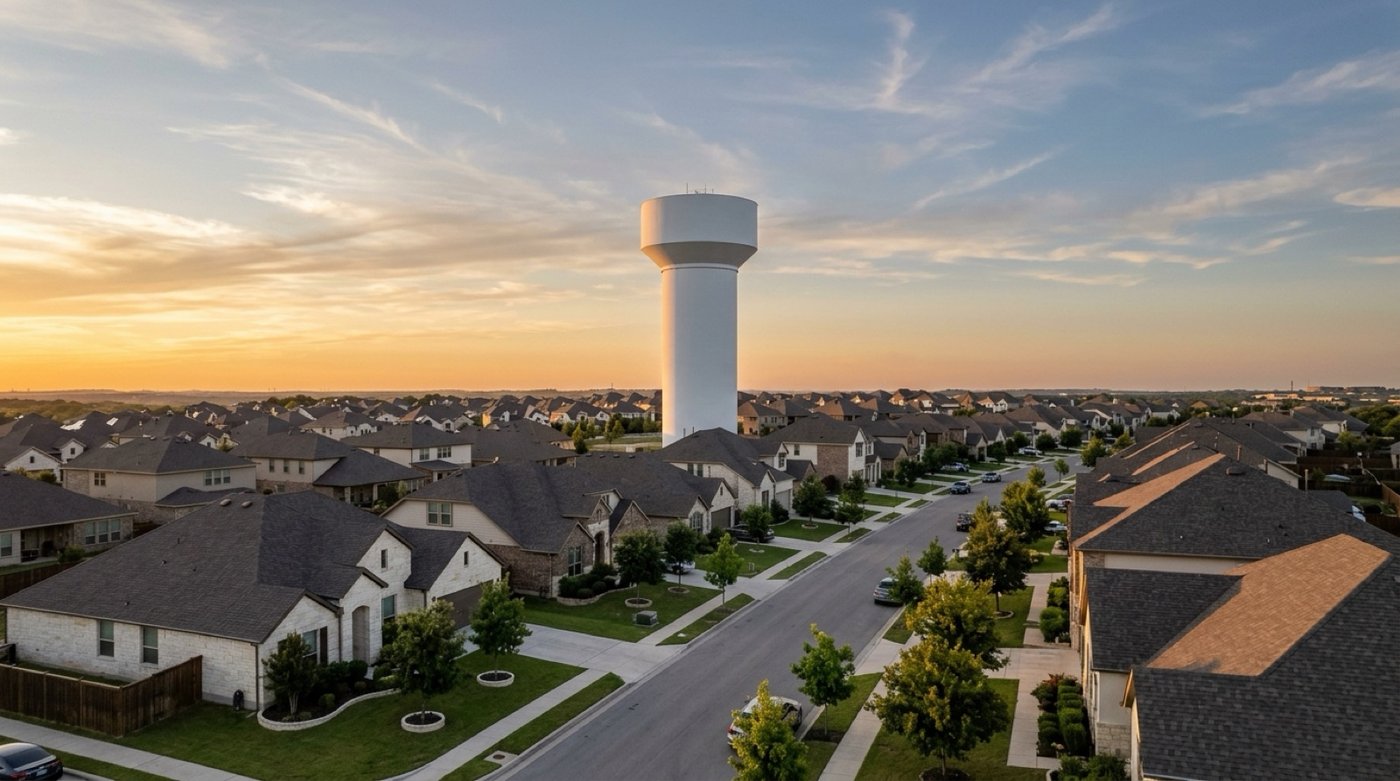
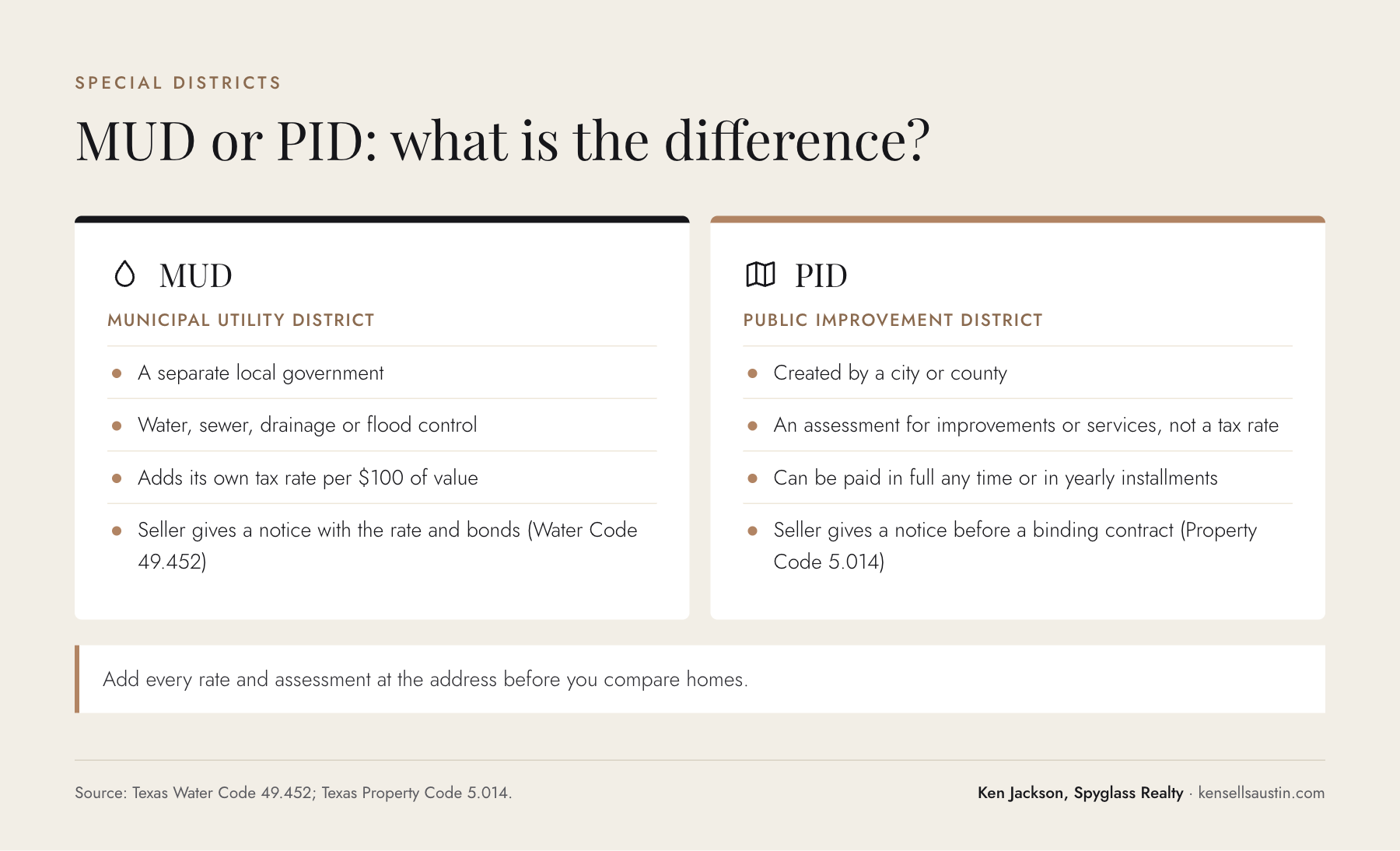
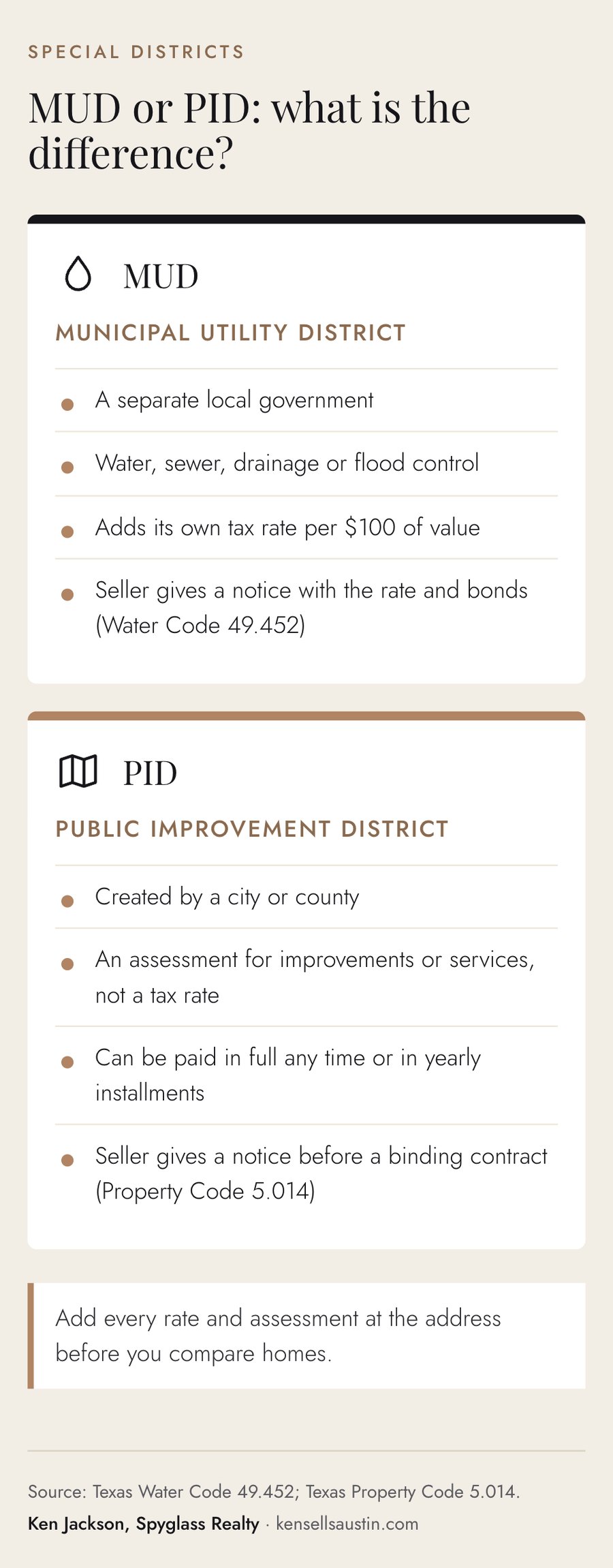
A MUD is a municipal utility district. It is a special district that provides water, sewer, drainage or flood control services, and it can be financed with bonds paid from district taxes. If your home is in one, the district's tax rate is added to the other rates on your bill, so your total is higher than a home outside it with the same other rates. Texas law requires the seller to give you a written notice with the district's rate and bond amounts. Read that notice before you sign.
Check four places. First, the seller's statutory notice, which must be given before you sign. Second, the TCEQ Water Districts Map Viewer, where you can search an address that includes the city or ZIP code. Third, the appraisal district's property search, which lists taxing units for the address. Fourth, the tax bill. Your title company can also confirm. For the rate, bond debt and build-out of the district, call the district or the tax office.
Texas Water Code 49.452 requires the seller to give you a notice with a bold title: Notice to Purchaser of Special Taxing or Assessment District. It names the district and states its current tax rate per $100 of value, or a projected rate if no tax has started. It gives the bond amounts voters approved and the amounts already issued, split into water, sewer and drainage, roads, parks and other. It also says whether there are assessments or a standby fee and whether the district sits in a city's extraterritorial jurisdiction. Read the rate and bond lines first.
I will not give you a blanket answer. A MUD tax is added on top of the other rates that apply to the home, and the notice says the district may issue bonds and impose an unlimited rate to pay them. What matters is the total at your address. Add the school district, county, any city, any emergency services district, and the MUD. Compare that total, and the purchase price, with the alternatives. Ask for the district's current rate and its outstanding bonds, not last year's number.
Read the notice
The MUD notice states the current rate per $100 of value and the bond amounts voters approved and already issued.
A PID is a public improvement district. A city or county creates it, and it levies an assessment on each property to pay for improvements or services. In Williamson County, the annual PID assessment is on the property tax bill that the county tax office collects. A MUD is a special district with its own tax rate, set under the Water Code. A PID assessment is a charge set in a service and assessment plan. The state notice says it may be paid in full at any time.
Look at the seller's PID notice, which Property Code 5.014 requires before a binding contract, and at the PID line on the tax bill. Williamson County lists its PIDs on its tax office page and links to each one's notice, and says the city that created a PID handles payoff questions. A city's Service and Assessment Plan lists the assessment on each parcel. Leander says assessments can be paid in full at any time. Ask the city for a written payoff and the remaining term.
Ask Ken
Want this checked for a specific home? Call (737) 307-4848 or send Ken a message.
Property Code 5.014 requires the seller to give you a written notice before the effective date of a binding contract. It says you are obligated to pay assessments for the cost of improvements or services. It says an assessment has been levied on the property, may be paid in full at any time, and otherwise is due in annual installments that vary with interest and costs. It names the city or county that can tell you the exact amount, and warns that unpaid amounts can bring penalties, interest and a lien. Read it, and ask for the amount.
It depends on the address, so compare the total rate at each one. A bill is the sum of the school district, county, city, special districts and any MUD or PID that apply, times the taxable value. Two homes in the same city can be in different school districts or districts with different rates. I will not make a sweeping claim. Ask me and I will pull the current rates for the specific addresses you are comparing, with the year and the tax office page.
Topic 5 of 9 · 7 questions
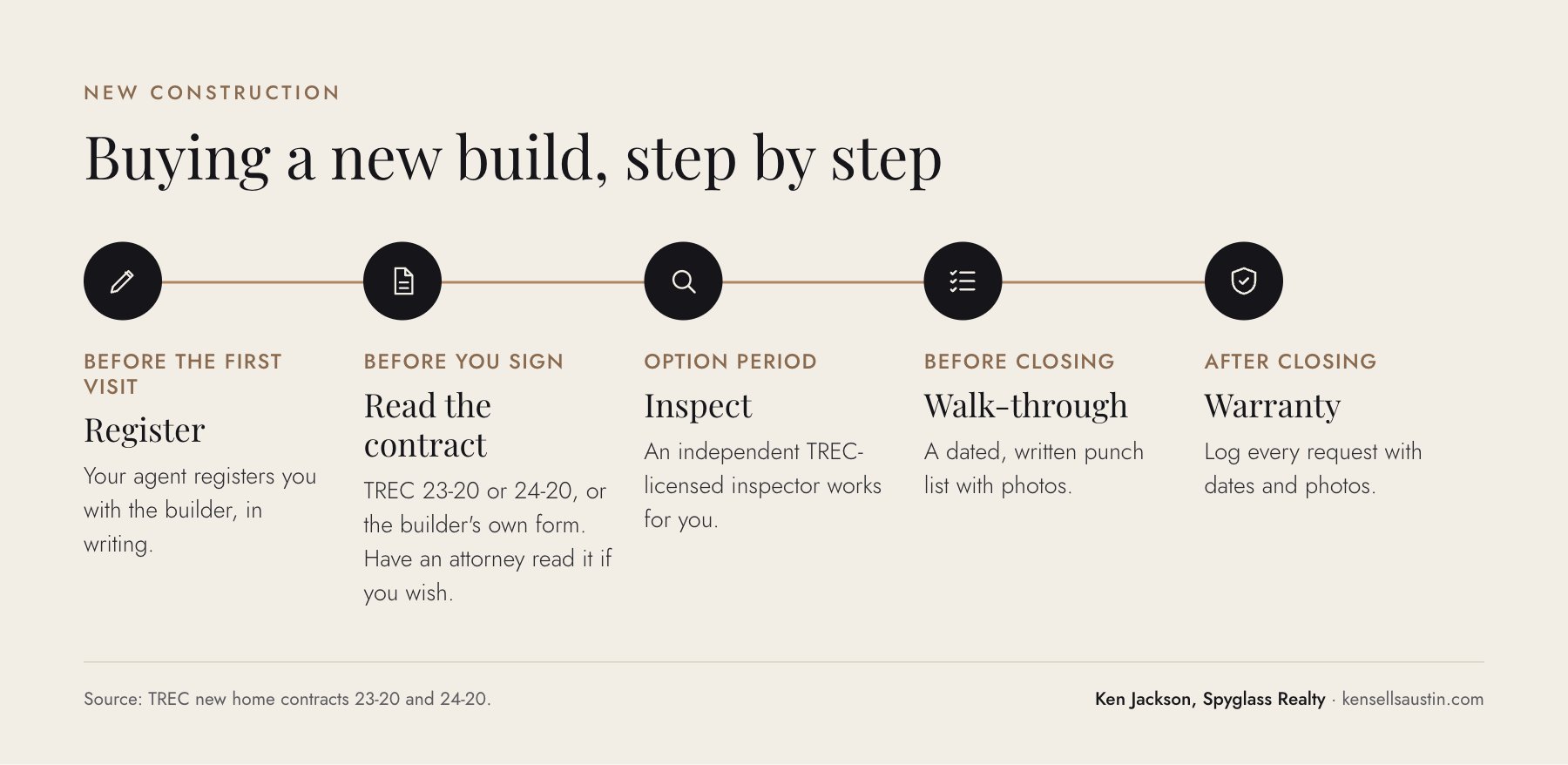
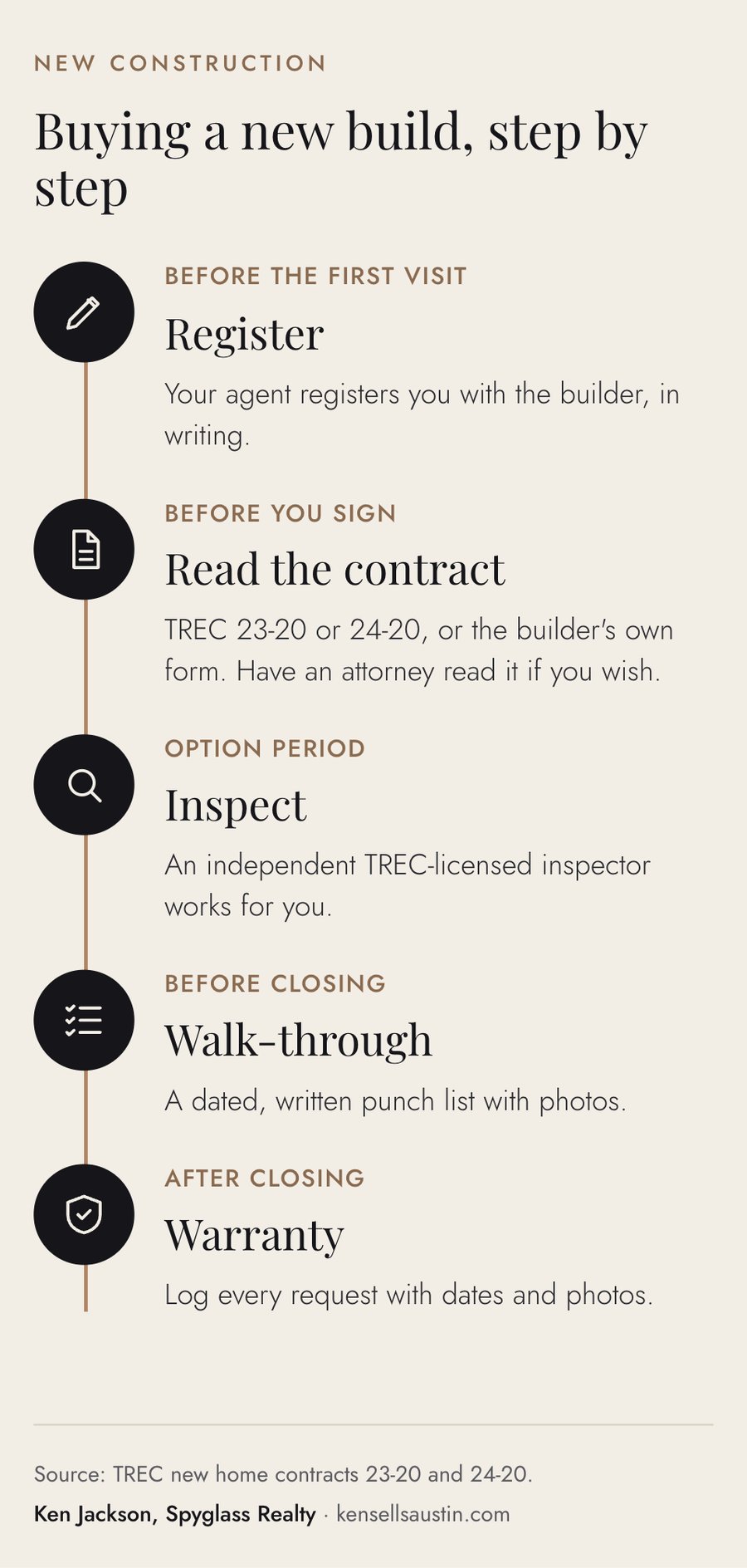
Before your first visit, and in writing. Each builder sets its own registration rules, and some tie the buyer's agent's role or pay to when you were registered. I cannot tell you a builder's rule without asking the builder, so I ask in writing before you tour. If you already visited alone, tell me which builder and when, and write down the date. Texas also requires a written agreement with your agent before an agent shows you a home, and it must be signed before we tour.
Not by default, and not always. The brokerage notice says an agent's fee is not set by law and is fully negotiable. Who pays is decided by the written agreement with your agent and by what the builder offers. The TREC new home contract says brokerage compensation is negotiable, and each party pays their own broker under their separate agreements unless the contract says otherwise. Ask what a builder pays and in what form before you sign anything, and I will show you my agreement with you in plain terms.
TREC publishes two new home contracts, one for incomplete construction (23-20) and one for completed construction (24-20). Whether a given builder uses a TREC form or its own contract varies, and I cannot say what a builder will hand you. If it is the builder's own form, read it as closely as a TREC form and compare the same items: deposit, option, closing date, warranty, selections and remedies. Have your agent and, if you wish, an attorney read it before you sign. Do not sign it at the sales desk.
TREC's incomplete construction form is for a home that the builder has not finished building. It ties the builder to plans, specifications, finish schedules and a completion date. The completed construction form is for a home that is already built. Both forms say they are not for use in condominium transactions. Which one you need depends on the stage of the house at the time you sign.
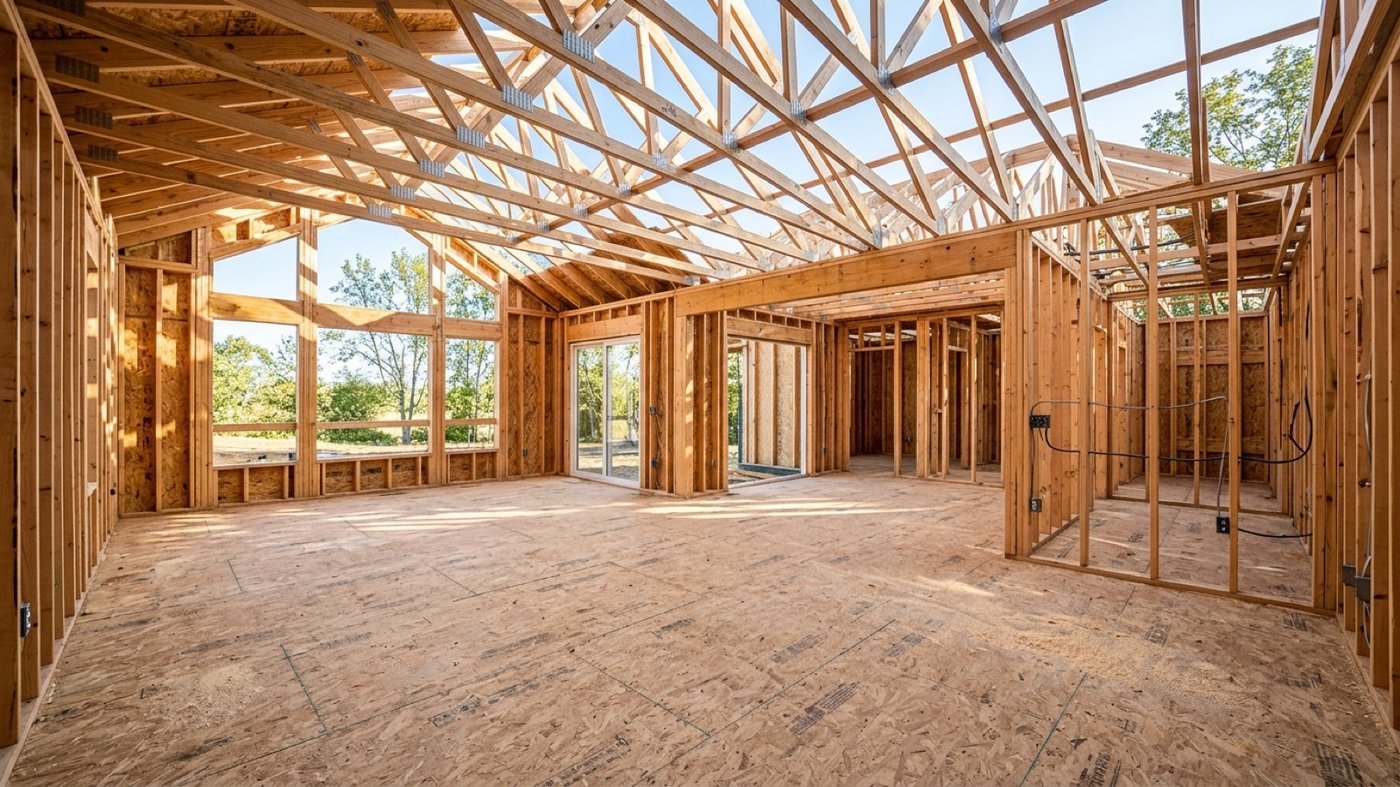
The incomplete construction contract has blanks for a start date and a date the home will be substantially complete and ready for occupancy. Substantial completion means the final inspection and approval by governmental authorities and any lender. Delays from acts of God, fire or other casualty, strikes or unavailable materials can add time, but substantial completion cannot go beyond the Closing Date. So the closing date you write is the outer limit. Ask what happens if the house is not ready then.
Two TREC forms
TREC 23-20 is for incomplete construction and 24-20 is for completed construction. Neither is for condos.
The contract states a date to close on or before, and a new build adds a wrinkle, because the house must be substantially complete first. The TREC form says delays are added to the time allowed for completion, but completion can never run past the Closing Date. If the date is going to move, both sides need to agree in writing, and your lender may need to adjust the loan timing. Ask your lender how a later closing affects your rate lock and approval before the date is at risk.
No. Both TREC new home contracts say they are not for use in condominium transactions. A new condo needs a different contract, and the builder or developer may supply its own. Read it with extra care, because a condo purchase also has the declaration, the budget, the reserve study, the association's rules and any assessments to review. The TREC condo resale contract gives you a useful comparison list.
Related guides
Leander buyer guide Buyer agreements Buyers guide Back to topics
Topic 6 of 9 · 3 questions
The TREC incomplete construction form lets the seller substitute materials, equipment and appliances of comparable quality for those in the construction documents. The documents are the plans, specifications, finish schedules, change orders and allowances that you and the builder sign. Change orders must be in writing. If you care about a specific brand, color or finish, put it in the construction documents by name instead of leaving it to a model or a sales sheet.
An allowance is a dollar amount set aside for an item you choose, such as flooring or lighting. A change order is a written change to the plans or selections. Under the TREC form, change orders must be in writing. If your choices cost more than the allowance, you pay the extra as the contract states. If a change or unused allowance costs less, the price decreases, adjusted as the lender requires. Ask for a running total of selections, not a verbal tally.
Not unless it is in the contract. The TREC form says the builder completes the home in line with the construction documents, which are the plans, specifications, finish schedules, change orders and allowances you sign. A model may have upgrades, furniture, landscaping and finishes that are not in your price. Walk the model with a list, and mark each item as included, an upgrade with a price, or not offered. Get the list attached to the contract.
Related guides
Hutto buyer guide Georgetown buyer guide House or condo Back to topics
Topic 7 of 9 · 5 questions
It depends on the builder's written warranty, so read it before you sign. The TREC new home contract says the seller makes no express warranties except those in the contract, in a separate writing or provided by law, and assigns assignable manufacturer warranties to you at closing. Ask the builder for the warranty document and what it covers, how long each part lasts, how to submit a request, and who services it. Keep a log of every request with dates and photos.
The TREC new home contract says it is subject to Texas Property Code Chapter 27. If you have a construction defect that has not been fixed as required by law or contract, you must send the contractor written notice by certified mail, return receipt requested, at least 60 days before you file suit or start arbitration. The notice must refer to Chapter 27 and describe the defect in reasonable detail. The chapter also covers a later purchaser who files a claim against a contractor. This is legal procedure, so talk to an attorney about a real defect.
Chapter 27 notice
For a construction defect, written notice by certified mail at least 60 days before you file suit or start arbitration.
I recommend one. The TREC new home contract lets you have the property inspected by inspectors you choose who are licensed by TREC. A new house is not automatically free of problems, and an independent inspector works for you, not the builder. Ask the builder what stage and what access they allow, and whether the option period fits that schedule. Ask the inspector to use the standard TREC report. A builder's own punch list is a different document from an inspection.
That is the builder's call, because it is a construction site. Many builders limit access for safety and scheduling, so ask what they allow, with whom and at what stage, before you sign. Whatever they allow, put it in writing. The TREC form gives you the right to inspect through a TREC-licensed inspector, but the stage and the access are practical matters to sort out with the builder.
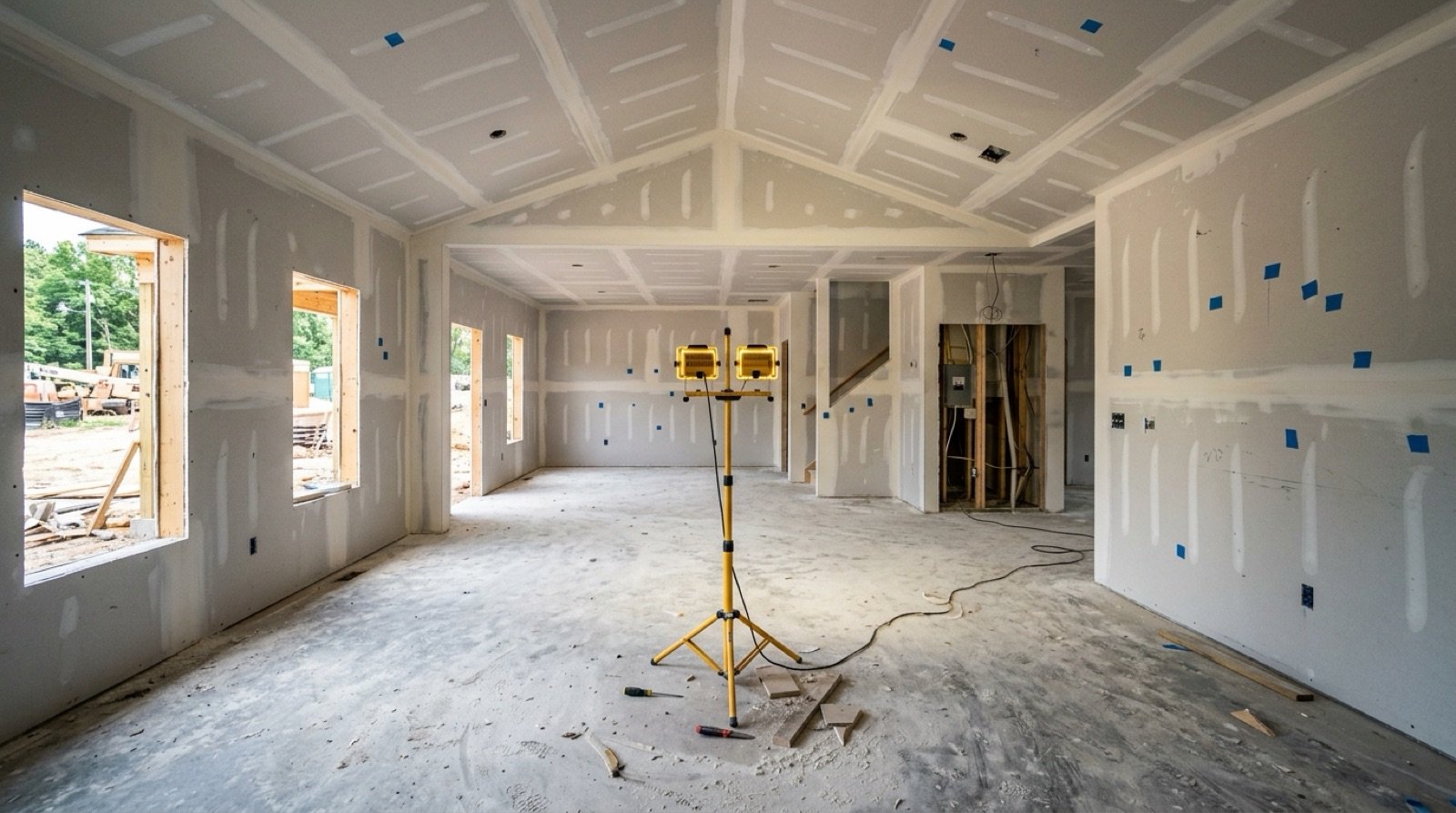
The walk-through is your last look at the finished house before you close. A punch list is the written list of items that need fixing, such as paint, trim, fixtures or a door that rubs. Bring your inspector's report and your selections list. Date and photograph every item, get the builder's written promise to fix each, and ask for the list to be finished before closing or tracked afterward with a due date. Do not rely on a verbal promise.
Topic 8 of 9 · 5 questions
Compare them in dollars over the time you will keep the loan. A lower price can lower your payment for the life of the loan, your taxes and your equity. An incentive such as closing cost help or a rate buydown has a one-time cost to the builder and a specific benefit to you. Ask the lender to run both versions on a Loan Estimate, and ask for the incentive terms in writing, including any lender requirement. The CFPB advises comparing costs over several possible timeframes.
A buydown lowers your interest rate or payment for a time, in exchange for an up-front payment. The CFPB describes a temporary buydown as a lower payment for a limited time, usually one to three years, with payments rising each year until it ends. A builder or seller can pay for it. Get the step-up schedule in writing, including the rate and payment after the buydown ends, and ask whether it is written into the note. Compare the cost with and without it.
Compare in dollars
Ask the lender to run a lower price and the incentive on a Loan Estimate, over the time you expect to keep the loan.
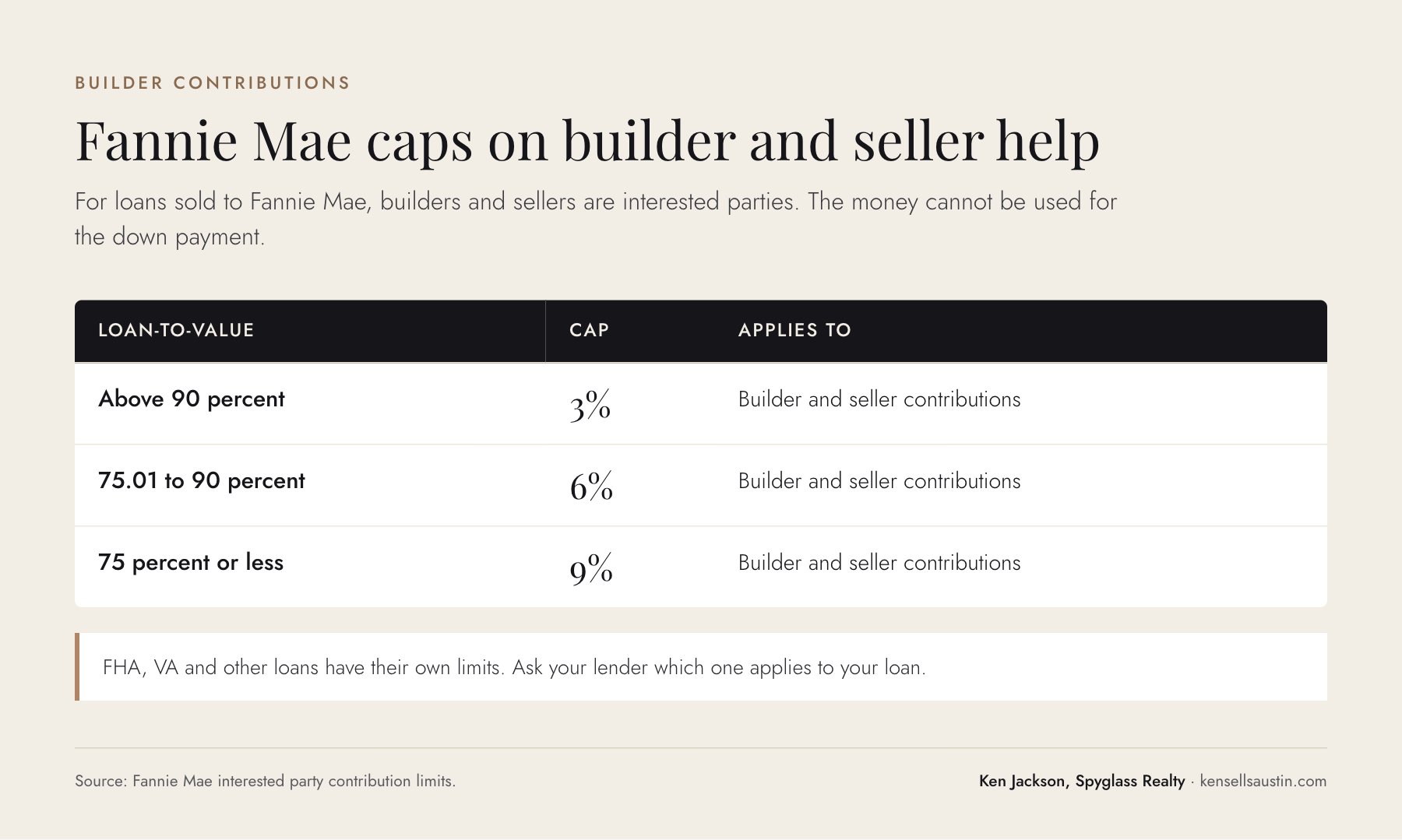
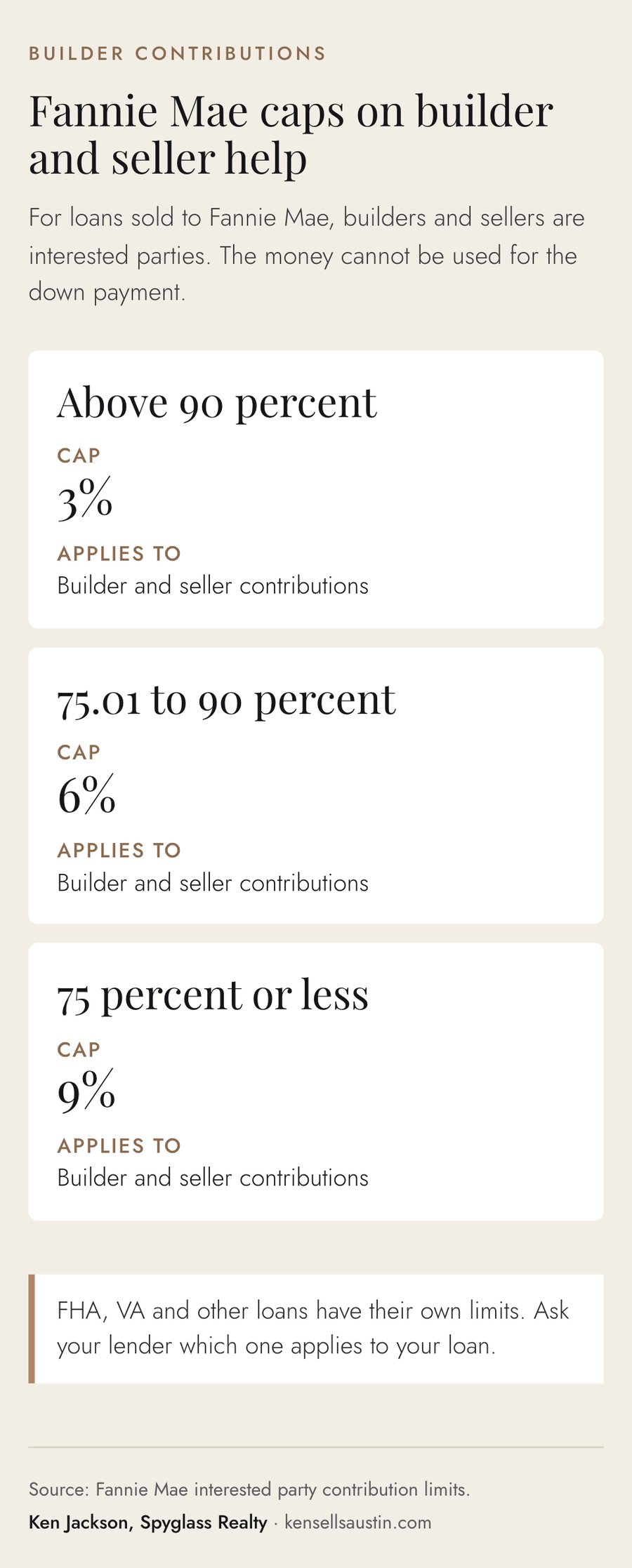
The cap depends on your loan. For loans sold to Fannie Mae, builders and sellers are treated as interested parties, and the cap on their contributions is 3 percent for a loan above 90 percent of value, 6 percent from 75.01 to 90 percent, and 9 percent at 75 percent or less. The money cannot be used for the down payment. FHA, VA and other loans have their own limits. Ask your lender which limit applies to your loan before you plan on a number.
You are free to choose your lender. A builder may offer an incentive if you use its preferred lender, and the terms are in the offer. Ask for that in writing, and ask the builder's lender and at least one other lender for a Loan Estimate with the same loan type and the same points or credits. The CFPB says to compare offers with the same amount of points or credits from each lender. Choose on total cost and service, not on the incentive alone.
Sometimes, and it varies by builder, plan and stage. Ask for the price, the incentives and the closing cost help separately and in writing, and compare them against each other. A standing home usually has more room than one with a long list of selections not yet made. I will point out the lines in the contract to take to an attorney, and I will compare the offer with recent sales.
Related guides
Lending and costs FAQ Pre-approval Closing costs in Texas Back to topics
Topic 9 of 9 · 5 questions
It can add a district tax or a yearly assessment, and the total is what matters. Some new communities have a MUD, a PID, or both. Texas law requires the seller to give you a MUD notice with the district's rate, or a projected rate if the district has not yet imposed taxes, plus its bond amounts. For a PID, the seller must give you a written notice before a binding contract. Add every rate and assessment at the address before you decide.
It may be, and then it can rise. Appraisal districts value property as it stands on January 1. If your home was not finished on that date, the bill for that year may be based on the lot or partial value, and a later year includes the finished home. Prorating taxes at closing uses the current bill, and the contract allows adjusting when the real bill arrives. So plan for a higher bill than the first one. Ask the appraisal district what value it has on the property and when it will update.
First-year bill
If the home was not finished on January 1, the first bill may be based on the lot or a partial value. Plan for a higher bill later.
As soon as you own and live in the home. The Tax Code lets a person who acquires property after January 1 get the homestead exemption for the rest of that year if the previous owner did not get it, and requires you to apply before the first anniversary of the date you acquired it. Otherwise the filing window is before May 1. Your 10 percent appraised-value cap begins on January 1 of the year after you first qualify. File with the county appraisal district.
The TREC new home contract has a blank where the parties choose whether the seller or buyer pays for the owner's title policy. Check the box before you sign and compare it with the builder's offer. On the survey, the contract says it must be made after the substantial completion date by a registered land surveyor acceptable to the title company and your lender, and the contract has blanks for who provides it. Whoever pays, ask the title company for a written estimate before you agree.
Survey timing
On a new home, the survey must be made after the substantial completion date by a registered land surveyor acceptable to the title company and your lender.
The TREC new home contract includes the same kind of termination option as a resale: you pay an option fee and have a number of days that you and the builder agree on. If you give notice in time, the earnest money is refunded and the builder keeps the option fee, which is credited to the price at closing if you buy. The days and the fee are blanks in the contract. A builder using its own contract may do this differently, so read it. Put your inspection inside that window.
Related guides
MUD and PID explained Homestead exemption Title and survey Back to topics
Keep reading
Each page has short, sourced answers on one part of buying a home in Texas.
General information, not legal, tax or lending advice. Your contract, your lender and your title company control the details. Questions about your own situation? Call Ken Jackson at (737) 307-4848 or send a message.
Last reviewed: October 13, 2026.
Still have questions? Ask Ken.
Call (737) 307-4848 or send a message.

SPYGLASS REALTY 8501 N MOPAC EXPY STE 110 AUSTIN TX 78759
SPYGLASS REALTY 8501 N MOPAC EXPY STE 110 AUSTIN TX 78759