Fit by lot size
Which zoning districts allow the largest lots in four north Austin cities, and the septic, well, flood and ETJ rules that change once you go past a half acre.
Space to spread out
Short answer
Larger lots sit mostly at the edges of the north Austin cities and just outside them. Inside city limits, zoning sets the floor: Round Rock's SF-R district requires 2 acres, Georgetown's RE district 1 acre, Leander's SFR district 1 acre and Pflugerville's SF-E district a half acre. On septic, Williamson County requires 2 acres if the lot uses a private well.
Sources: city zoning codes and the Williamson County OSSF order, linked below. Checked October 14, 2026.
Area guides note the same pattern: Leander has homes on larger lots toward the edges of the city, and Georgetown and Hutto have acreage outside their cores. A bigger lot usually means more to check before you buy, so this page lists those checks with the official place to look each one up.
Zoning
Each city's zoning code sets a minimum lot size for each residential district. The table shows the district with the largest minimum lot in four cities, next to a common single-family district for comparison. Existing lots can be older than the current code, and a planned development can set its own rules, so check the plat for any specific property.
City | Largest-lot districts | For comparison | Code |
|---|---|---|---|
AG Agriculture: 2 acres | RS Residential Single-Family: 5,500 sq ft | ||
AG Agricultural: 10 acres | SF-2 Standard Lot: 6,500 sq ft | ||
SFR Single-Family Rural: 1 acre | SFU Single-Family Urban: 7,200 sq ft | ||
A Agriculture/Conservation: 3 acres | SF-S Single Family Suburban: 9,000 sq ft |
Sources: Georgetown Unified Development Code Sec. 6.02; Round Rock Code of Ordinances Part III Sec. 2-26; Leander Code Ch. 14, Exhibit A, Art. III; Pflugerville Unified Development Code Table 4.2.4 A. Cedar Park and Hutto zoning tables could not be opened when this page was checked, so they are not listed. Checked October 14, 2026.
SFR district lots of one acre or more. Homes on larger lots toward the edges of the city.
RE district minimum of one acre. Acreage and ranch properties outside the core.
Acreage and rural homesites sit on the edges of the city. Check zoning and septic rules by lot.
Septic
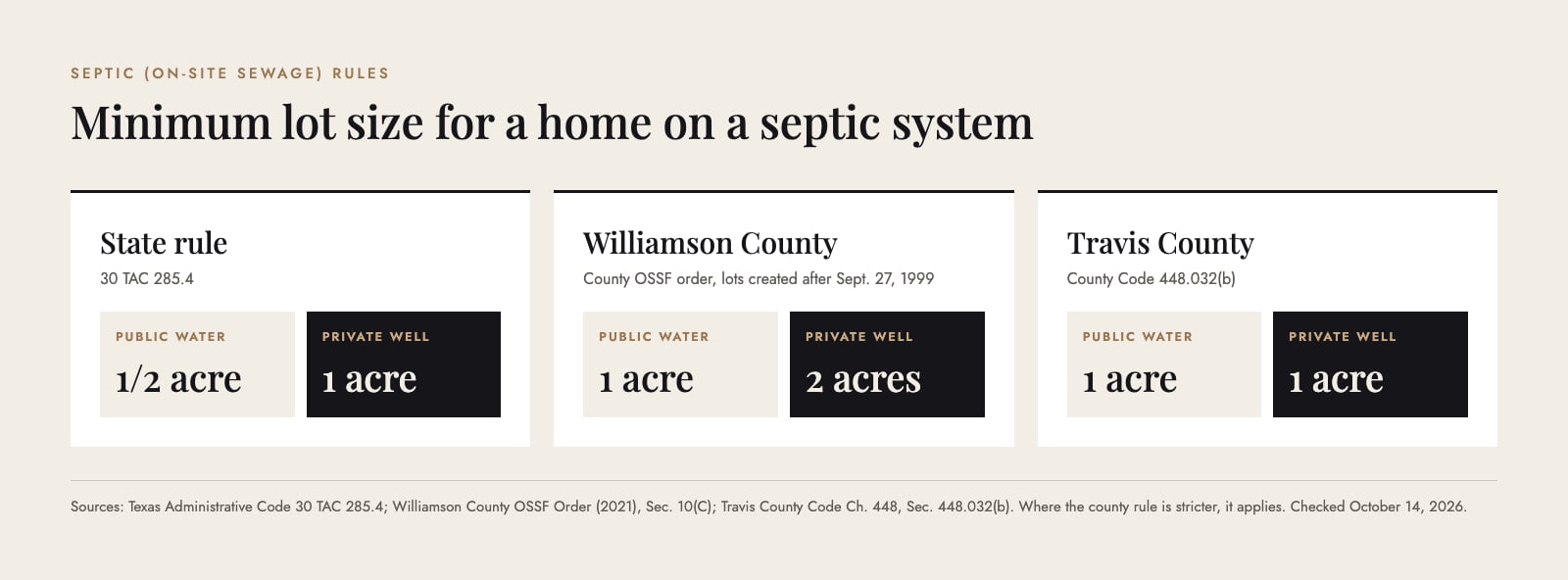
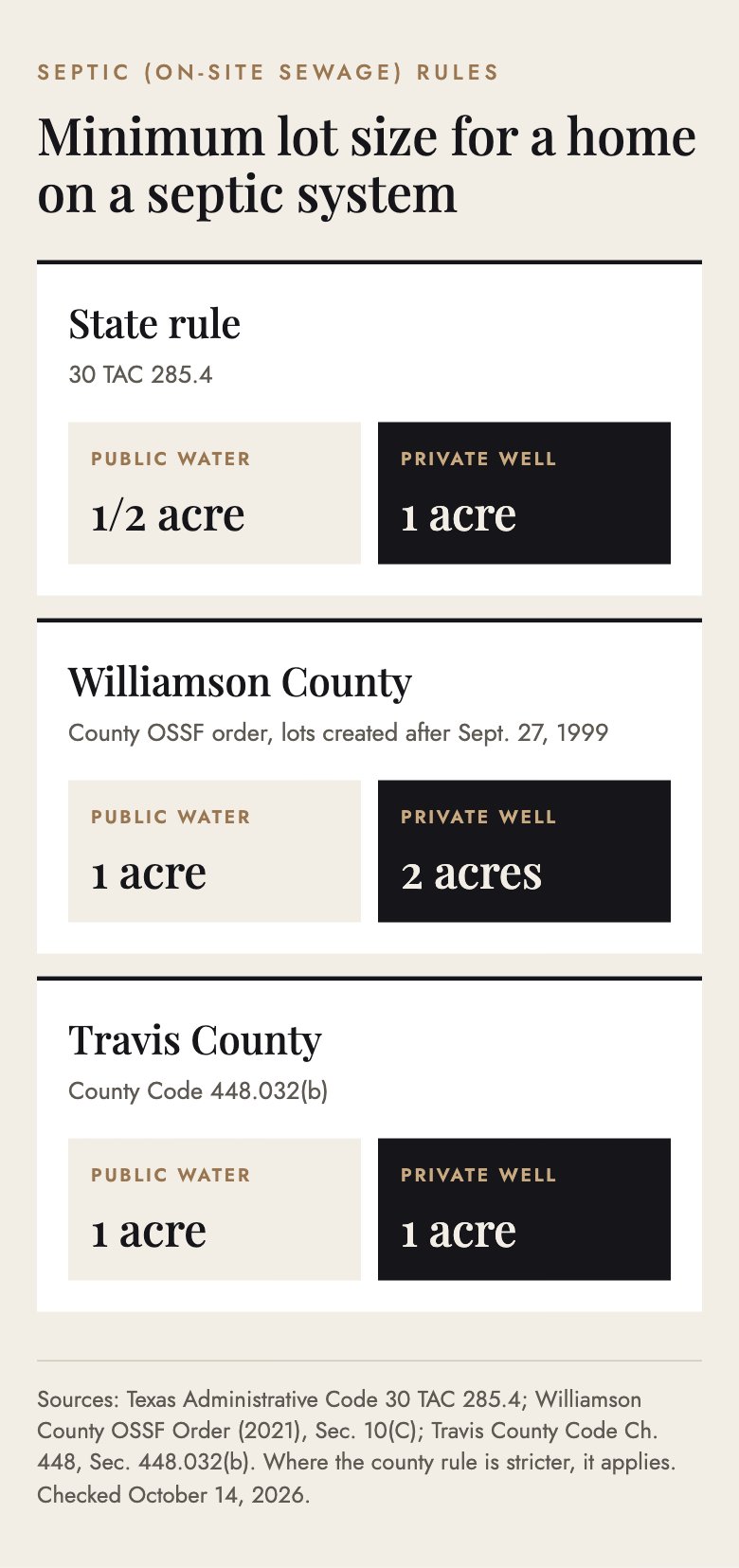
Many larger lots are not on city sewer. Texas sets a minimum lot size for a home on an on-site sewage facility (OSSF), and Williamson and Travis counties set stricter rules of their own. The county permits the system, and the permit file shows what was approved for that lot.
Who permits it | Where to look |
|---|---|
State of Texas (TCEQ) | |
Williamson County Engineer | Williamson County OSSF (permits outside City of Austin areas) |
Travis County TNR |
Sources: 30 TAC 285.4; Travis County Code Ch. 448; Williamson County OSSF Order adopted January 2021. Checked October 14, 2026.
Private wells
A private well is the owner's to maintain and test. Texas requires a license to drill a water well and to install a well pump, issued by the Texas Department of Licensing and Regulation. Well reports filed by drillers can be looked up in the Texas Water Development Board's drillers report database, which can show the depth and the date a well was drilled.
In parts of Travis County, a groundwater conservation district also has rules for wells. Ask the seller for any well report, water test and service records during the option period.
Sources: TDLR water well drillers and pump installers; TWDB Submitted Drillers Reports database. Checked October 14, 2026.
Outside city limits
Land just outside a city's limits is often in its extraterritorial jurisdiction, or ETJ. Texas law describes the ETJ as the unincorporated area next to a city's boundaries. Since September 2023, owners of a majority in value of an area in an ETJ can petition the city for release. A city and the county cannot both regulate subdivisions there, so which one applies depends on their agreement. Ask the city and the county which rules govern the lot.
Flood risk is checked by address on the FEMA Flood Map Service Center, which FEMA calls the official public source for flood hazard information. More in the inspections, flood and foundation FAQ.
The ETJ of a municipality is the unincorporated area contiguous to its corporate boundaries.
Texas Local Government Code 42.021. Checked October 14, 2026.
Owners of a majority in value of an area can petition for release from a city's ETJ, under SB 2038 (2023).
SB 2038, Local Government Code 42.102. Checked October 14, 2026.
Agricultural valuation
Some acreage is appraised on its capacity to produce agricultural products instead of market value, which lowers the tax bill. The Texas Comptroller says the land must have been devoted to agricultural or timber production for at least five of the past seven years. If the use changes to a non-agricultural use, the owner who changes it owes a rollback tax for each of the previous three years. Ask the appraisal district about the parcel before you plan changes.
FAQ
Larger lots are more common at the edges of Leander, Georgetown, Hutto and Round Rock and just outside their limits. Inside the cities, large-lot zoning districts include Round Rock SF-R (2 acres), Georgetown RE (1 acre) and Leander SFR (1 acre).
Under the county OSSF order, lots created after September 27, 1999 need 1 acre with public water and 2 acres with a private well. Older lots and specific permits can differ, so check the county permit file.
Travis County Code 448.032(b) sets a 1-acre minimum for a home on a septic system, whether or not the lot has public water.
Search the Texas Water Development Board Submitted Drillers Reports database and ask the seller for any report and water test.
The extraterritorial jurisdiction is the unincorporated area next to a city's limits. Since September 2023, owners of a majority in value of an area can petition for release.
The Texas Comptroller says the owner who changes the use owes a rollback tax for each of the previous three years.
Reviewed October 2026 by Ken Jackson, REALTOR, Spyglass Realty, TREC #754679. General information, not legal or tax advice.
Keep reading
Talk to Ken
Send Ken the address and ask about septic, well and flood records before you write an offer.
Ken Jackson, REALTOR, Spyglass Realty, TREC #754679. General information, not legal, tax or lending advice.

SPYGLASS REALTY 8501 N MOPAC EXPY STE 110 AUSTIN TX 78759
SPYGLASS REALTY 8501 N MOPAC EXPY STE 110 AUSTIN TX 78759