

Buyers ask this in a panic, usually late at night, usually the day something went wrong. The answer depends entirely on when you are asking and what the contract says at that moment. I can walk you through the process and the deadlines, but what the contract means in your situation, and whether you can terminate, is a question for a real estate attorney.
The most important distinction, and the one people get wrong, is this: the right to terminate and the right to get your earnest money back are separate questions. You can have one without the other. Keep them separate in your head as you read.
The option period, which is the clean exit
Paragraph 5B of the TREC One to Four Family Residential Contract gives the buyer an unrestricted right to terminate by giving notice of termination to the seller within a stated number of days after the effective date. Unrestricted means what it says. You do not need a reason, a defensible reason, or any reason.
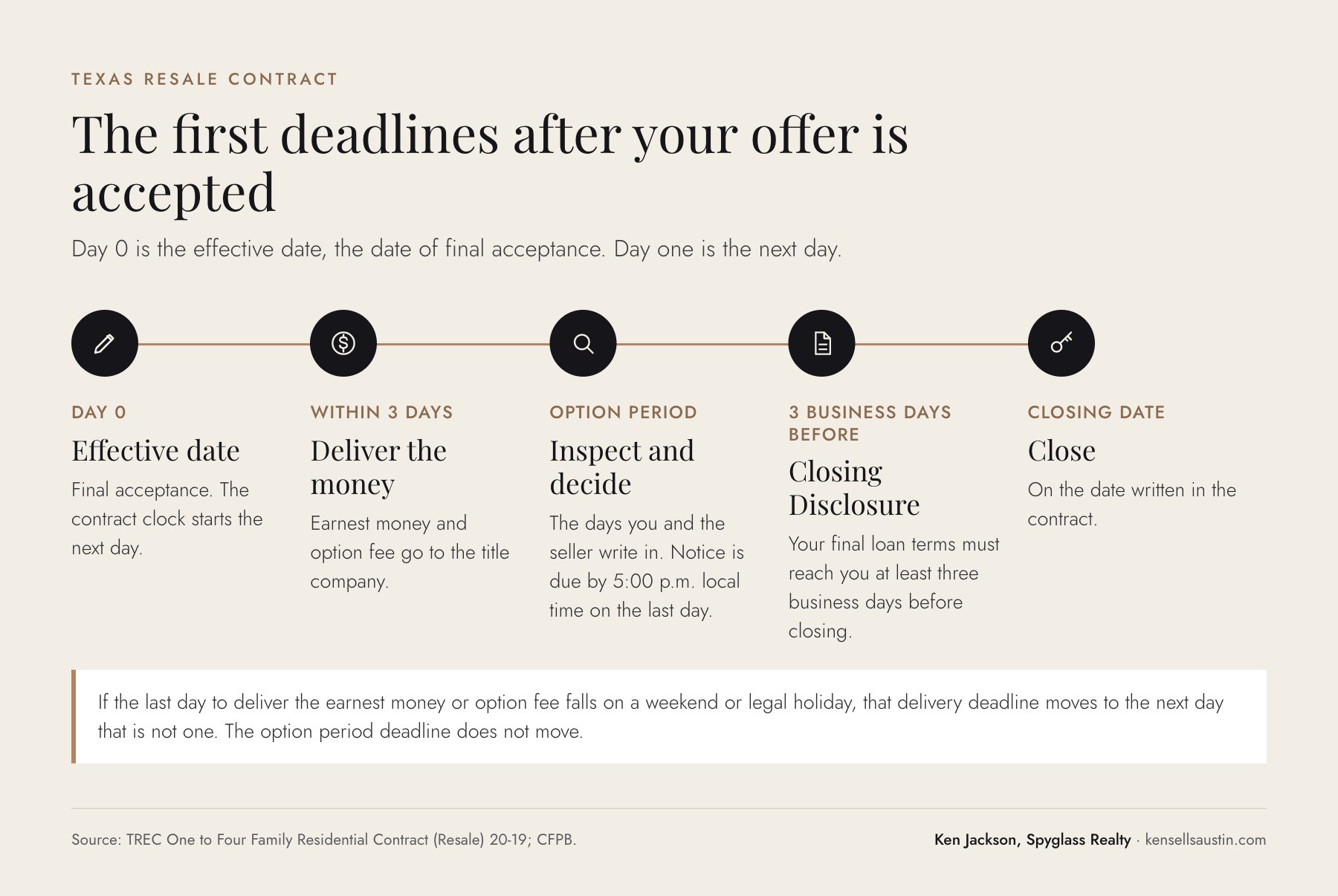
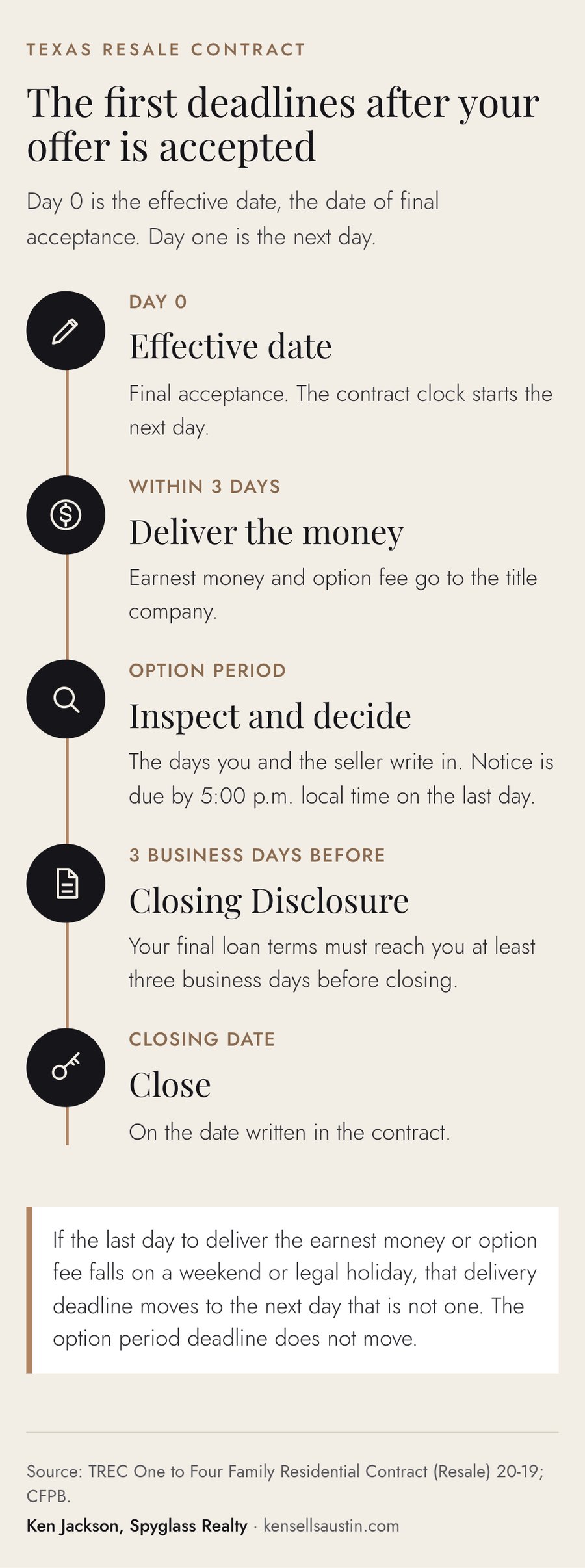
Notice must be given by 5:00 p.m. local time on the last day. That deadline is real. I have watched people lose it by an hour. The earnest money and option fee are due within 3 days after the effective date.
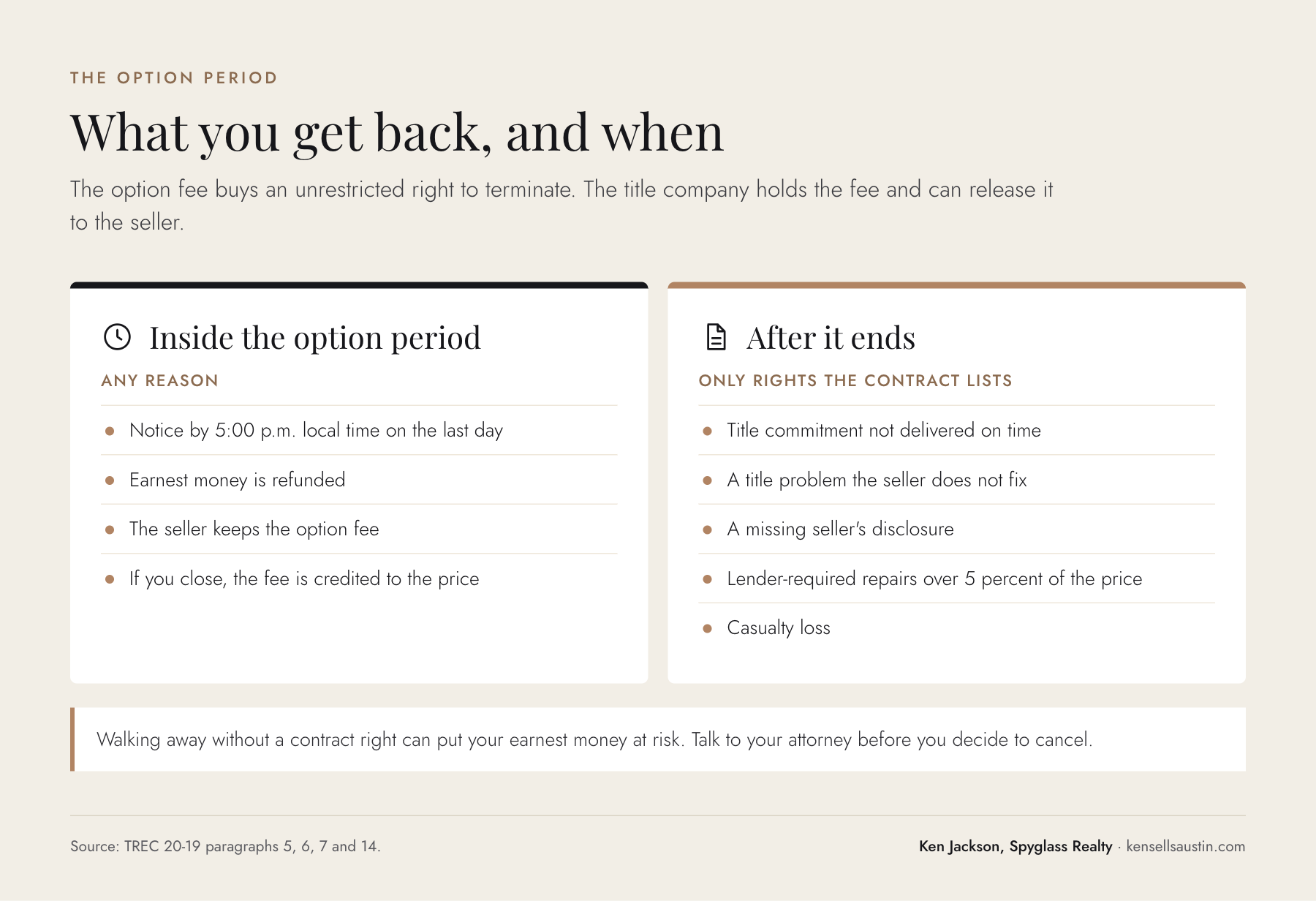
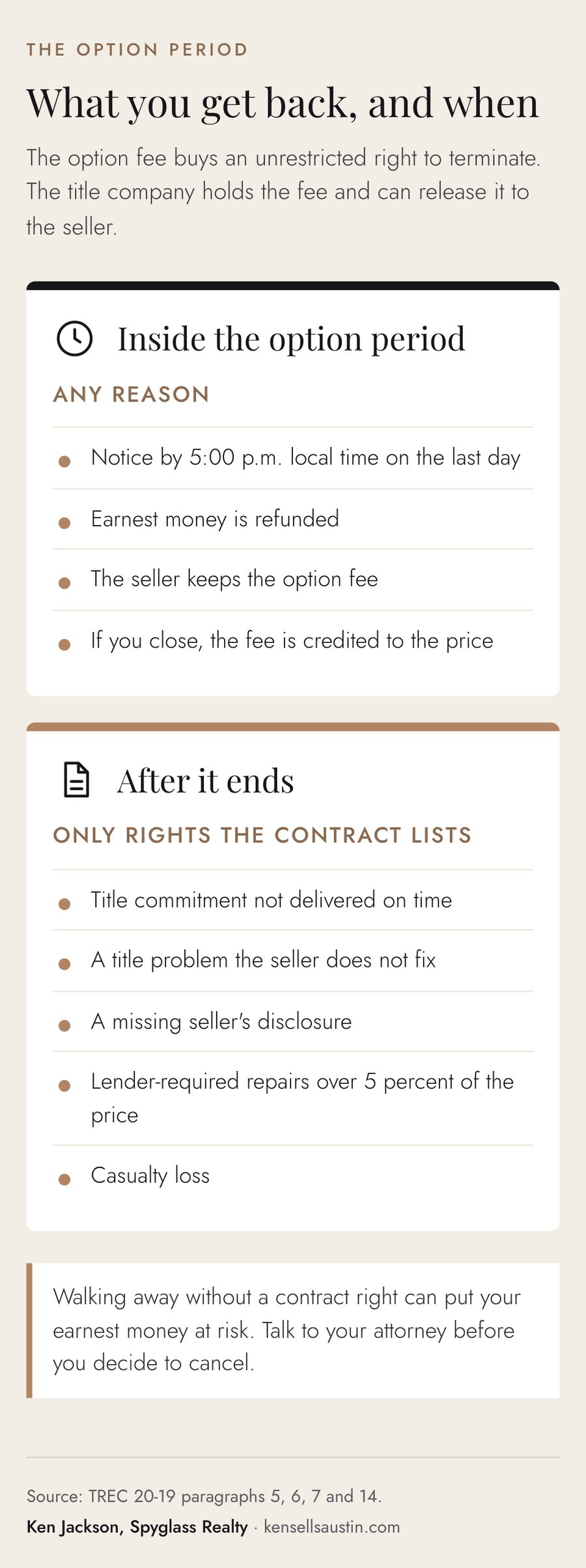
If you terminate within the option period, the option fee is not refunded. The title company holds it and can release it to the seller. Your earnest money comes back to you. That is the entire cost of walking away.
The short version
- The option period is the clean exit: give notice by 5:00 p.m. local time on the last day and your earnest money comes back.
- Financing and appraisal exits need a written statement from your lender and have their own windows.
- After the option period, every exit needs a specific contractual basis. Walking with none is a default.
- For what your contract means in your case, ask a real estate attorney.
If you close instead, the option fee is credited to the sales price, per Paragraph 5A(4). So in a deal that closes, the option fee costs you nothing.
Counting days matters. The delivery deadlines run from the effective date, and the contract extends a deadline that falls on a Saturday, Sunday or legal holiday to the next business day. I wrote the full explanation of how this window works in what the option period actually is in Texas real estate.
The failure I see most often is not losing money in the option period. It is buyers not using it at all: not inspecting, not reading the survey, not reading the title commitment, and then discovering a problem three days before closing when the free exit has already closed behind them.
Terminating under the financing addendum
If your contract includes a Third Party Financing Addendum, you have two separate exits in it, and they work differently.
Buyer Approval, Paragraph 2A. If the box is checked making the contract subject to your loan approval, and you cannot obtain approval, you may terminate within a stated number of days after the effective date. To do it you must give the seller a notice of termination and a copy of a written statement from the lender setting out why the lender made that determination. If you terminate properly, the earnest money is refunded.
Read the next sentence in the form carefully, because it is the trap: if you do not terminate under 2A within that window, the contract is no longer subject to buyer approval. The financing exit for your personal creditworthiness closes on that date. If your loan falls apart afterward because you changed jobs or opened a credit card, you are not protected by 2A.
Property Approval, Paragraph 2B. This one stays open much longer. If your lender determines the property does not satisfy the lender's underwriting requirements, and the form lists appraisal, insurability and lender required repairs as examples, you may terminate on or before the third day before the closing date. Same mechanics: notice of termination plus a written statement from the lender. Earnest money is refunded.
That is the provision that handles a low appraisal in the standard form. It is not an open-ended appraisal contingency. It requires the lender to actually determine the property does not satisfy underwriting, and it requires the written statement.
Offers and closing FAQ
Contract, option period and closing questions are answered in the Texas buyer FAQ on offers and closing.
The appraisal addendum
There is a separate TREC Addendum Concerning Right to Terminate Due to Lender's Appraisal. It exists to modify 2B, in either direction.
It offers a full waiver, in which you give up the appraisal-based right to terminate entirely and commit to bringing additional cash; a partial waiver, in which you cap how much extra cash you will bring by setting a minimum appraised value; and an additional right to terminate, which gives you a cleaner exit at a specified value.
In a competitive situation, buyers get pushed toward waiving. Understand what you are agreeing to. If you waive appraisal rights and then cannot close because you do not have the cash, you are in default, and the consequence is not limited to losing earnest money. The seller's remedies include specific performance and other relief provided by law, and the prevailing party in litigation over the contract is entitled to attorney's fees and costs.
Other exits people forget
The contract has several smaller termination rights, and they are worth knowing:
- Title commitment not delivered on time. Paragraph 6 gives an automatic extension, and if the commitment and exception documents still are not delivered within the time required, you may terminate.
- HOA subdivision information. Under the POA addendum, if the seller was responsible for delivering the Subdivision Information and did not, the buyer may terminate at any time prior to closing as the buyer's sole remedy. Once you do receive it, you have three days, or until closing, whichever comes first.
- Seller's disclosure delivered late. Under Texas Property Code 5.008, if the notice was not delivered before the contract was executed, you may terminate for any reason within seven days after you receive it.
- Seller's Water Disclosure. The TREC resale contract form in use since July 1, 2026 includes a separate Seller's Water Disclosure with its own termination right.
- MUD notice. If the contract was signed without the MUD notice, the buyer can terminate. If the seller gives the notice at or before closing and the buyer closes anyway, that right is waived.
- Casualty loss. If the house is damaged after the effective date and the seller cannot restore it, Paragraph 14 lets you terminate with earnest money refunded.
Inspections FAQ
What to check inside the option period is covered in the Texas buyer FAQ on inspections, flood and foundation.
Walking with no contractual basis
Now the uncomfortable one. The option period has expired, you have no financing or appraisal basis, and you simply do not want the house.
You can still stop performing. Nobody physically forces you to closing. But you are in default, and Paragraph 15 gives the seller a choice: enforce specific performance, seek other relief provided by law, or both, or terminate and receive the earnest money as liquidated damages.
In practice most sellers take the earnest money and move on, because litigation is slow and expensive and they would rather re-list. But specific performance is a real remedy in that paragraph, and a seller who has already bought another house and is now carrying two payments is a seller with motivation. Paragraph 17 entitles the prevailing party to reasonable attorney's fees and all costs of the proceeding, which cuts both ways.
Do not treat the earnest money as a cap on your exposure. It is the most likely outcome, not the guaranteed one. If you are thinking about walking away without a contractual basis, talk to a real estate attorney before you stop performing.

How an earnest money dispute actually plays out
Here is the mechanical part that nobody explains, and it is in Paragraph 18C.
The title company is the escrow agent. It holds the earnest money and it is not a party to your contract. It has no authority to decide who is right, and it will not.
When the contract terminates, either party or the escrow agent may send a release of earnest money to both parties, and both parties are supposed to sign it and return it. That is the normal path, with a signed release and a check.
If one party refuses to sign, the other party may make a written demand to the escrow agent for the earnest money. The escrow agent then promptly sends a copy of that demand to the other party. If the escrow agent does not receive a written objection to the demand within 15 days, it may disburse the money to the party who made the demand, less any unpaid authorized expenses.
So a party who just stops responding loses after 15 days. A party who objects in writing freezes the funds, and now you have an actual dispute, which goes to mediation under Paragraph 16 and to court after that.
Do not treat the earnest money as a cap on your exposure.
When someone refuses to sign the release
Paragraph 18D adds teeth: a party who wrongfully fails or refuses to sign a release acceptable to the escrow agent within seven days of receiving the request is liable to the other party for damages, the earnest money, reasonable attorney's fees, and all costs of suit.
Which means holding earnest money hostage out of spite is a bad idea for both sides. If you are entitled to it, demand it in writing. If you are not, sign the release.
What a release of earnest money is
It is a short document that says who gets the earnest money and releases the escrow agent and the parties from further claims related to it. Read it. Some versions release all claims related to the contract, not only the escrow funds, and if you have an unresolved dispute with the other side you want to know what you are signing away.
The escrow agent may also require a written release of liability from all parties before releasing any money, and may deduct unpaid expenses it incurred on your behalf. That is Paragraph 18B, and it is why the check is occasionally smaller than the deposit.
The short version
Use the option period. Pay for the inspection, read the title commitment, read the survey, and make your decision inside that window. It is the only place in a Texas contract where you can change your mind for free, and it costs less than almost anything else in the transaction.
After it closes, every remaining exit requires a specific contractual basis and usually a piece of paper from your lender. Know which ones you have before you need them.
Keep reading
Questions about this? Talk to Ken.
Call (737) 307-4848 or send Ken a message.
