

People ask this quietly, as if it is a rude question. It is not. You are hiring someone for a large transaction and you are allowed to think about how that arrangement works.
The real answer depends almost entirely on what you have signed.
The short version
- Whether you can use several agents depends on your signed agreement: exclusive or non-exclusive.
- An exclusive agreement can owe compensation within its scope even if another agent found the house.
- To leave an agent, say so directly, ask for a written release and check the protection period.
- Interviewing several agents helps you. Working with several at once usually does not.
It comes down to the agreement
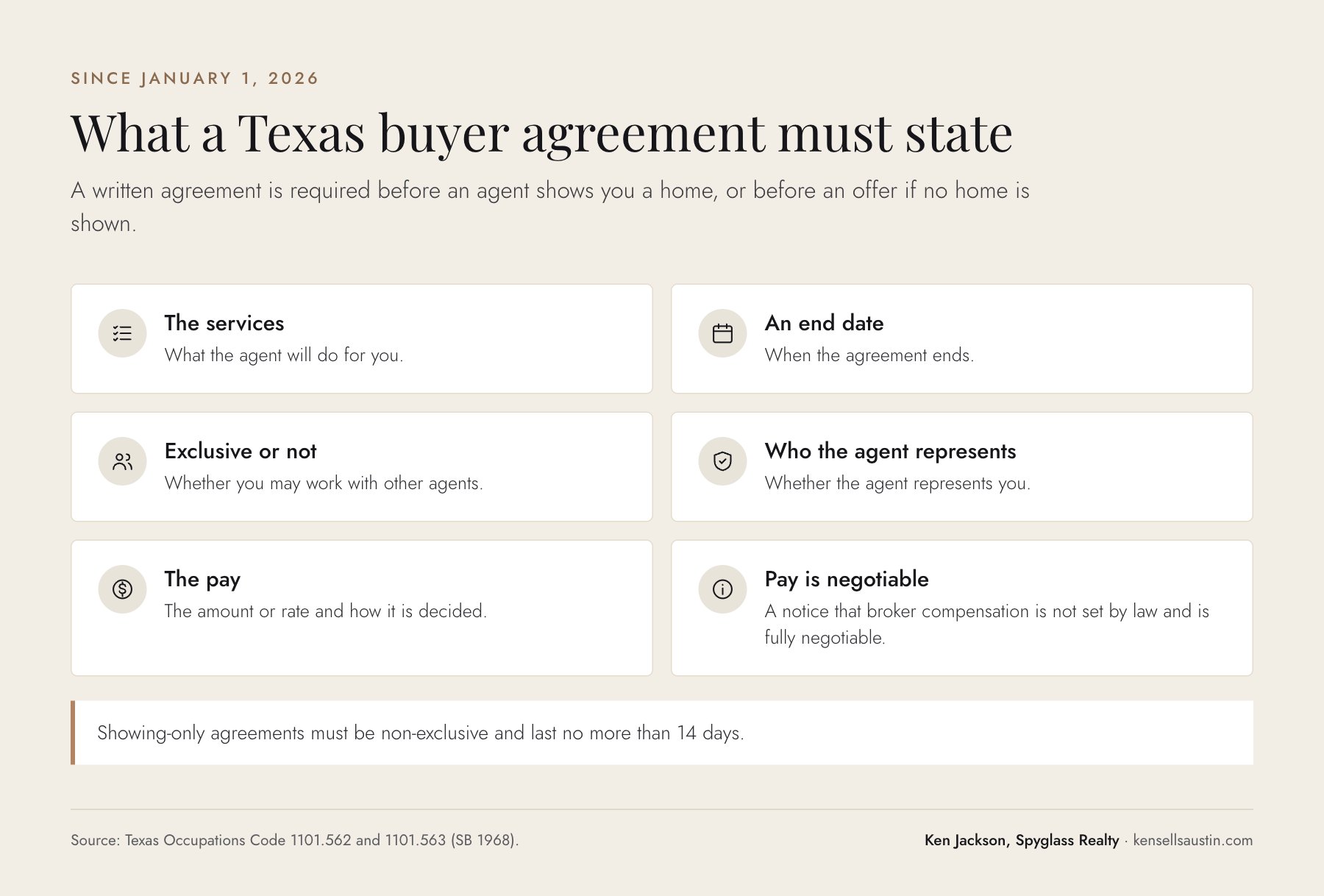
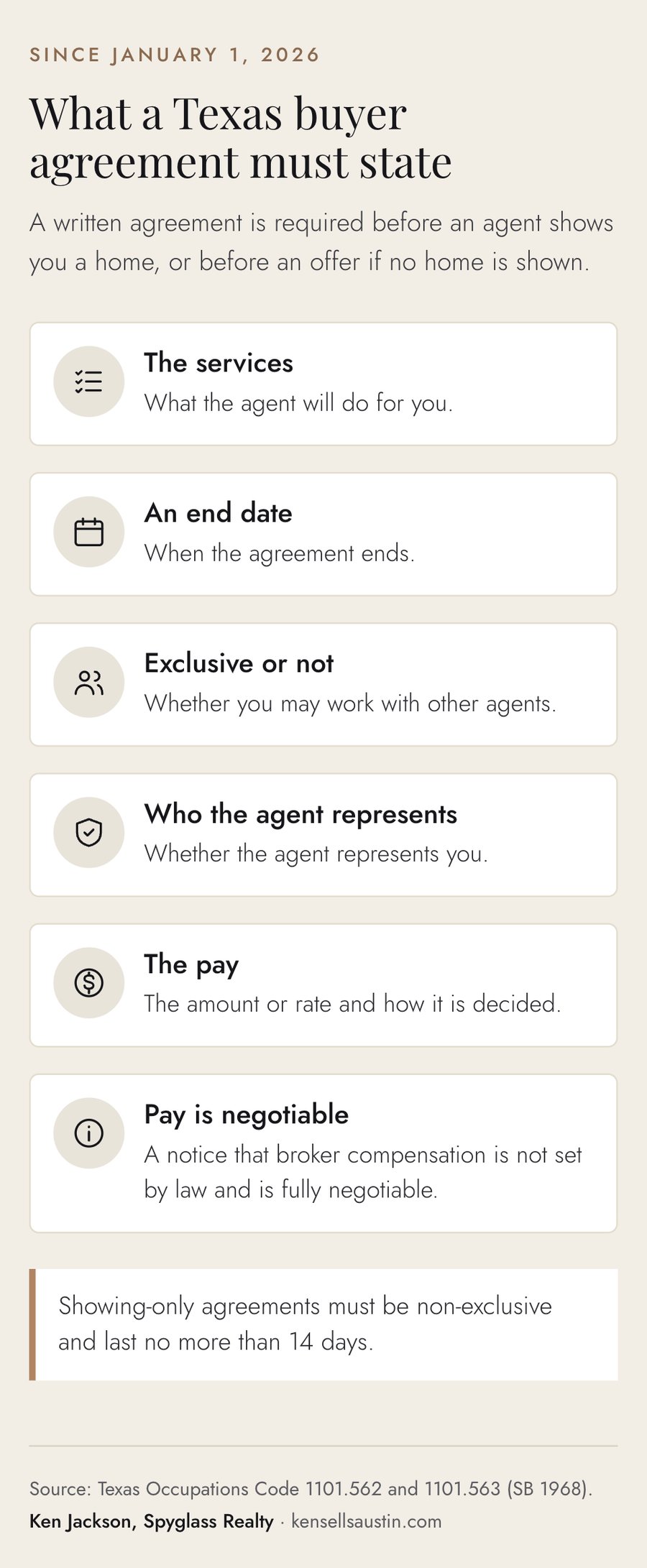
Since January 1, 2026, Texas law requires a license holder performing brokerage work for a prospective residential buyer to have a written agreement with that buyer. That agreement has to state, among other things, whether it is exclusive or non-exclusive. A showing-only agreement is also allowed. It is non-exclusive and runs 14 days or less.
That single line answers this question for you.
Non-exclusive means you can work with other agents at the same time. Compensation generally follows whoever is actually involved in the purchase. If you are genuinely trying people out, this is the honest structure for it.
Exclusive means that for the term and within the scope described, that agent is your agent. If you buy a property within that scope during that term, compensation is generally owed to them whether or not they found the house, showed it, or knew about it. That is the part people miss. Exclusivity is not about who did the work. It is about the scope you agreed to.
So read your agreement before you assume anything. Look at four fields: exclusive or non-exclusive, the end date, the geographic and property scope, and whether there is a protection period after termination.
What exclusivity actually buys you
It is easy to read exclusivity as purely a restriction on you. It is not only that.
An agent working for a buyer is spending time, mileage and attention with no guarantee of a closing. Previewing houses, pulling plats, calling listing agents about unpublished conditions, sitting at inspections, reading survey exceptions on a property you may not buy. None of that is billable.
An agent who knows you are committed will do more of it. An agent who suspects you are running the same conversation with three other people will triage you, and you will get the version of them that answers texts and forwards listings. That is a rational response and you should expect it.
So there is a real trade. Exclusivity in exchange for someone who treats your search as their actual job. Whether that is a good trade depends on whether you picked well, which is why the interview matters more than the agreement.
Exclusivity is not about who did the work.
Procuring cause in plain English
This term comes up whenever two agents both think they are owed on the same sale.
Procuring cause is the question of whose efforts actually caused the sale to happen. It is not a simple rule like "whoever opened the door first." It is a whole-course-of-conduct analysis: who introduced the property, who stayed continuously involved, who did the work that led to the contract, and whether that chain was broken along the way.
Two things are worth knowing.
First, it is primarily a dispute between brokers, resolved through arbitration under association rules rather than in court, and the buyer is usually not a party to it. You are generally not the one writing a second check.
Second, "generally" is doing work in that sentence. If you signed an exclusive agreement with Agent A and then bought a house through Agent B within the term and scope, Agent A may have a claim under your contract with them, separate from any broker-to-broker dispute. Contract claims and procuring cause are different things. What your own agreement means is a question for a real estate attorney.
The practical version: do not create the situation. It is almost always avoidable with one email.

What happens when two agents show you the same house
The common mess is simple. You tour an open house on a Sunday, sign the sheet, chat with the agent sitting it. Two weeks later you want to write an offer on that house with your own agent. Now the open house agent believes they introduced you to the property.
How to avoid it:
- At an open house, say up front that you are working with an agent and give their name. Write it on the sign-in sheet.
- At a builder's model home, the same, except it matters more. Builders set their own broker registration policies and many require your agent to be identified on your first visit. Miss that and you may lose representation on that community entirely. More on that in buying new construction in Texas.
- Do not ask a listing agent for advice about their own listing while intending to bring your own agent later. It is awkward for everyone and it muddies the record.
- Keep the list of properties you have been shown, and by whom, in writing.
Buyers guide
The steps of buying a home, from the first agent conversation to closing, are in the Texas buyers guide.
How to leave an agent you are unhappy with
This is the part people avoid, and avoidance is what creates the problem. The usual pattern is that someone stops responding to their agent and quietly starts working with someone else. That is how you end up with two agents both thinking they represent you.
Do it directly instead.
Say it. A short, clear message. You do not have to justify it at length. "This is not working out and I would like to end our agreement."
Ask for a written release. A termination or release signed by both of you, in writing. Most agents will give it. A broker who will not release an unhappy client is usually more trouble to keep than to lose, and you can escalate to their broker, who is the one actually responsible.
Check the protection period. Many agreements say that if you buy a property the agent showed you within some window after termination, compensation is still owed. Ask which specific properties are covered and get that list in writing. If the list is properties you have no interest in, this is a non-issue.

Do not start with the new agent until the old one is resolved. A day or two of overlap creates all the ambiguity you are trying to avoid.
Go to the broker if you need to. Every Texas agent works under a broker who is responsible for their conduct. If the agent will not engage, the broker will.
Does shopping multiple agents actually help you?
Here is the honest answer, and it is not the one that flatters my industry.
Interviewing multiple agents helps you a great deal. Talk to three. Ask them hard questions. Compare how they price a house, how they describe the contract-to-close sequence, what they say is wrong with your property, what they will not promise. This is free and it is the single highest-value thing you can do.
Working with multiple agents simultaneously usually does not. It feels like it should produce competition, and it does not. What it produces is three agents each giving you their lowest-effort service tier, because none of them knows if the work will ever pay.
Offers and closing FAQ
Contract and offer questions come up often, and the answers are in the Texas buyer FAQ on offers and closing.
Why parallel agents do not create competition
There is no bidding war for you as a buyer. The houses are in the same MLS. Any agent can show you any of them. What varies is judgment, the quality of contract terms they write, whether they catch a survey exception or a foundation pattern, and whether they answer the phone at 8pm when you need to make a decision. You get more of all of that from someone who is committed, not less.
The one place running parallel makes sense is when you are genuinely undecided between two people after interviewing both. Then sign non-exclusive, short term, and decide within a few weeks. Say out loud that you are doing it. Most agents would rather know than find out.
On the seller side
Different situation. A listing agreement is a contract on a specific property for a specific term, and listing with two brokers at once is not a thing you can do in practice. The MLS record is one listing.
If you are unhappy with your listing agent, the path is the same as above: talk to the agent, then the broker, and ask for a written release or a mutual termination. Your position is that a broker sitting on an expiring listing with an angry seller is not getting a closing out of it either.
What I would do
Interview more than one. Pick one. Sign a short, geographically scoped agreement so that if you picked wrong the exit is cheap. Then actually commit to the person you picked and let them do the work.
If you want to understand what that work is supposed to look like before you decide, I laid it out in what a buyer's agent does in Texas and who pays them.
Keep reading
Questions about this? Talk to Ken.
Call (737) 307-4848 or send Ken a message.
