

For years in Texas, buyer representation agreements were common but not required. Plenty of buyers worked with an agent for months on a handshake. That changed on January 1, 2026.
The short version
- Since January 1, 2026, Texas requires a written buyer agreement before an agent shows you a home.
- A showing-only agreement is allowed. It is non-exclusive and runs 14 days or less.
- The agreement must state the compensation and that compensation is negotiable. Term, exclusivity and area are yours to negotiate.
- Read it before you tour, never sign a blank form and keep a signed copy.
What changed on January 1, 2026
Texas Senate Bill 1968 took effect January 1, 2026. It requires a license holder who performs an act of real estate brokerage for a prospective residential buyer to enter into a written agreement with that buyer.
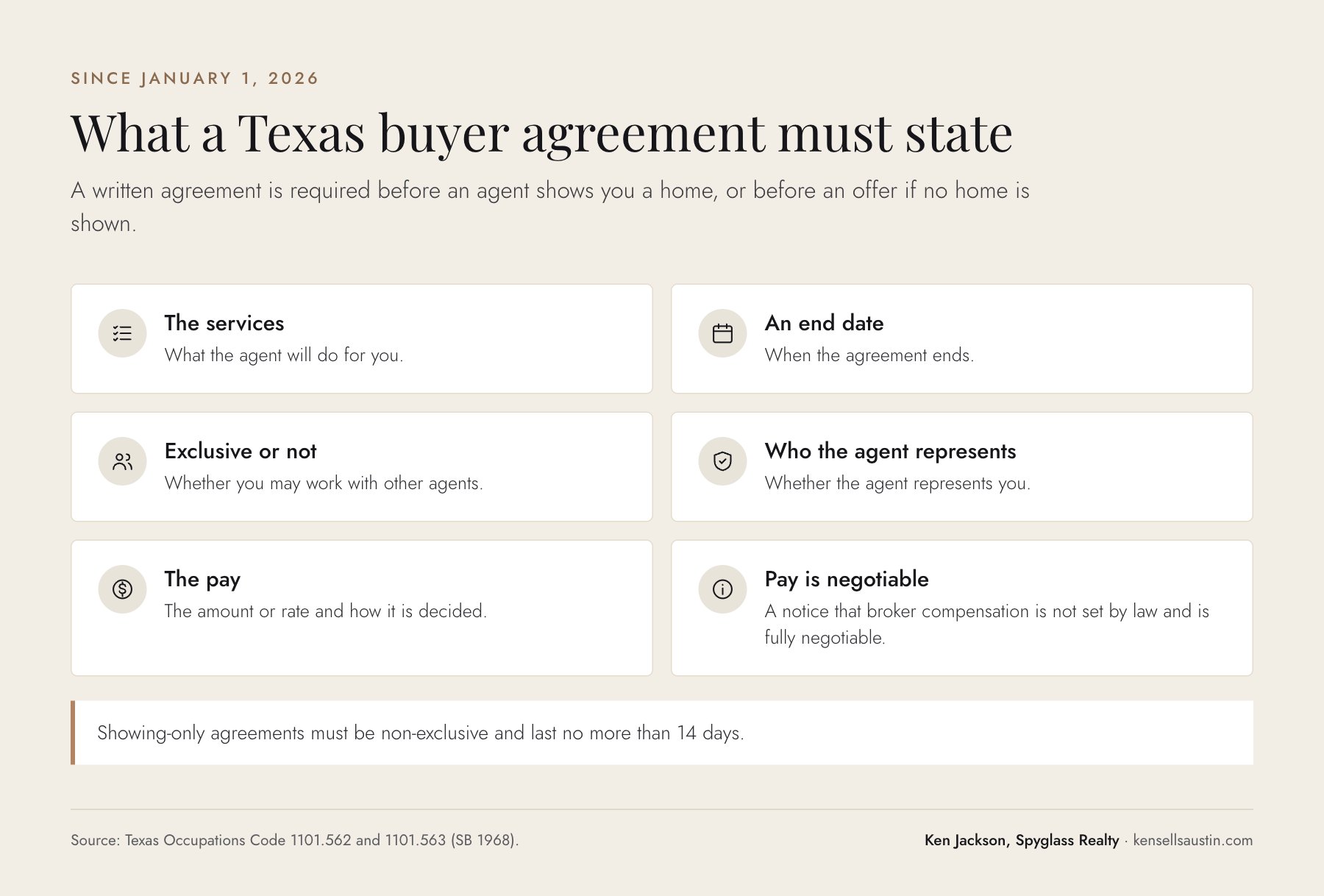
The rule is strict. A written agreement is required before an agent shows you a home or, if nothing is shown, before an offer is presented. A showing-only agreement is allowed. It is non-exclusive and runs 14 days or less.
So when an agent tells you they need paperwork before they can go further, that is not a sales tactic invented to pin you down. It is the law they work under.
You can read outside summaries at HousingWire and RISMedia.
What the agreement has to contain
The statute sets a floor. The written agreement must state:
- The services the agent will provide
- When the agreement ends
- Whether it is exclusive or non-exclusive
- Whether the agent represents you as a buyer's agent
- The compensation
- A conspicuous statement that broker compensation is negotiable and not set by law
That last line is worth pausing on. It is in the document because it is true. There is no standard rate, no customary rate, no number anyone is allowed to present to you as fixed. Any agent who tells you otherwise is wrong.
Buyers guide
The full path from first showing to closing is laid out step by step in the Texas buyers guide.
So do you have to sign one?
You have to sign one before an agent shows you a home. You do not have to sign that particular agent's version of it, and you do not have to sign it the way it was handed to you.
The requirement is that an agreement exist and contain those elements. It is not that the terms be whatever the agent wrote on their first draft. This is the part most buyers do not realize.
What is negotiable
Term length
The agreement has to say when it ends. It does not have to say a year. If you are a first time buyer who wants to see how the working relationship goes, ask for a short term with the option to extend. A confident agent will take that. An agent who insists on a long term with a new client is telling you they expect to need the lock rather than earn the renewal.
Exclusivity
The agreement must say whether it is exclusive or non-exclusive. Exclusive means that agent is your agent for the scope and term described, and compensation is generally owed on a purchase within that scope whether or not they were the one who found the house. Non-exclusive leaves you free to work with others.
Exclusive is the more common ask and it is not unreasonable. An agent doing real work for you is spending time and money with no guarantee of a closing. But it should be a conversation, not an assumption.
Geographic scope
This is the most useful lever and the most commonly ignored one. The agreement can be limited to a defined area. If you are looking in Leander and Cedar Park, the agreement can say Leander and Cedar Park rather than the entire Austin metro or the entire state.
The benefit runs both directions. You are not accidentally bound if your job relocates you to Houston, and your agent is committing to the market they actually know.
You can also limit it by property type, or carve out specific situations. If your brother-in-law is a builder and you might buy directly from him, say so in writing at the start.
Handle it at the kitchen table before you tour anything.
Compensation and the protection period
The number, how it is calculated, and where it is expected to come from are all negotiable. Ask the two questions that matter.
First, what happens if the seller or builder offers less than the agreement provides. Does the agent accept what is offered, or do you owe the difference? Get the answer in the document, not in conversation.
Second, is there a protection period after the agreement ends, and if so, how long and which properties does it apply to. A protection period is the clause that says if you buy a house the agent showed you shortly after the agreement expires, compensation is still owed. It is a reasonable concept and it is also the clause most likely to surprise someone later. Ask for it to be limited to specifically identified properties furnished to you in writing.
More on how buyer agent compensation actually flows through a Texas transaction is in this post.

How to not get locked into something bad
A few practical rules.
Read it before you are emotionally committed to a house. The worst time to negotiate an agency agreement is standing in a driveway on a Saturday with a listing you love and a deadline. Handle it at the kitchen table before you tour anything.
Do not sign a blank or partially completed form. Every field that defines term, scope, exclusivity and compensation should be filled in when you sign it.
Ask how to terminate. Every agreement should have a way out. Ask what it is and whether the agent will provide a written release on request if the relationship is not working. Get that answer before you sign, because the answer you get then is more honest than the one you will get later. What a termination clause means in your situation is a question for a real estate attorney.
Keep a copy. A signed copy, not a promise to email it.
Do not sign one with an agent you have not interviewed. The agreement is the end of a hiring decision, not the beginning of one.
Offers and closing FAQ
Offer, contract and closing questions are answered in the Texas buyer FAQ on offers and closing.
Why the agreement is actually good for you
I want to be even-handed here, because it would be easy to write this as either "sign whatever they hand you" or "agency agreements are a trap." Neither is right.
Before this, the ambiguity mostly cut against buyers. You could work with someone for three months, assume they were your agent, and discover at an awkward moment that nothing defined what they owed you or what you owed them. Compensation was often described vaguely as something the seller handled, which was never entirely accurate and became much less so after the 2024 changes to how cooperative compensation is handled.
A written agreement puts the terms where you can see them. It establishes in writing that the person advising you represents you rather than the seller, which is not a small thing when you are the only unrepresented person in a room. And it forces the compensation conversation to happen at the start, when you have room to negotiate and time, instead of at the closing table.
The document also creates a record of what services you were promised. If an agent commits in writing to attending inspections and negotiating repairs, that is now a term rather than an assumption.
Where this shows up in new construction
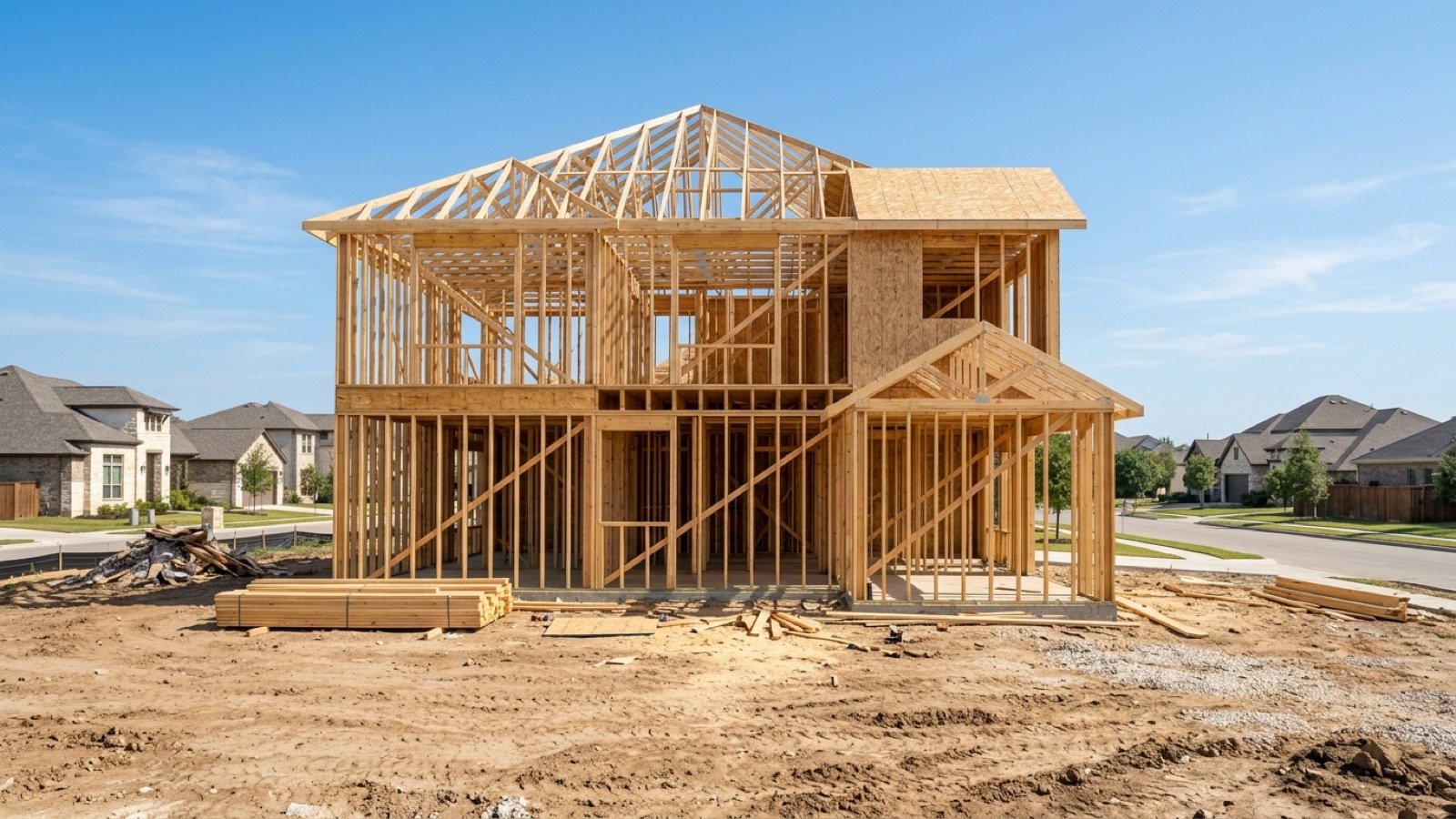
It matters more than people expect at a builder's model home. Builders set their own broker registration policies, and many of them want your agent identified on your first visit. If you walk in alone, give your information, and come back later with an agent, you may be told it is too late for that agent to be recognized.
Signing your agreement before you start touring models is the clean way to avoid that. I go through the rest of the new construction mechanics in buying new construction in Texas.
The short version
Yes, you have to sign one before an agent shows you a home. No, you do not have to accept the first draft. Term, exclusivity, geography and compensation are all yours to negotiate, and the form itself has to tell you in conspicuous print that the compensation is negotiable.
Once you are under contract, the protection you rely on most is a different document entirely, which is the option period in the TREC contract. But that only helps if you had someone on your side writing the offer in the first place.
Keep reading
Questions about this? Talk to Ken.
Call (737) 307-4848 or send Ken a message.
