

The number a seller cares about is not the sale price. It is the wire amount. Those two numbers are never the same, and the distance between them surprises people who have not sold in a while.
Here is the actual list of things that come out between contract and closing, and where to find the real figures for your house instead of a guess from the internet.
The short version
- Brokerage compensation is negotiable and agreed in writing. Nobody can give you a standard rate.
- Title policy, escrow, survey, HOA fees, tax prorations and loan payoff each come out of your proceeds.
- Ask a title company for a seller's net sheet before you list, at three different prices.
- Inspection repairs and concessions are the lines that most often break a seller's math.
Brokerage compensation
This is usually the largest single line, and it is the one I will not put a number on. The current TREC One to Four Family Residential Contract says it plainly in Paragraph 12B: brokerage compensation is not set by law and is fully negotiable. There is no standard rate, no customary rate, and any agent who tells you otherwise is telling you something that is not true.
What that means practically is that you negotiate what you pay your own broker, and it is agreed in writing in your listing agreement, and separately you decide whether to contribute anything toward what the buyer owes their broker. Since the 2024 industry changes, those are two distinct decisions, and the contract now has separate checkboxes for the contribution in Paragraph 12B(1).
Evaluate it the way you would evaluate any other expense. Ask what is actually being done, who is doing it, what the marketing plan is, and what happens if the house does not sell. Then compare offers. The right question is not "what is the rate," it is "what am I getting and is it worth what I am paying."
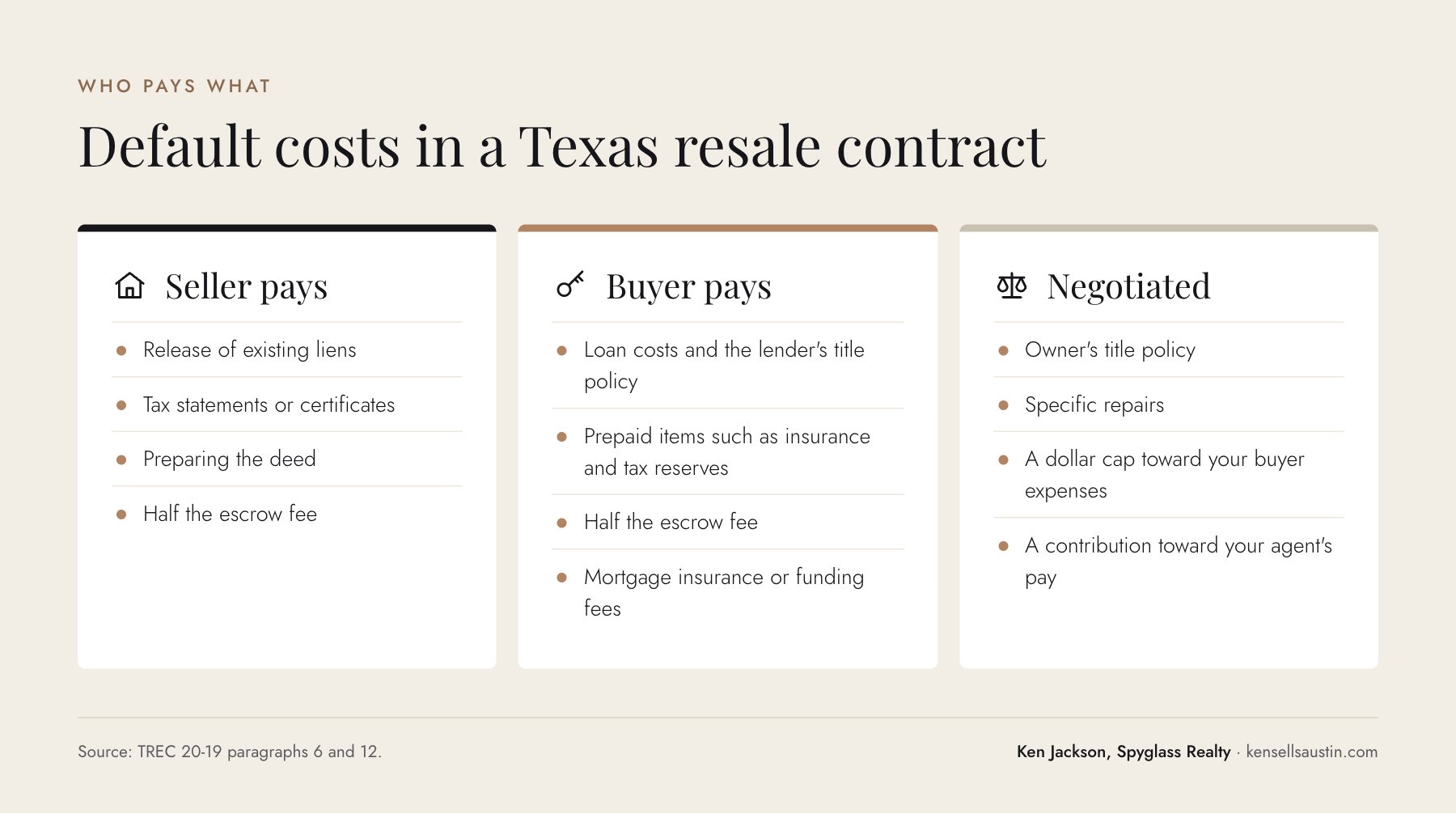
Owner's title policy
In Texas, title insurance premiums are promulgated by the Texas Department of Insurance. That means the premium for an owner's policy is the same regardless of which title company you use. You can look the rate up yourself at tdi.texas.gov rather than taking anyone's word for it.
Who pays it is a checkbox. Paragraph 6A of the contract has a box for Seller's expense and a box for Buyer's expense. In the north Austin market it is common for the seller to pay, but it is negotiated in every deal and I have seen it go the other way in a tight market. If you want to understand what you are actually buying the buyer, I wrote about that in what title insurance in Texas covers and why it matters.
Seller guide
The steps from preparing a listing to closing day are laid out in the Texas home seller's guide.
Escrow and closing fees
The contract splits the escrow fee: Paragraph 12A says the seller pays one half and the buyer pays one half. Separate from that, Paragraph 12A(1)(a) assigns the seller a specific short list of items:
- Releases of existing liens, including prepayment penalties and recording fees
- Release of the seller's loan liability
- Tax statements or certificates
- Preparation of the deed
These are real dollars but they are not usually the items that move your net. The title company can quote them exactly. Ask.
Survey
Paragraph 6C gives three choices. The seller can furnish an existing survey along with a T-47 affidavit or T-47.1 declaration, the buyer can obtain a new one at their own expense, or the seller can furnish a new one at seller's expense. If you go the existing survey route and the title company or the buyer's lender will not accept it, you can end up paying for a new one anyway. If you have improved the property since your survey was made, expect that to happen.
HOA transfer fees and the resale certificate
Most of the newer neighborhoods in Leander, Hutto, Georgetown and north Round Rock have a mandatory HOA, which means the TREC Addendum for Property Subject to Mandatory Membership in a Property Owners Association comes into play. That addendum has four options for who obtains and pays for the Subdivision Information, which includes the resale certificate. It also states that the buyer pays association fees, deposits and reserves up to a stated amount and the seller pays any excess.
The number is set by the association or its management company, not by anyone in the transaction. Call your HOA management company early and ask what they charge for a resale certificate and a transfer. Some of them charge more than sellers expect, and some of them are slow, which is a separate problem when you are trying to hit a closing date.
Call your HOA management company early and ask what they charge for a resale certificate and a transfer.
Property tax prorations, and why this one stings here
Texas property taxes are paid in arrears. The bill that comes out in the fall covers the year that is ending. So at closing you credit the buyer for the portion of the year you owned the house, and they pay the full bill later.
Paragraph 13 prorates taxes through the closing date, and it also says that if the actual taxes for the year vary from what was prorated, the parties adjust once the statements are available.
In Williamson County this line is bigger than sellers moving from elsewhere expect, because the effective tax rate here is high and because many of these subdivisions sit inside a MUD or a PID that adds its own levy on top of the city, county, school and college rates. If your house is in a MUD, that assessment is part of the proration. I went through how that works in what a MUD district actually costs you in Leander.
Do not estimate this. Pull your property on the Williamson County Appraisal District site, look at the current assessed value and the list of taxing entities, and have the title company run the proration off the real rates.

Loan payoff and prepayment items
Your payoff is not your last statement balance. It includes per diem interest through the funding date, and it may include a recording fee for the release. Most residential mortgages written in recent years do not carry a prepayment penalty, but some do, and the contract specifically makes prepayment penalties a seller expense, which tells you it happens often enough to be in the form.
Order the payoff, do not guess at it. If you have a HELOC or a second lien, that has to be paid and released too, and HELOCs need to be formally closed, not just paid to zero.
Marketing plan
What a listing marketing plan should include, and what to ask any agent about it, is on the marketing strategy page.
Repairs negotiated after the inspection
This is the line item that is impossible to predict and the one that most often breaks a seller's math. The buyer inspects during the option period, comes back with a list, and you negotiate. Whatever you agree to gets documented in an amendment.
You have three ways to handle it: make the repair, give a price reduction, or give a credit toward the buyer's closing costs. Which one is better depends on the buyer's loan, because some loan programs limit what credits can be applied to. Doing the obvious work before you list changes this conversation considerably, which is the whole argument in what repairs to make before selling in Texas.
Seller concessions toward buyer costs
Paragraph 12A(1)(b) lets the seller agree to pay an amount toward the buyer's expenses, separate from brokerage compensation. In markets with more inventory than buyers, which describes stretches of the north corridor, this is frequently part of how a deal gets made. It is a real cost and it comes off your proceeds like anything else.

Moving, and the things nobody budgets
Movers, a storage unit if your timing does not line up, utilities in both houses for an overlap period, cleaning, and whatever it costs to keep the lawn presentable while the house is on the market. None of these appear on a settlement statement, and all of them are money.
How to get a real number instead of a guess
Ask for an estimated seller's net sheet before you list, not after you get an offer. A title company can produce one. It takes your target price, your payoff, your actual tax rates and your actual HOA fees and shows you what is left.
Run it at three prices: what you hope for, what you expect, and a number below that. If the low case does not work for you, you need to know that before the sign goes in the yard, not during negotiations when your position is weakest.
If you want to see how the same closing looks from the other side of the table, I broke that down in who pays closing costs in Texas.
Keep reading
Questions about this? Talk to Ken.
Call (737) 307-4848 or send Ken a message.
