

This is the question I get asked most, and it is the one where the honest answer has changed twice since 2024. If you last bought or sold a house before that, most of what you remember is no longer how it works.
Here is the current state of things, what changed, and what it means when you are putting a budget together.
The short version
- Since January 1, 2026, a written buyer agreement is required, and it must state that compensation is negotiable.
- Each side pays their own broker. The seller may agree to contribute toward the buyer's broker in the deal.
- Settle your down payment, closing costs and agreed broker compensation before you look at houses.
What used to happen
For decades, the listing broker would publish an offer of compensation to buyer brokers in the MLS. A buyer's agent could look at a listing, see what the seller's side was offering, and largely operate on the assumption that their pay was handled by the seller. Buyers generally never saw a number and frequently believed a buyer's agent was free.
That structure is gone.
What the NAR settlement changed
As of August 17, 2024, offers of compensation to buyer brokers can no longer be published on an MLS. That is the core change. A seller can still agree to contribute toward what a buyer owes their broker, but that is negotiated in the deal itself, not advertised on the listing.
The settlement also required that agents working with buyers under MLS rules have a written agreement with the buyer before touring a home, and that the agreement state the compensation in specific terms rather than open-ended terms.
Separately, sellers can and do still offer buyer concessions on the MLS, meaning help with the buyer's closing costs. That is a different thing from compensating the buyer's broker, and the distinction matters. Concessions go to the buyer's loan and closing expenses. Compensation goes to the broker.
Buyers guide
The written agreement and the rest of the buying process are laid out in the Texas buyers guide.
What Texas SB 1968 added
Texas then passed its own law. SB 1968 took effect January 1, 2026, and it applies to residential transactions in this state regardless of whether an agent belongs to a trade association.
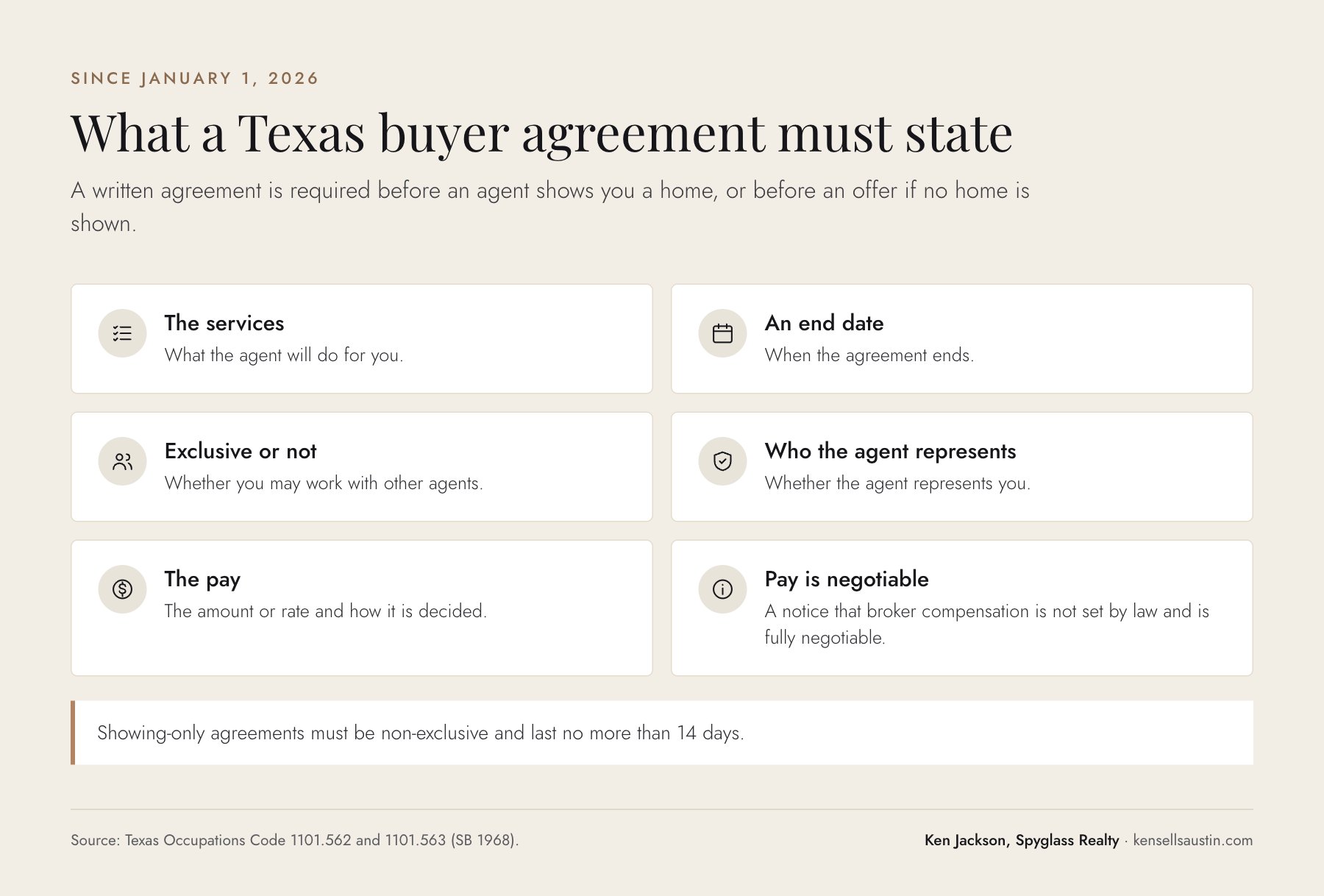
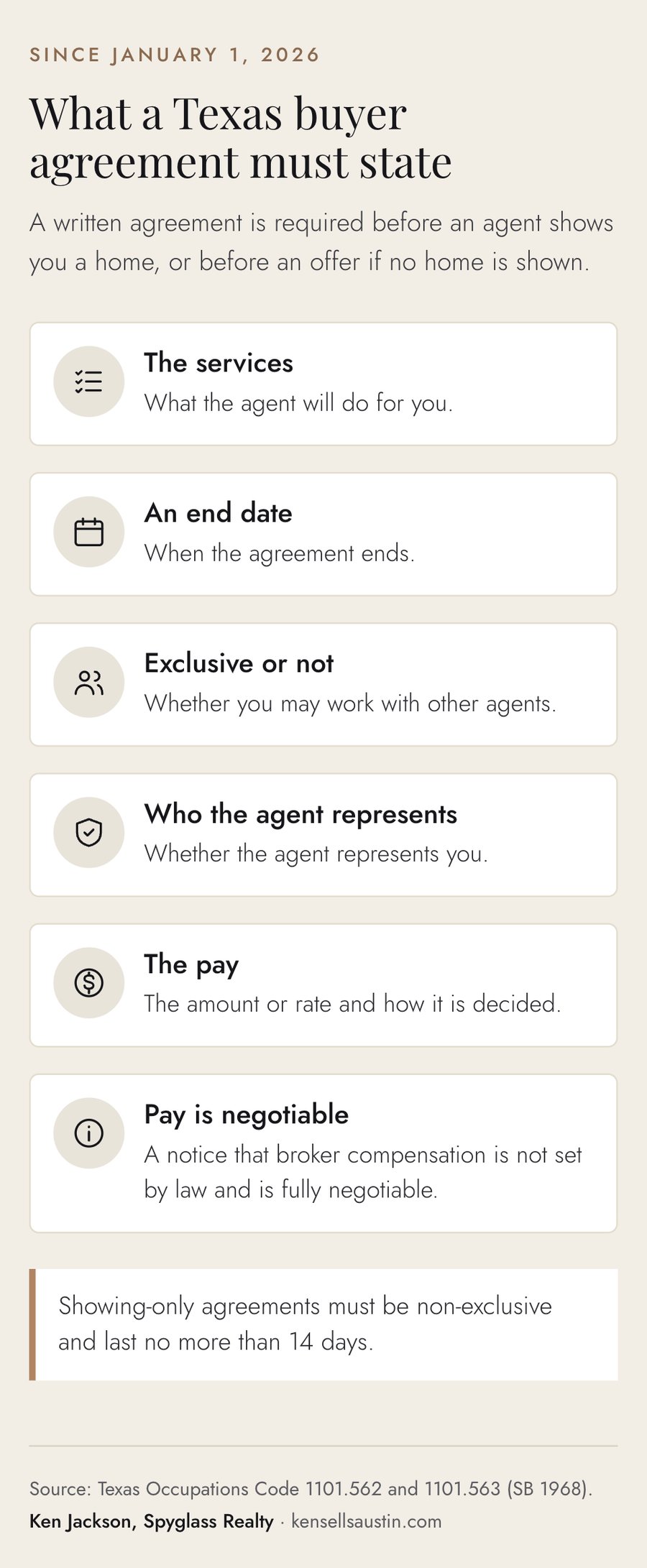
The requirement is that a license holder must enter into a written agreement with a prospective buyer before performing an act of brokerage for that buyer. The agreement has to include:
- The services the agent will provide
- When the relationship ends
- Whether the agreement is exclusive or non-exclusive
- How the broker is compensated
- Conspicuous language stating that broker compensation is not set by law and is fully negotiable
The rule is strict. A written agreement is required before the agent shows you a home or, if nothing is shown, before an offer is presented. A showing-only agreement is allowed. It is non-exclusive and runs 14 days or less.
SB 1968 also eliminated the old default of subagency in Texas.
The practical effect for a buyer is simple. You are going to sign something before an agent goes to work for you, and that something will have a number in it. That is not an agent being pushy. It is state law.
So who actually pays
The accurate answer is that the buyer owes their broker what their written agreement says they owe, and the seller may agree to contribute toward it, and how much of it the seller contributes is negotiated deal by deal.
The current TREC One to Four Family Residential Contract handles this in Paragraph 12B. It opens by stating that brokerage compensation is not set by law and is fully negotiable, and that each party pays their own broker under their own separate written agreement. Then it provides two checkboxes:
- Seller will pay a stated amount toward the compensation the buyer owes the buyer's broker
- Buyer will pay a stated amount toward the compensation the seller owes the listing broker
Note the language in the form: those contributions are applied to the obligation, they do not change it. If your agreement with your broker says one thing and the seller contributes less than that, you may owe the difference. That is the single most important point in this article, and what it means under your own agreement is a question for a real estate attorney.
Closing costs guide
Where every closing cost lands, and who customarily pays it, is in the Texas closing costs buyer guide.
What this means for a buyer's budget
Before you look at a house, get three numbers straight: your down payment, your estimated closing costs, and what you have agreed to pay your broker. Then, when you make an offer, you know exactly how much of that third number you need the seller to cover for the deal to work.
A few things I tell buyers:
Ask about seller contribution before you write. Listing agents will tell you what a seller is willing to consider. It is not on the MLS anymore, but it is a phone call away, and any competent buyer's agent makes that call before writing the offer, not after.
Understand it is part of your offer. Asking the seller to contribute more is not free. It comes out of their proceeds, exactly like a price reduction. A seller weighing two offers is looking at net, so an offer at a higher price with a larger contribution can beat a lower price with none. That is real negotiating room and most buyers do not use it.
It is generally not financeable. Broker compensation is not something you roll into the loan. If the seller does not cover it, it comes from your cash at closing alongside your down payment. Plan for that possibility rather than assuming it away.
Negotiate the agreement itself. The compensation in your buyer agreement is negotiable, and so is its length and whether it is exclusive. If you are not sure about an agent, a shorter term or a non-exclusive arrangement is a reasonable thing to ask for. An agent who will not discuss it is telling you something.
Asking the seller to contribute more is not free.
The part agents do not love saying
These changes forced a conversation the industry avoided for a long time. When compensation was published on the MLS and buyers never saw a bill, a lot of buyer representation was mediocre and nobody had to defend it. Now you have to sign a document with a number on it, which means you are entitled to ask what you get for it.
So ask. What does this agent do during the option period. Do they know how to read a survey and a title commitment. Have they handled a low appraisal. Do they know the MUD and PID situation in the specific subdivision you are looking at in Leander or Hutto, because it varies block to block. Will they be the one showing you houses or will you get handed to someone else.
I wrote up the fuller version of what representation should actually look like in what a buyer's agent does in Texas and who pays them.
For sellers
You have a decision to make that you did not have to make before. You are not obligated to contribute anything toward the buyer's broker. You also should not decide that in a vacuum.
The question is not philosophical, it is arithmetic. Offering a contribution widens your buyer pool, particularly for buyers who are already stretched on cash. Not offering one saves you money if the buyer can absorb it. In a market with real inventory, which describes much of the north corridor right now, the wider pool is often worth more than the savings. Run both scenarios on a net sheet and decide with numbers.
For how the rest of the closing splits out, see who pays closing costs in Texas.
One caution
Compensation is negotiable and not set by law. If you hear anyone describe a rate as standard, customary, or what everyone charges, that is not a market fact. Treat it as a reason to get another opinion.
Keep reading
Questions about this? Talk to Ken.
Call (737) 307-4848 or send Ken a message.
